
What are the growth prospects for the wave of AI agents reshaping travel entrances Booking (BKNG.US)? Goldman Sachs takes a cautious stance and keeps a close eye on reservation conversions
The Zhitong Finance App learned that after Booking Holdings (BKNG.US), an accommodation and travel reservation service platform covering more than 220 countries and regions, released a tracking booking research report on Wednesday morning Beijing time, the tracking booking research report released by Wall Street financial giant Goldman Sachs showed that Booking has the foundation to transform AI smart user experiences into broader travel and housing reservation transactions, but the market still needs to confirm that these advantages can offset demand fluctuations and customer acquisition competition, as well as reservation conversion and actual cash driven by AI agents The return remains to be seen for a long time.
According to the Goldman Sachs research report, the agency recognized five main lines of business — the growth trajectory of AI-driven travel products, growth in membership and non-hotel accommodations, cross-category transactions, customer service and R&D efficiency, and growth investment in parallel with shareholder returns; however, Goldman Sachs maintained a “neutral” stock rating and lowered the 12-month target price from $180 to $175, corresponding to a 12.4% increase in the closing price of the earnings day. According to a static estimate of about 743.7 million shares in circulation on October 26, the target price corresponds to a market value of about US$13.1 billion.
Orders and profits both exceeded expectations, and AI travel services showed potential for commercialization
Booking's operating performance in the third quarter was stronger than the stock price response: it reached 345 million overnight, up 7% year on year, exceeding the market forecast of 340 million dollars listed in the Goldman Sachs report; total reservation volume was US$54.5 billion, up 10% year on year, higher than the US$52.23 billion forecast of about 3.4%. Goldman Sachs said that the revenue side needs to be taken apart: the FTC incident caused a revenue reduction of 900 million US dollars and an additional loss of 100 million US dollars, resulting in GAAP revenue falling to 8.893 billion US dollars, down 1% year on year; after excluding revenue reduction, adjusted revenue was 9.793 billion US dollars, up 9% year on year, higher than market expectations of 9.519 billion US dollars, about 2.9% higher than market expectations of 9.519 billion US dollars.
Furthermore, adjusted EBITDA was US$4.607 billion, up 9% year on year, exceeding expectations of US$4.483 billion; adjusted EPS was US$4.66, up 17% year over year, higher than the forecast of US$4.49. The company's unified adjusted EBITDA profit margin was 47.0%, which is roughly the same as the same period last year. Therefore, exceeding expectations at the profit level is mainly reflected in business scale and earnings per share; merchant model revenue increased 14% to 6.998 billion US dollars, and agency model revenue fell 4% to 2,463 billion US dollars, which also reflected the continued shift in payment and transaction settlement models. At the same time, buybacks reduced the average number of shares by about 7.5%, helping EPS's growth rate exceed the growth rate of total profit.
Goldman Sachs places the most emphasis on incremental growth, focusing on the commercial value of AI applications, especially the growth trajectory of user engagement, reservation conversion rates, and order amounts driven by AI. Booking is accelerating the extension of its AI layout to actual booking and travel services: Booking.com's AI itinerary search, Agoda AI Assistant, Priceline Penny, and the newly launched Lola and active travel agent Vayo, all covering search, planning, booking and follow-up services.
According to the information disclosed at the Booking Performance Call quoted by Goldman Sachs, Booking.com's daily AI search visitors in the third quarter reached 10 times that of the second quarter; the conversion rate of Penny and Agoda AI Assistant users was about twice that of non-users, and the average order amount for Agoda AI Assistant users was about 20% higher. These numbers show the positive performance of specific user groups, and cannot be equated to doubling the conversion rate across platforms. Overall, some Booking AI tool users showed higher reservation conversion rates and order amounts, providing an initial basis for AI to drive business growth.
Goldman Sachs said that the business mechanism behind AI-driven performance growth prospects is that real-time housing conditions, prices, payment and after-sales capabilities can turn travel suggestions generated by AI models into huge incremental orders that can be delivered; the membership system helps the platform maintain user relationships. Genius Level 2 and 3 members account for more than 30% of active customers, contributing nearly 60% of the night; Connected Trip's cross-category transactions grew by about 20%, accounting for a low double-digit ratio of Booking.com transactions. Customer service automation, engineering efficiency and reduced model deployment costs provide another path for profit improvement. The Group's overall transformation plan still aims to achieve annual savings of US$650 million in 2027. However, marketing expenses still increased 11% during the quarter, mainly driven by B2B alliance business expansion, and AI's improvement in the Group's overall customer acquisition costs still needs to be realized.
How to achieve the $175 target: long-term cash flow supports the bottom, and short-term growth depresses multiple
The pressure on stock prices after the financial report was concentrated due to forward-looking demand and regulatory uncertainty. The company expects overnight growth of 1% to 3% in the fourth quarter, increase in total bookings by 2% to 4%, and adjusted revenue growth of 0% to 2%. The adjusted EBITDA will remain roughly the same year on year; the Middle East conflict, higher ticket prices, and partial turmoil in some European cities affected international travel, and exchange rate headwinds of about 2 percentage points further depress the dollar's growth. Furthermore, no settlement has been reached on FTC matters, and confirmed losses do not mean the end of all regulatory risks.
Goldman Sachs accordingly lowered its fourth-quarter revenue forecast to $6.557 billion, and adjusted EBITDA and EPS forecasts by about 9% to $2.94 billion and $2.11, respectively. However, Goldman Sachs's adjusted EPS forecast for the full year of 2026 is still $10.37, which is basically the same as the previous $10.36; the adjusted EPS forecast for 2027 and 2028 will rise slightly to $12.50 and $14.26, respectively. As a result, the report shows that short-term growth has cooled down and valuation multiples have shrunk, and the long-term profit model has not been completely overturned. Management, on the other hand, maintained the long-term goals of at least 8% increase in reservation volume and adjusted revenue and 15% increase in adjusted EPS at a fixed exchange rate, but has yet to issue official guidance for 2027.
Cash flow determines whether this set of long-term narratives can support valuations. Free cash flow for the third quarter was US$1,069 million, down 22% year on year, but it still increased 2% to US$7.82 billion in the first three quarters; management explained that the quarter was affected by the seasonal decline in deferred merchant reservation funds. Goldman Sachs expects free cash flow of $9.509 billion, $11.756 billion, and $12.767 billion from 2026 to 2028, respectively, to support continued investment and buybacks.
The target price of $175 accounts for 50% each using two methods: the GAAP EBITDA for the next 12 months is a factor of 10 times the corporate value, lower than the previous 11 times; free cash flow after deducting equity compensation for a longer period of 12.5 times, lower than the previous 13 times, and then discounted at a 12% discount rate for 3 years. Goldman Sachs also gave different scenario estimates for a pessimistic $95, a benchmark target price of $175, and an optimistic bull market target price of $265, showing that the increase in demand and the multiples the market is willing to pay will significantly change the stock price space.
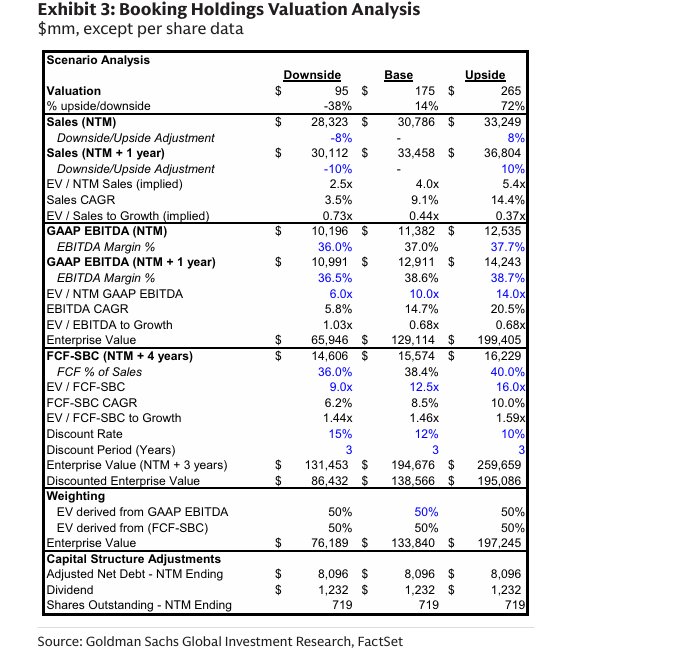
Goldman Sachs said that for investors, what is really worth tracking for a long time is whether the accelerated penetration of cutting-edge AI technology can expand the share of direct transactions and travel spending, whether members can increase repurchases, whether marketing investment can bring higher returns, and whether cash flow can continue to support capital returns. Market share in North America and Europe, competition between general AI platforms and vertical travel agents, and changes in consumer spending options will jointly determine whether these business improvement factors can be implemented at an accelerated pace.