
The Democratic Party swept through the US Congress, and European bank stocks went wild! Fiscal easing and cooling US bond yields ignite market sentiment
The Zhitong Finance App learned that the Democratic Party swept through the US Congress, weakening the market's bets on further expansion of US military spending, but boosted European bank stock expectations for an improvement in the financing environment and credit prospects. The market structure of the day also highlighted the rotation of Western policy expectations. The European Stoxx 600 index rose by nearly 1%, the banking and clean energy sectors led the way, while military stocks lagged behind clearly. Funds are being reallocated bets on the beneficiary paths and directions of the different Democratic Party policies in the context of the Democratic Party's sweeping the National Assembly.
Bank stocks led the European market. The Democratic Party's overwhelming victory in the US midterm elections removed some of the uncertainty that had suppressed the stock market in recent weeks. At the same time, falling bond yields also provided a boost.
The Stoxx Europe 600 Index once rose 4.5%, which is expected to be the best one-day increase since May. HSBC and Santander, the major stocks in the European banking sector, contributed the most to the rise in the current round of the index; Lion Finance Group and OFC had the highest gains, surging 5.9% and 6.4%, respectively. Bank of America stocks also rose in pre-market trading.
Wednesday's rise marked a clear reversal in European bank stocks after the sector fell sharply on the eve of the election. Due to the recent sharp rise in US and European bond yields, which raised market concerns about credit quality and default rates, the sector recovered from the record high set in early September. However, the sector is still up 11% since this year.
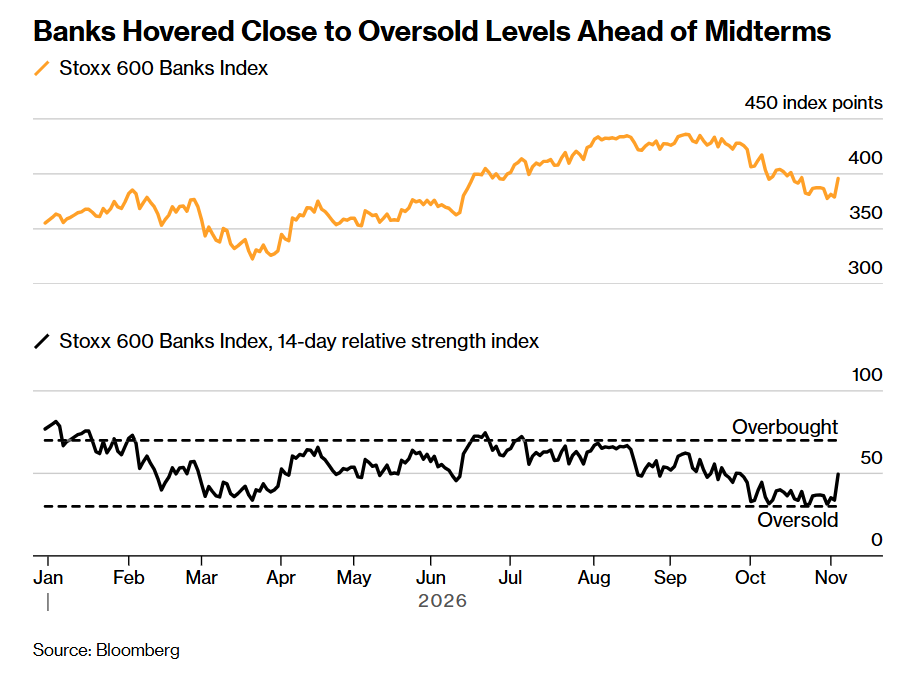
As shown in the chart above, European bank stocks hovered at a pessimistic level close to oversold before the US midterm elections.
“Despite strong fundamentals, investors had significantly reduced their risk exposure to bank stocks before the midterm elections. As the uncertainty has been lifted, we are now seeing a strong, relieving rebound,” said Ulrich Urbain, head of multi-asset strategy and research at Berenberg Bank. “This is a 'sale at the rumor stage and buying after the facts are realized' market.”
US Treasury yields declined as midterm election results were announced one after another. Investors are betting that the new political environment will limit tax cuts led by the Trump administration and the US administration's huge fiscal spending plans. Treasury yields in the UK, France, and Italy have also declined.
“From a broader perspective, if financial conditions are significantly less restrictive and economic growth covers a wider range of fields, this is a good thing for the international financial sector,” said Geoff Yu, senior macro strategist at Bank of New York Mellon. “When people are unwilling to borrow money and credit risk rises, a steep treasury yield curve does not help banks increase their profitability.”
Election pressure released, European bank stocks ushered in a “buying fact” market
The core of the massive rebound in European bank stocks is that the clear election results, the release of pressure to reduce positions in the early stages, and the fall in bond yields all contributed to a reduction in bank stock risk discounts. The Democratic Party swept through the US Congress, weakening the market's bets on further expansion of US military spending, while boosting European bank stock optimism about improving the financing environment and credit prospects.
European bank stocks previously fell from historic highs in early September. The main pressure came from a sharp rise in US and European treasury bond yields: higher financing costs are threatening corporate solvency and loan needs, and investors are re-examining the risk of bad debts and provision as a result.
“Blue Congress” means that the Democratic Party controls both houses of the Senate and the House of Representatives at the same time. When midterm election voting data showed that the Democratic Party controlled both houses of the Senate and House of Representatives, the market expected that Trump's push for additional tax cuts and spending plans would be further restrained. According to Reuters European morning data, US 10-year Treasury yields fell by about 2.1 basis points to 4.9291%, supporting a rebound in risky assets. Bank stock buying and trading logic focuses on reducing the risk that financing pressure may ease and profits will be eroded by credit losses.
Pre-election position adjustments amplified the rebound. Belenberg Bank believes that banking fundamentals are still strong, but investors have clearly reduced their risk exposure before, and there was a relieving increase after the results were revealed. Bloomberg Intelligence also observed a shift in capital to European bank stocks that previously lagged behind the market; during the same trading session, the military sector was under pressure, indicating that the market was redistributing industry benefits brought about by policy changes.
Why is falling yield good for banks: Credit quality is more important than spread expansion
Bank profits don't just depend on whether interest rates on loans rise. Higher interest rates can increase returns on some assets, but if borrowers reduce financing, increase deposit and wholesale financing costs, and increase default losses, interest spread earnings may be offset.
When market concerns shift from “interest rates are not high enough” to “borrowers cannot afford high benchmark borrowing costs,” falling yields are beneficial to bank valuations. If improved financing conditions can drive demand for loans, reduce debt repayment pressure, and reduce expected credit losses, banks may maintain profits by improving business scale and asset quality.
This is also the key point of view of Bank of New York Mellon strategist Geoff Yu: a steep yield curve does not automatically mean that banks are more profitable; if companies are unwilling to borrow and credit risk rises, it is difficult to realize the advantages of the curve. What investors prefer is that economic growth covers more industries, financing activity resumes, and bank profits are no longer overly dependent on interest rates or the yield curve continues to rise.
Some banks already have the operating foundation to undertake valuation repairs. HSBC's profit before tax increased 10% year-on-year in the third quarter at a fixed exchange rate and excluding major projects; Santander's Tier 1 capital adequacy ratio (CET1) for common shares at the end of September was 12.7%, higher than the minimum requirement of 9.86%. Profit growth and capital buffers provided support for banks to absorb potential losses and maintain credit supply. The sustainability of the rebound in bank stocks depends to a greater extent on whether easing financing pressure can be implemented into steady loan growth, stable credit costs, and shareholder returns, rather than a single day rise or fall in yield.