
The Democratic Party swept through Congress and ignited hopes for a cease-fire between the US and Iran! European gas fell four times in a row, falling nearly 20% this week
The Zhitong Finance App learned that on Thursday, European gas prices continued to decline, as the market generally bet that the Democratic Party will take control of the Senate and House of Representatives in the US midterm elections, which may speed up the search for a diplomatic solution to the Middle East conflict.
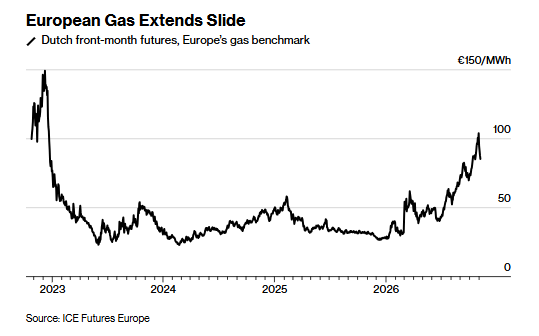
According to the data, Dutch futures, which are the benchmark for European gas, fell by about 2% in recent months to 86.42 euros per megawatt-hour. Prices once hit their lowest level in more than two weeks and fell for the fourth day in a row, with a cumulative decline of about 18% so far this week.
US Vice President JD Vance said on Wednesday that the cause of the Republican Party's defeat in the midterm elections was that the government's war against Iran was unpopular, and US President Trump also acquiesced in this statement. Democrats have gained control of both houses of Congress, giving them a greater advantage in influencing government spending and may limit Trump's ability to advance the conflict.
The war has taken nearly one-fifth of the world's liquefied natural gas exports out of the market, causing Europe to have abnormally low fuel stocks this winter, and increasing the prospects for fierce competition with Asia for supply. Natural gas prices in the two places recently soared to their highest level since 2022, more than three times the level at the beginning of the year.
“After the Democratic Party's victory in the US midterm elections, the energy market is under tremendous pressure because people are increasingly hoping that this political shift will speed up efforts to end the war against Iraq,” Dutch International Group strategists Warren Paterson and Eva Manti said in a report. “However, from a fundamental point of view, the supply and demand pattern in the European gas market is still tight.”
As temperatures drop and wind and solar power generation decreases this week, European traders have begun to use natural gas stocks. Natural gas stocks across the EU fell to 74%, below the five-year seasonal average of 90%. In Germany, the largest economy, inventory levels have fallen below 61%.