
NIOX Group And 2 Other British Healthcare Stocks To Own
Rising UK inflation and the prospect of higher Bank of England interest rates are putting pressure on household budgets, which keeps healthcare spending in sharp focus. People tend to delay some big purchases when borrowing costs climb, but core medical demand often holds up. That combination puts select British healthcare stocks in the spotlight. This article highlights three companies from our screen of financially solid healthcare leaders.
The three stocks that follow are just a first cut from the healthcare screen, and the full results surface 3 more companies with equally compelling stories that are not covered here. To see everything in one place, head straight into the Best Healthcare Stocks screener to identify, compare, and analyze the highest-conviction healthcare candidates for your watchlist.
NIOX Group (AIM:NIOX)
Overview: NIOX Group develops and sells its NIOX VERO point of care FeNO device and consumables that help clinicians assess and manage asthma and COPD.
Operations: The business currently reports all its £47.5 million revenue from the NIOX branded respiratory diagnostics line, primarily tied to NIOX VERO and related consumables.
Market Cap: £269.4 million
NIOX Group provides focused exposure to respiratory diagnostics, with its NIOX VERO device and consumables used directly in asthma and COPD care. Earnings have recently grown faster than the wider medical equipment sector, supported by rising margins and a concentrated product offering. A key consideration is how the current premium P/E may respond to any changes in demand or pricing power for this system.
If that premium P/E has your attention, review the DCF valuation analysis for NIOX Group to see how market expectations line up with cash flow assumptions and downside risk.
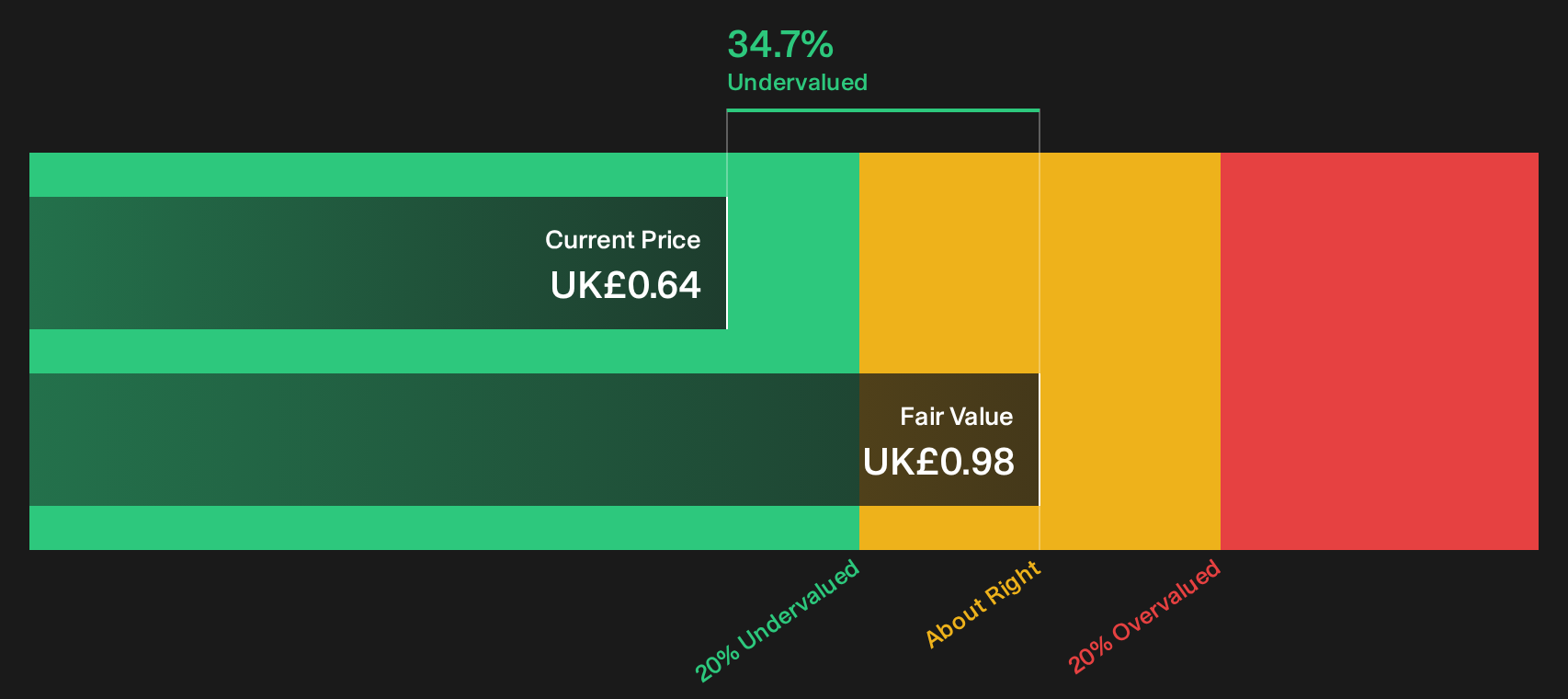
HUTCHMED (China) (AIM:HCM)
Overview: HUTCHMED (China) develops and commercializes targeted cancer and immunology drugs such as Fruquintinib and Savolitinib across global markets.
Operations: The group generates about $237 million from marketed oncology and immunology therapies, $245 million from other ventures, and earns most revenue in China.
Market Cap: £1.8 billion
HUTCHMED (China) matters in this Best Healthcare Stocks screen because its cancer medicines already contribute commercial revenue while a wider pipeline works through late stage trials. This puts real-world oncology demand and potential future product launches at the center of the story.
"Although FRUZAQLA has grown in market sales and expanded into more than 38 countries, the impact of the Medicare Part D redesign and potential payer pushback on colorectal cancer treatment costs could compress net pricing and reduce milestone and royalty inflows, which would limit top line growth and pressure net margins."
One key question is what happens if a relatively quiet shift in how these therapies are paid for starts to reshape both pricing power and the quality of long term earnings.
If that slow shift in payer power is what you are watching, read the full narrative for HUTCHMED (China) to see how changing incentives could be masking HUTCHMED (China)'s next leg of potential value creation.

AstraZeneca (LSE:AZN)
Overview: AstraZeneca develops and sells prescription medicines across oncology, cardiovascular, renal and metabolism, respiratory, immunology, vaccines, and rare diseases, giving it a broad, product-led healthcare footprint that fits the Best Healthcare Stocks theme without relying on any single blockbuster franchise.
Operations: AstraZeneca currently reports all its US$62.4b revenue from pharmaceuticals. This reflects a single but wide-ranging prescription medicines business.
Market Cap: £217.5b
AstraZeneca matters for this Best Healthcare Stocks screen because its prescription medicine engine spans oncology, cardiometabolic conditions, respiratory and immunology, vaccines, and rare diseases. This gives the group multiple ways to turn scientific assets into long-lived cash flows.
"The company's robust and diversified late-stage pipeline, particularly in oncology, rare diseases, and cardiovascular or metabolic therapies, is now underpinned by management's disclosure of 12 programs each with risk adjusted peak sales potential above US$5b and several more in the US$3b to US$5b range."
What really moves the needle for AstraZeneca from here is how one quiet assumption about future pricing and uptake actually plays out.
If that assumption is what you are testing, read the full narrative for AstraZeneca to see how pricing, pipeline risk, and potential upside could be quietly decoupling.

Seeking Alternatives Before The Crowd?
Fresh opportunities do not sit still. Breakout themes gain momentum, quiet quality gets caught, and tired ideas start dropping. Scan these under the radar lists while it matters and get in early.
- Target resilient compounding potential by scanning a curated 4 dividend fortresses that focuses on durability of payouts alongside meaningful income strength.
- Hunt for future category leaders inside a focused 5 high quality undiscovered gems built to spotlight quality that has not yet flown onto most radars.
- Position ahead of the next compute wave with a filtered 25 quantum computing stocks capturing businesses tied directly to real world quantum progress and commercialization momentum.
Have feedback on this article? Concerned about the content? Get in touch with us directly. Alternatively, email editorial-team@simplywallst.com