
Delta Air Lines (DAL) Bond Sale Puts Its Valuation Debate Back In Focus
Delta Air Lines (DAL) has just completed a fixed income offering tied to new 5.5% senior unsecured notes, a funding move that gives investors fresh information about its capital structure and balance sheet decisions.
Against this funding backdrop, Delta Air Lines’ share price has pulled back 4.35% over the past day to US$85.36 but is still up 23.60% year to date. The 1 year total shareholder return of 49.23% and the very large 163.58% 3 year total shareholder return suggest momentum has been strong over a longer stretch, even as the 90 day share price return has eased by 6.55%.
Compare Delta Air Lines’ bond issuance with that of other carriers by reviewing a curated set of balance sheet focused opportunities in our list of solid balance sheet and fundamentals (24 results).
Delta Air Lines now trades below both its own estimated value and the average analyst target after that bond sale and share pullback. Is the discount a genuine opportunity, or is the market pricing in real earnings risk?
Most Popular Narrative: 35% Overvalued
Delta Air Lines closed at $85.36 while the most followed narrative pegs fair value closer to $63.21, which frames the current bond financing and share pullback against a richer starting point for valuation.
Atlanta's home airline still shines bright, and indeed brighter than most in a notorious low-margin, low-profit industry. In its Q2 trading update, Delta once again trounced analysts' expectations both top and bottom line, yet there's a snag: The legacy carrier comes from all-time high profitability. Hence, the risk distribution is skewed to the downside as long as there's no final and reliable re-opening of the Strait of Hormuz.
See why 23 investors see Delta Air Lines as 35% overvalued.
According to PittTheYounger, who penned this leading narrative, Delta Air Lines is priced roughly 35% above an estimated value of $63.21, based on an 11% discount rate and revenue growth assumptions of 2% with an 8% profit margin and a future P/E of 10x.
That framework contrasts with the SWS DCF output that points to Delta Air Lines trading about 63.5% below an intrinsic value of $233.70, suggesting a wide gap between a cash flow heavy valuation model and a more cautious earnings based thesis anchored in thinner airline margins and macro risks.
Result: Fair Value of $63.21 (OVERVALUED)
Still, the narrative could unravel quickly if travel demand softens further, or if Delta Air Lines faces another external shock that pressures already thin margins.
Find out about the key risks to this Delta Air Lines narrative.
Another View: Delta Air Lines Through Market Multiples
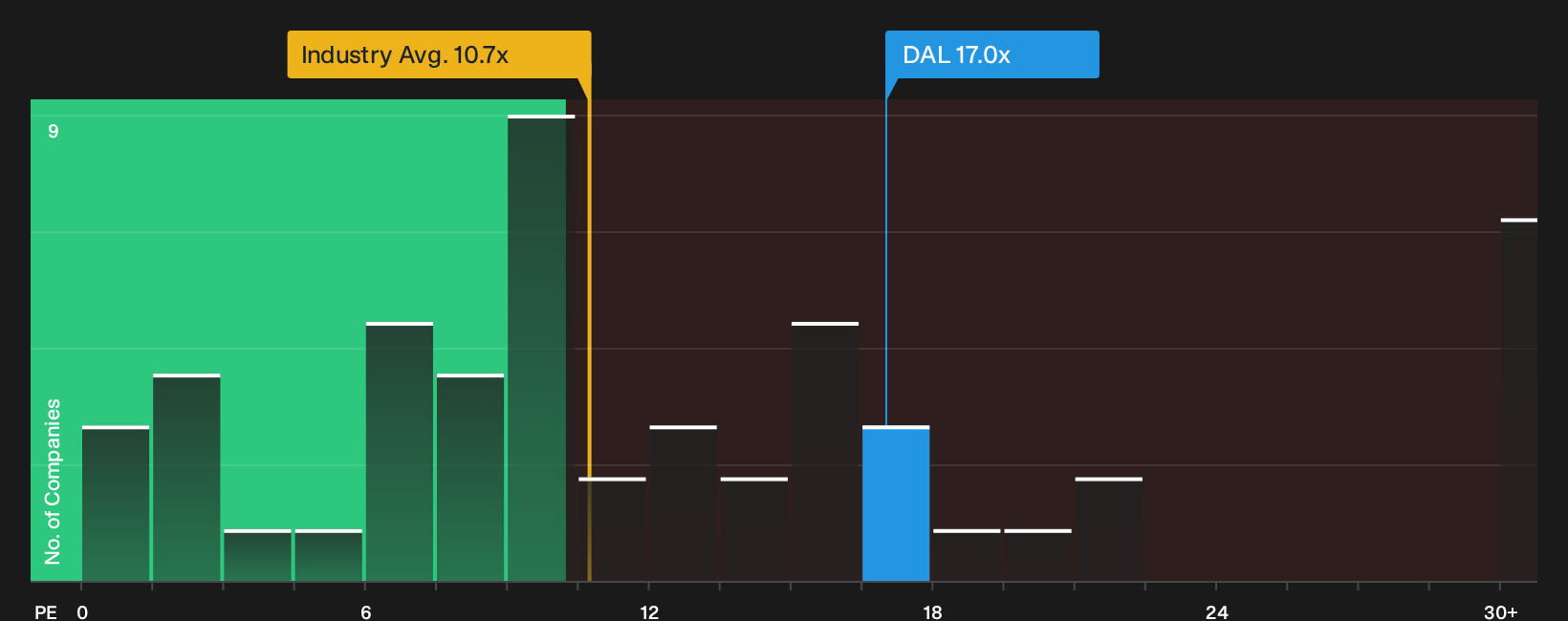
There is a very different signal coming from simple market ratios. Delta Air Lines trades on a P/E of 17x compared with a fair ratio of 20.7x, which hints at some headroom on this metric even though the stock is priced well above both US and global airline averages of 11.8x and 10.7x. That kind of gap can cut both ways, either as a cushion if earnings hold up or as extra downside if the sector re-rates lower, so which side do you think the crowd is really paying for here.
See what the numbers say about this price — find out in our valuation breakdown.
Next Steps
Sentiment on Delta Air Lines is split, so treat this as a prompt to dig into the numbers yourself and decide fast where you stand. A good place to start is by weighing its 2 key rewards and 3 important warning signs.
Looking for more investment ideas beyond Delta Air Lines?
Do not stop with Delta Air Lines. Broaden your watchlist with a few focused stock ideas that match how you like to balance risk and opportunity.
- Target resilient potential by scanning for companies with robust finances and low-risk profiles using the 32 resilient stocks with low risk scores.
- Hunt for value-oriented opportunities where quality and attractive pricing intersect by checking the 42 high quality undervalued stocks.
- Build a cash flow focused portfolio by reviewing income ideas in the 6 dividend fortresses.
Have feedback on this article? Concerned about the content? Get in touch with us directly. Alternatively, email editorial-team@simplywallst.com