
The yen appreciated+global bonds plummeted. Japan's GPIF lost for the first time in six quarters, and there was almost no adjustment in asset allocation
The Zhitong Finance App learned that the latest quarterly report of the Japanese Government Pension Investment Fund (GPIF) shows that in the three months up to the end of September, its asset allocation was almost unchanged compared to the model mix, and the allocation of domestic bonds and stocks was still close to the 25% target, indicating that there was no significant shift in its investment position; however, due to the sharp drop in global bond prices and the appreciation of the yen, the fund recorded a 1.7% quarterly loss during the same period, for the first time in six quarters.
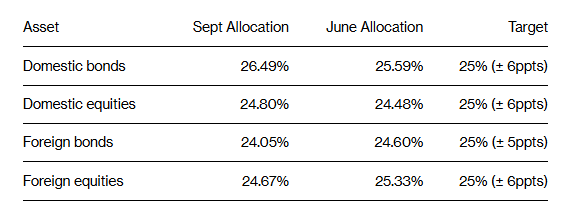
According to the allocation data, GPIF allocates 26.49% of the portfolio to Japanese bonds and 24.80% to Japanese stocks. Both are within the narrow range that the fund has stuck to in recent years, although they were approved to deviate 5 to 6 percentage points from the 25% target. The allocation of Japanese bonds rose to 26.49% from 25.59% in June, but this ratio often rises in March and September due to the seasonal pattern of cash management in the Japanese pension system.
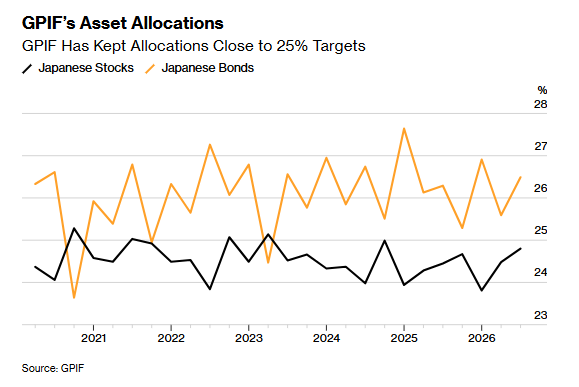
For several months, it has been rumored that this 314.4 trillion yen (about 2 trillion US dollars) fund — one of the world's largest public pension investment institutions — may transfer more capital to the local Japanese market, which is expected to boost the Japanese stock market and bond market.
Japanese Prime Minister Sanae Takaichi hinted in July that GPIF might increase its domestic assets. Coupled with an unexpected management meeting in August, this speculation was further fueled. However, the latest data shows that the fund is maintaining its status quo, which may dampen market expectations for short-term allocation adjustments.
Hiroshi Okuda, an executive researcher at the Dai-ichi Life Research Institute, said that GPIF seemed to have hardly used the deviation range allowed by the model combination; by the end of September, the fund seemed to be rebalancing the portfolio to the 25% target as in the past. “From these results alone, there is no indication that GPIF is moving in the direction of changing the model mix.”
According to analysis, increasing domestic asset holdings may support Takaichi Sanae's agenda by curbing the weakening yen and depressing yields on Japanese treasury bonds. She is seeking to expand fiscal spending to stimulate growth. However, for GPIF, the threshold for adjusting the configuration is very high. The fund emphasizes that its sole goal is to guarantee pension payments for future generations.
Market participants say GPIF is unlikely to adjust positions without clear investment reasons; however, given the influence of Japan's Ministry of Health, Labor, and Welfare, which is responsible for overseeing the fund, in setting target returns, the possibility of an adjustment cannot be ruled out.
Results disclosed on the same day as the allocation decision showed that GPIF's quarterly return was -1.7% in the three months ending September, the first loss in six quarters due to falling global bond prices and the strengthening of the yen.
The fund said it had quarterly losses of 5.253 trillion yen (approximately US$33.3 billion) and total assets of 314.4 trillion yen. Among them, Japanese stocks recorded a positive return of 3.71%, but foreign bonds, domestic bonds, and overseas stocks lost 6.52%, 1.80%, and 1.86%, respectively.
In September of this year, due to renewed tension in the Middle East driving up oil prices, which heightened market concerns about inflation, bond prices fell at an accelerated pace.
During the quarter, the MSCI global stock index rose 1.3%, the S&P 500 index rose 2.0%, and the Eastern Stock Exchange index rose 2.9%; the 10-year US bond yield rose 81 basis points; the yield on Japan's benchmark treasury bond rose by about 38 basis points; and the US dollar fell more than 3% against the yen. Despite overall losses, GPIF domestic bonds and foreign bonds outperformed the benchmark by 5 and 13 basis points, respectively. Japanese stocks outperformed the benchmark by 8 basis points, and the performance of overseas stocks remained on par with the benchmark.