
Caught Out By Rail Vikas Nigam's Fall? What Bears Saw
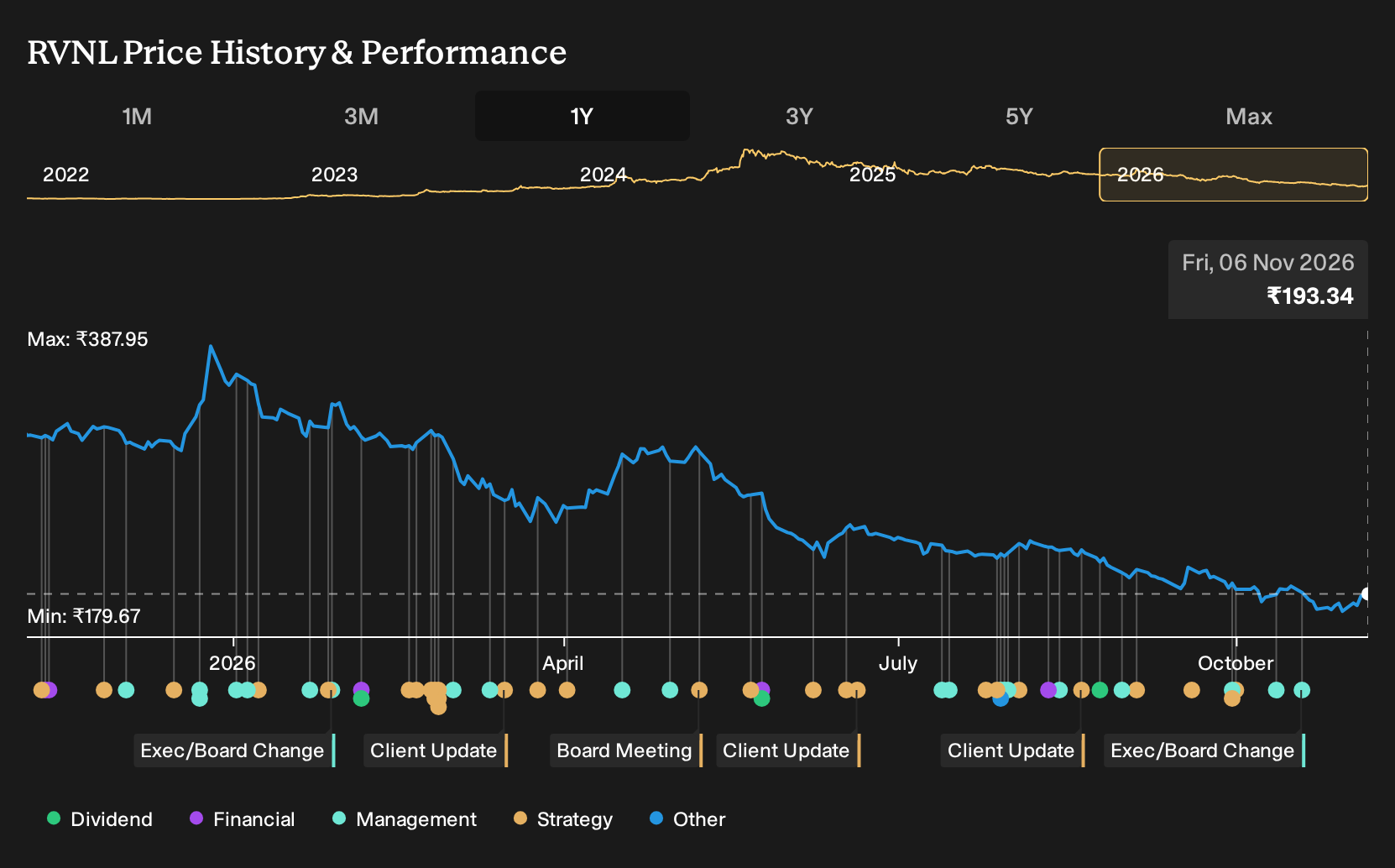
Holding Rail Vikas Nigam over the past year would have meant a 38.8% loss, including dividends. If you had bought on 6 November 2025, you would have been leaning on a bullish story built around urbanisation, green mandates and a shift into asset ownership, while a more cautious view stressed margin strain, Vande Bharat delays and execution risk. Given those explicit assumptions, which parts of the original Rail Vikas Nigam case failed to allow for what actually unfolded?
The useful thing about a Narrative is that the reasoning is checkable: the assumptions sit beside the argument, and together they imply an estimated Fair Value you can disagree with.
Rail Vikas Nigam has already moved. See which of 225 high quality undervalued stocks still trade below our estimates.
The Two Rail Vikas Nigam Stories Investors Had To Weigh
The shares cost ₹318 at the start of the period, and anyone looking at Rail Vikas Nigam then had two very different stories to weigh.
On the bullish side, a Fair Value of ₹340 assumed revenue rising 10.7% a year with profit margins easing from 6.0% to 5.4%, backed by a shift into asset ownership and long-duration projects such as Vande Bharat manufacturing and maintenance.
The cautious view put Fair Value at ₹272 and treated 10.8% annual revenue growth and a 6.1% margin as realistic, while warning that lower margin non railway bids and execution risk on projects like Vande Bharat could keep earnings volatile.
What The Results Changed For The Rail Vikas Nigam Story
The clearest fresh fact was Rail Vikas Nigam posting Q1 2027 revenue of ₹43,212.3m and net income of ₹1,593.6m, with net margin at 3.7% versus 3.4% a year earlier. Slightly better profitability supported the bullish claim that earnings quality could improve. However, the margin level still sat well below the 6% envisaged by both camps, so the evidence pointed in both directions.
The key assumption here was margin resilience. For another infrastructure stock, you might test that by tracking net margin alongside any shift into new contract types or geographies, and then checking whether reported profitability moves toward the level implied by the valuation.
Rail Vikas Nigam, And What You Pay For Today
Rail Vikas Nigam now trades at ₹193, with the one year return over the past year showing a loss of 38.8%. The selected Narrative places its Fair Value below that price, because the focus has shifted to how order mix, not just order size, feeds through to profitability.
Readers weighing this Narrative are really judging one thing. A buyer today would need to decide whether the current valuation fully reflects the risk that lower margin bidding work or problem contracts drag future earnings below what the price implies.
"The recent large increase in competitive, non railway bidding projects has boosted Rail Vikas Nigam's order inflows and revenue visibility. Management is now targeting work orders of around ₹20,000 crores to ₹25,000 crores for the year, with bidding works contributing roughly one third of revenue and margins on domestic bidding projects guided at about 5% to 6%, which directly affects future net margins and earnings."
The price and this Narrative do not agree. → Uncover what this Narrative says Rail Vikas Nigam is actually worth
Go Straight To The Source
Passing on this one could have spared you a loss. Where might you find the opposite surprise? Start looking for companies whose prices leave room for a better outcome than investors expect. These three trade below our estimated value.
- Company 1 - 49% below our estimate - runs an asset light hotel network while scaling a linked retail platform.
- Company 2 - 29% below our estimate - ties subscription software, cloud infrastructure and AI workloads into a single platform.
- Company 3 - 25% below our estimate - shifts toward higher margin adult and oral health probiotics via direct channels.
Those are three of them. See every one of the 193 solid balance sheet companies →
Have feedback on this article? Concerned about the content? Get in touch with us directly. Alternatively, email editorial-team@simplywallst.com