
Sun Life Financial And 2 Top Canadian Dividend Stocks
With Social Security facing projected benefit cuts from 2032, more Canadians are looking to build their own reliable income streams rather than rely solely on government programs. That is where high quality Canadian dividend payers offering yields above 3% with well covered, steady payouts come in. This article breaks down three of the strongest candidates from that income focused universe so you can see how they might fit your long term plan.
The three stocks highlighted here offer a compelling starting point if you want exposure to higher yielding dividend payers with steady, well covered income streams. However, if you want the pick of this theme, these 3 dividend aristocrats stocks are the best of the best.
Sun Life Financial (TSX:SLF)
Sun Life Financial is a global insurer and asset manager that fits the Dividend Powerhouses theme because its steady insurance premiums and fee income help fund a consistent payout. Most revenue comes from the U.S. at about CA$14.0b, Canada at roughly CA$12.1b and Sun Life Asset Management at around CA$7.1b, with Asia adding CA$2.7b, supporting a business valued at about CA$56.1b.
For income focused investors, Sun Life Financial offers a blend of predictable cash flows and a long dividend track record that fits neatly with a 3%+ yield screen. This is why one key risk around its newer technology push really matters.
Rapid deployment of AI across underwriting, client service and adviser tools risks execution errors, model drift and governance failures that could lead to higher claim costs or remediation expenses. This would pressure net margins and earnings.
What happens if a single assumption behind those dependable earnings streams is tested by pressure that has not yet fully shown up in the numbers?
When that core assumption feels shaky, reading the full narrative for Sun Life Financial shows how Sun Life Financial’s AI ambitions, capital strength and dividend policy may be decoupling from headline earnings risk.

Westshore Terminals Investment (TSX:WTE)
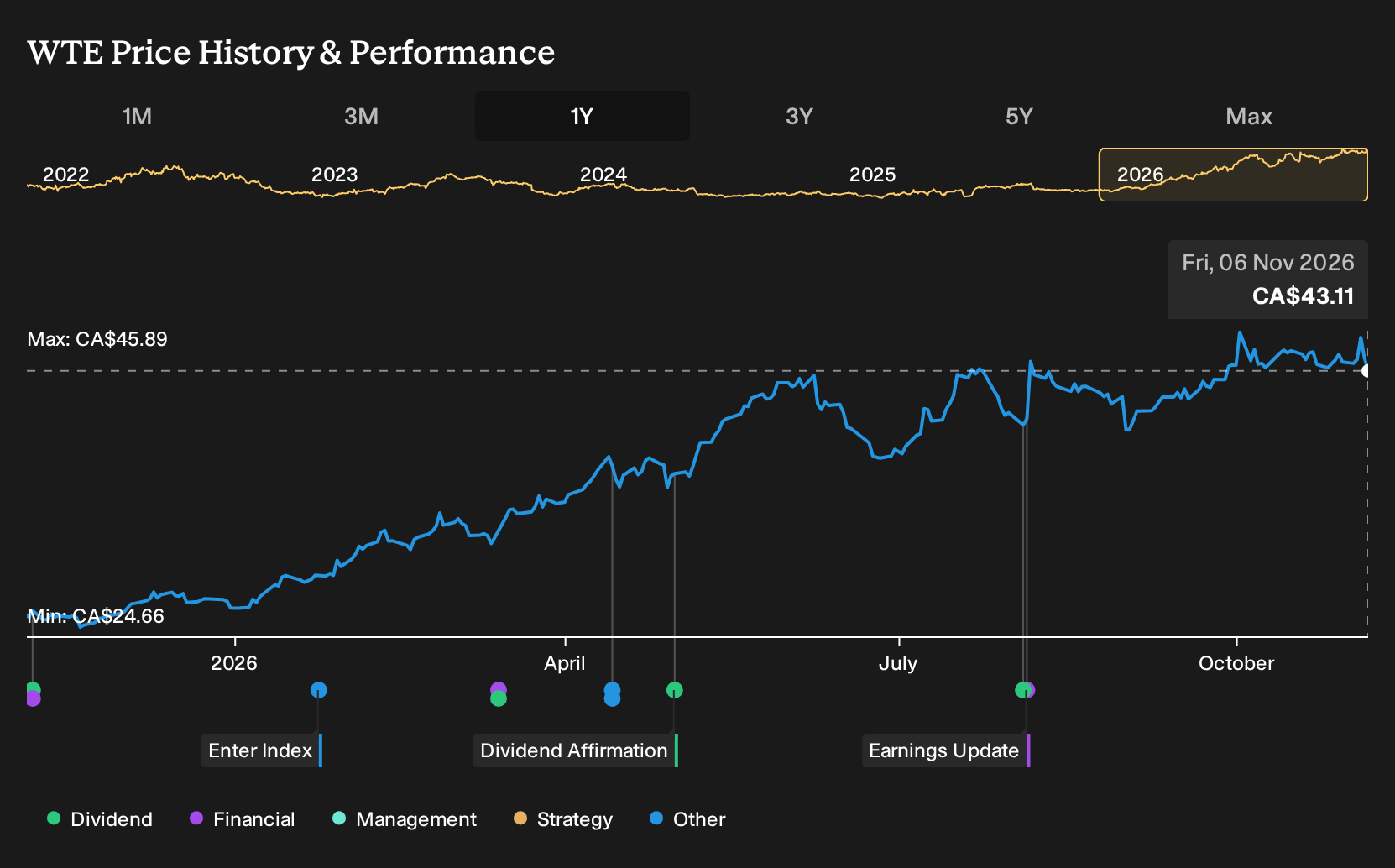
Westshore Terminals Investment runs the Roberts Bank coal terminal in British Columbia, handling export shipments under long term contracts that support its 3%+ dividend profile. The business is valued at about CA$2.7b, giving it meaningful scale within Canadian income oriented infrastructure stocks.
For income seekers, Westshore Terminals Investment offers something simple and very focused: a single major export terminal where long term handling contracts tie directly into the cash flows that support its dividend.
The planned commissioning of the BHP Jansen potash project in 2027 introduces Westshore Terminals Investment to a new commodity stream that could add an additional source of terminal revenue once volumes begin to move through the facility.
The durability of that payout will likely hinge on how one quiet pressure on future pricing power and margins ultimately plays out.
That quiet pressure is exactly why reading the full narrative for Westshore Terminals Investment can clarify how Westshore Terminals Investment balances contract visibility, coal exposure and the potash pivot ahead.
Bank of Nova Scotia (TSX:BNS)
Bank of Nova Scotia is one of Canada’s big lenders, with everyday banking and international operations supplying the steady cash flows that underpin its 3%+ dividend profile in this screener.
Bank of Nova Scotia runs consumer, commercial, wealth and capital markets franchises, drawing about CA$11.9b from Canadian Banking and CA$9.6b from International Banking, with Global Wealth Management and Global Banking and Markets adding CA$7.1b and CA$6.8b respectively, supporting a business worth roughly CA$157.6b.
For dividend focused investors, Bank of Nova Scotia brings a mix of long history, broad reach and income supported by retail and commercial banking that still leaves room for growth.
Expansion of banking and wealth management services in Pacific Alliance markets such as Mexico, Peru, Chile and Colombia remains a live driver, with International Banking revenue and loan growth in these regions and ROE above 16% pointing to further potential for fee income and earnings growth as Bank of Nova Scotia continues to deepen client relationships.
The real swing factor is how one underappreciated shift in the business model ultimately feeds through to margins and long term dividend headroom.
That shift is exactly why reading the full narrative for Bank of Nova Scotia can show how Bank of Nova Scotia’s expanding footprint could turn overlooked pressure into accelerating dividend firepower.

Seeking Alternatives Before The Crowd?
Fresh dividend ideas can move quickly when momentum builds, and the window for quiet entry points may close once attention starts shifting their way. Scan these under the radar lists and consider them ahead of broader interest.
- Identify income-oriented stocks that aim to keep paying when others pause by running the 3 dividend fortresses while it matters most, before yields potentially change.
- Look for potential bargains where fundamentals appear solid by checking the 7 high quality undervalued stocks before any renewed buying interest affects valuations.
- Focus on under followed opportunities that pair strong metrics with limited coverage by reviewing the 8 high quality undiscovered gems before broader market attention increases.
Have feedback on this article? Concerned about the content? Get in touch with us directly. Alternatively, email editorial-team@simplywallst.com