
Is First Busey (BUSE) Cheap Following Mixed Third Quarter Earnings?
Third quarter earnings put First Busey back in focus
First Busey (BUSE) moved back onto investor watchlists after third quarter 2026 results showed softer quarterly net interest income and net income, paired with higher net charge-offs and higher earnings per share from continuing operations.
At a share price of US$28.63, First Busey has seen short term momentum soften, with the 90 day share price return down 7.11%, even though the year to date share price return is up 19.79% and the 1 year total shareholder return is 29.28%.
Scan beyond First Busey and see how it compares to a hand picked 31 resilient stocks with low risk scores with resilient balance sheets and more muted drawdowns in tougher quarters.
First Busey now trades below both analyst targets and some intrinsic value estimates, even after a strong 1 year run. Does that discount still look like a margin of safety, or something else entirely?
Price-to-earnings of 11x: Is it justified for First Busey?
On simple earnings math, First Busey trades on a P/E of 11x, which sits slightly below both the US Banks average of 11.3x and a much lower level than the 16x peer group average. It is, however, a touch above its own estimated fair P/E of 10.7x.
The P/E ratio compares the current share price to earnings per share, so it effectively tells you how many dollars investors are willing to pay today for one dollar of profit. For a regional bank like First Busey, this multiple often reflects how markets view its earnings resilience, credit quality, and growth prospects relative to other financial institutions.
First Busey has grown earnings by 6.6% per year over the past 5 years, and profit expanded very sharply over the last twelve months, with earnings growth of 117.2% and net profit margins at 25.8% compared with 15.3% a year earlier. Against that backdrop, a P/E of 11x that is lower than the 16x peer average suggests the market is applying a discount. At the same time, the slightly higher level than the 10.7x fair P/E implies the current tag is a little richer than the level some valuation work suggests the shares could drift toward over time.
Compared with the broader US Banks industry at 11.3x, the multiple on First Busey is fractionally lower, which points to only a small gap in how investors are weighing its earnings versus sector peers. The much wider difference relative to the 16x peer average and the fair P/E estimate of 10.7x creates a split picture, where the market is more conservative than peers but a bit more optimistic than the fair ratio indicates the valuation could settle at.
Explore the SWS fair ratio for First Busey.
Result: Price-to-earnings of 11x (ABOUT RIGHT)
Still, First Busey faces real pressure if credit costs stay elevated or if softer revenue growth near 0.7% starts to squeeze those 25.8% net margins.
Find out about the key risks to this First Busey narrative.
Another view on First Busey’s value
The P/E work suggests First Busey is roughly in line with the sector, yet our DCF model presents a different perspective. On that approach, the estimated future cash flow value is $50.46 per share compared with a market price of $28.63. This relationship implies the stock currently screens as undervalued based on that model.
This kind of gap can indicate that earnings-based multiples might be missing parts of the story, including how long current profitability might be sustained. The key question is whether the cash flow path that underpins that DCF output appears realistic enough for you to rely on.
Look into how the SWS DCF model arrives at its fair value.
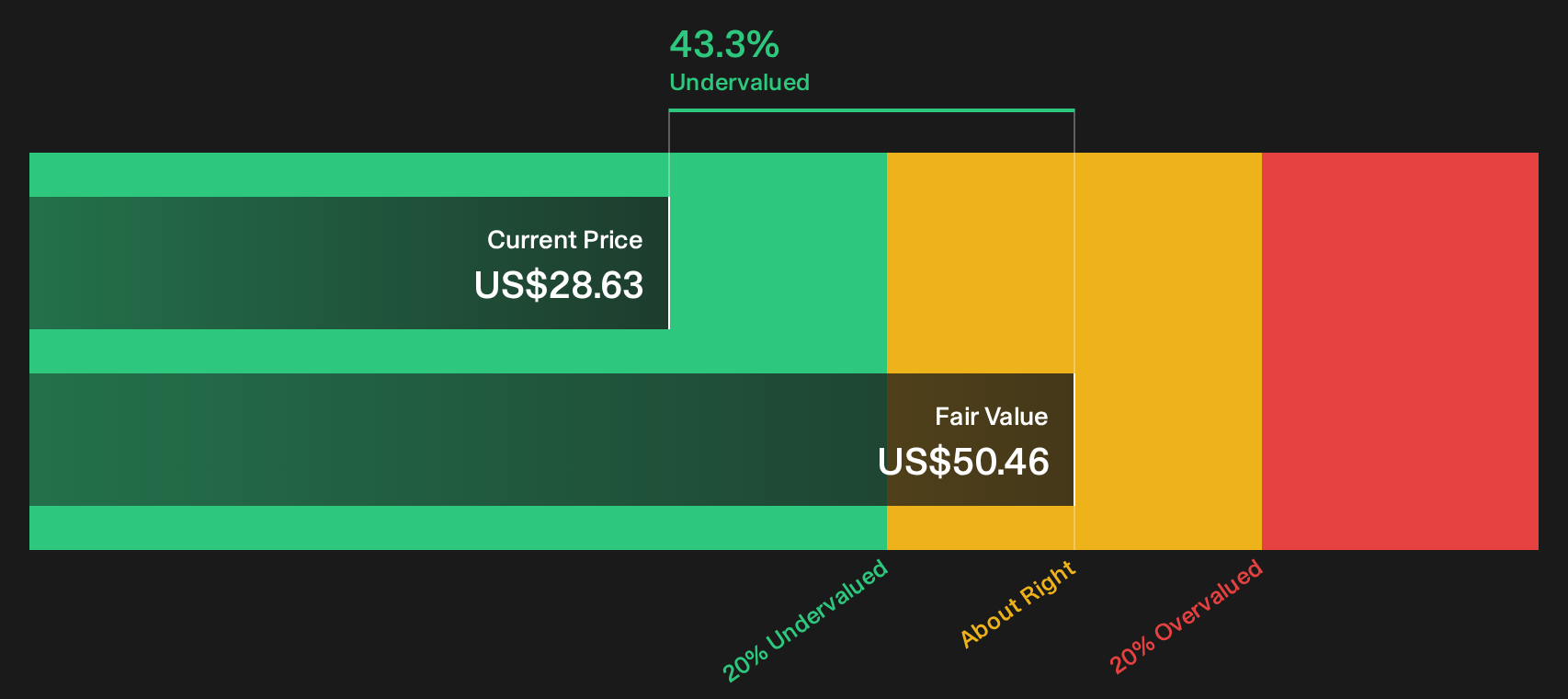
Simply Wall St performs a discounted cash flow (DCF) on every stock in the world every day (check out First Busey for example). We show the entire calculation in full. You can track the result in your watchlist or portfolio and be alerted when this changes, or use our stock screener to discover 38 high quality undervalued stocks. If you save a screener we even alert you when new companies match - so you never miss a potential opportunity.
Next Steps
Mixed signals around First Busey can feel confusing, especially with both risks and rewards on the table. Move quickly, study the underlying figures, and pressure test the story for yourself by starting with our breakdown of 3 key rewards and 1 important warning sign
Looking for more First Busey sized opportunities?
If First Busey has you thinking harder about valuation, risk and income, do not stop at one ticker. Cast a wider net and let data do the heavy lifting with carefully filtered ideas that match your goals.
- Target resilient performers with strong downside protection by scanning a 31 resilient stocks with low risk scores that filters for stocks aiming to keep drawdowns in check when conditions get tougher.
- Hunt for quality at a discount by reviewing a 38 high quality undervalued stocks built around companies that pair solid fundamentals with prices that look compressed against their financial profile.
- Strengthen your income stream by checking a 7 dividend fortresses that focuses on higher yielding payers designed for investors who care about cash returns alongside capital moves.
Have feedback on this article? Concerned about the content? Get in touch with us directly. Alternatively, email editorial-team@simplywallst.com