
Intel Stock Faces a New Threat That No One Saw Coming
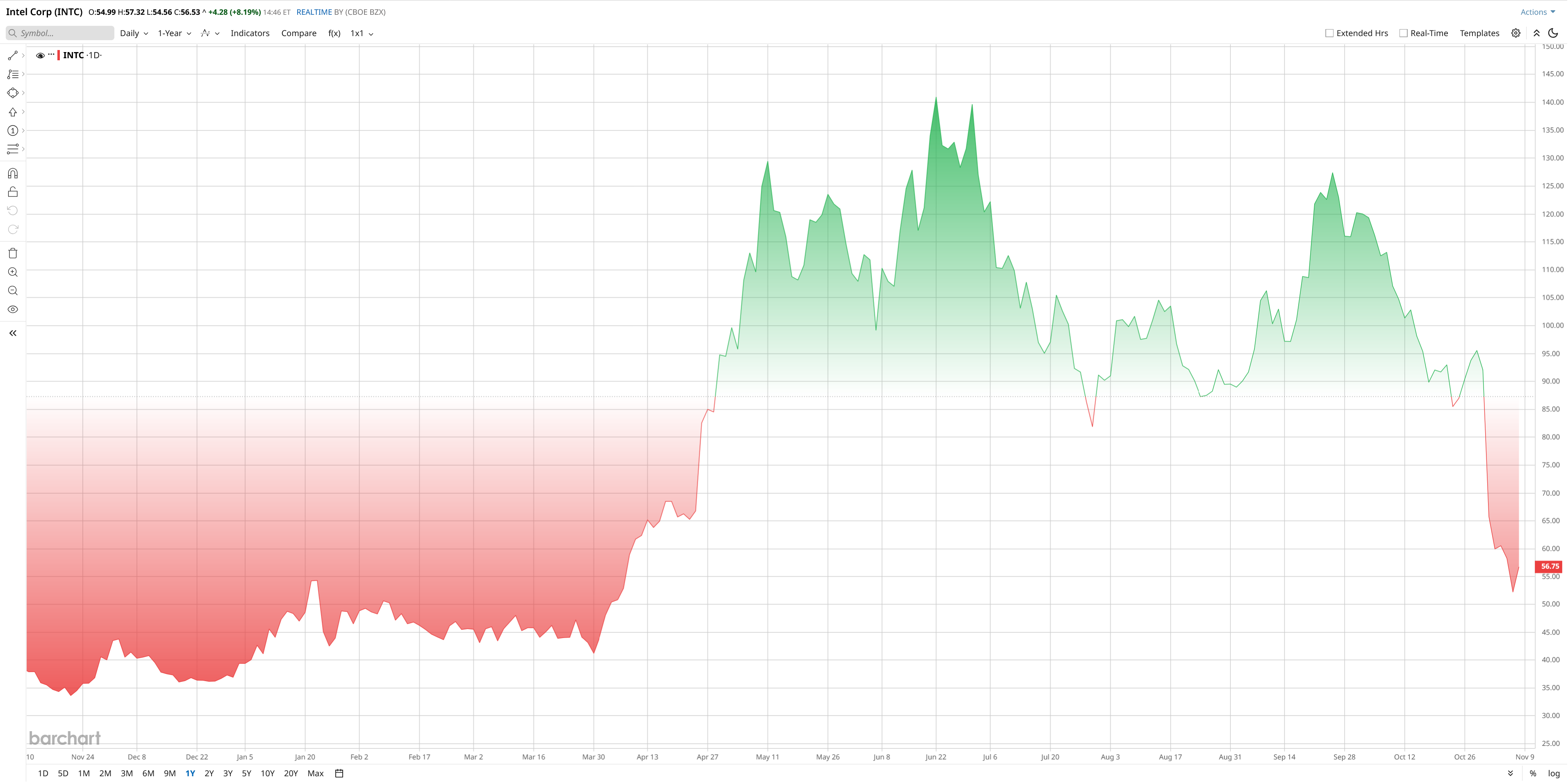
Intel (INTC) stock has been one of the wildest rides on Wall Street in 2026. Shares nearly quadrupled by June 2026. Then the bottom fell out. A brutal PC slowdown and a weak fourth-quarter guide erased billions in market value in days.
In simple terms, Intel stock plunged more than 49% over the past month. But a new risk is insinuating itself. The disaster for Trump was that the Democrats swept the midterm elections. Over on Wall Street, the companies that sold shares to the U.S. government may be subject to a new round of hearings and legal action.
Intel's leading the way on that list. Uncle Sam's stake in the chipmaker, about 10%, goes to the government via an $8.9 billion purchase last year. The rally was the result of that support. It potentially could be a “headliner issue” now.
Potential questions about this investigation will be whether it is going to alter Intel's turnaround narrative or simply dampen down a very volatile stock.
Intel Stock Still Not Cheap
Despite the selloff, Intel's stock does not come in cheap. However, on some metrics it’s below the sector median. Its forward price-to-book (P/B) ratio is 2.81 compared to the sector’s 4.55, indicating INTC stock is less expensive on this measure.
On the other hand, the forward price-to-sales (P/S) is 5.21 versus 3.31 for the sector, and the forward P/E is 40.73 relative to 21.21 for the sector, suggesting INTC is generally expensive and trading at a premium in most other metrics.
Means, the stock looks cheaper on P/B, but that is a small consolation when the core business is still rebuilding profitability. This is a show-me story trading at a premium.
The Blue Wave Risk
The Democratic sweep puts a new page in the political math books of Washington. The new Congress starts in January. Already, Democrats have indicated they will seek stronger corporate regulation. Firms can be called to appear before hearings or investigations for their past dealings with the Trump administration, and each other.
The largest on that list is Intel. Questions have already been raised in a shareholder lawsuit about whether the Commerce Department had the legal authority to replace chip subsidies with equity. That lawsuit could throw the entirety of the government stake into question if it takes traction. Ultimately, the Commerce Department's scheme could go, but Intel would not. However, it would cause confusion to a major cornerstone of the bull's argument. Government support for Intel's foundry build-out is still required, and long-term planning will be more difficult due to political noise.
A Beat Shadowed by a Weak Guidance
Intel recently reported third-quarter 2026 results, and the headline numbers were strong, yet the stock plunged heavily due to a much weaker-than-expected fourth-quarter outlook, a dim PC market forecast, and persistent supply constraints.
Revenue came in at $16.5 billion, up 21% year-over-year (YoY). Adjusted earnings per share hit $0.52, up 126% from a year ago. Net income attributable to Intel was $3.3 billion, down 18% due to higher taxes and other items.
The data center and AI segment was the star. Revenue jumped 78% to $7.3 billion. Foundry revenue rose 58% to $6.7 billion. But the client computing business, which sells PC chips, fell 5% to $8.1 billion.
CEO Lip-Bu Tan was blunt about the split. “Despite near-term headwinds across the PC industry, demand for our CPUs remains robust, reinforcing our confidence in the long-term growth opportunities for our business,” he said.
The problem was guidance. The company began with a warning for investors, with Intel warning that its fourth-quarter revenue will be $15.5 billion at the midpoint. Analysts were looking for $17.02 billion. The revised $0.25 EPS mark was off by more than four times the $0.44 consensus.
The company also generated $5.1 billion of cash from operations in the quarter and a cash balance of $54 billion at the end of the quarter. It's a shock absorber for that balance sheet. But the guidance scared off the market. INTC stock fell almost 29% the following day, hitting its lowest day since 1974.
What Wall Street Is Saying About INTC Stock
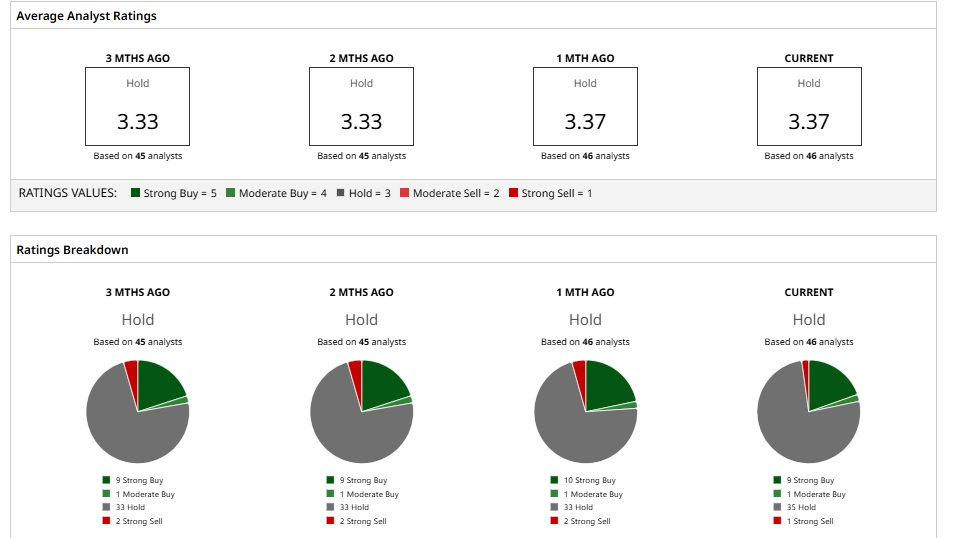
The analyst community seems divided, but most firms are staying on the sidelines. That’s why the consensus rating sits at “Hold.” But the price targets tell a different story.
Recently, Goldman Sachs slashed its target from $150 to $100. The firm kept a “Neutral” rating. It wants to see real foundry customer traction before getting more positive.
J.P. Morgan actually upgraded the stock to “Neutral” from “Underweight” in mid-October. The firm kept its $85 target. Analyst Harlan Sur said the risk-reward looks more balanced now that shares have pulled back 36% from June highs. He also credited CEO Lip-Bu Tan with improving execution in the core data center business.
BofA took the opposite path. Analyst Vivek Arya downgraded Intel to “Neutral” from “Buy” right after the Q3 print. He cut the target from $145 to $100. Arya said the turnaround is pushed out because of PC and supply headwinds. He also said Intel “has not communicated enough traction with external foundry customers.”
The average price target at all coverage is approximately $93.23. That means approximately a 64% upside based on the current price.
Furthermore, there was one important clue hidden within the CEO's recent trading activity. CEO Lip-Bu Tan bought $10 million worth of stock on the open market just days after the crash. He picked up 150,000 shares at prices between $64.70 and $64.74. That's not a ringing endorsement from Wall Street. But those are the words of faith from the person in the know.
On the date of publication, Nauman Khan did not directly have a position in any of the securities mentioned in this article. All information and data in this article is solely for informational purposes. For more information please view the Barchart Disclosure Policy here.