
Earnings Slip And Asset Sales Could Reshape Prudential Financial Stock
- Prudential Financial reported third quarter 2026 net income of US$1,388 million and diluted EPS of US$3.96, while also expanding its Group Insurance tools with the AI powered Claims Insight Assistant to simplify disability and absence claim management for employers.
- The planned sale of Prudential Financial’s Brazil and Mexico businesses for US$4.025b and ongoing share repurchases totaling 6,975,017 shares indicate a continued shift toward a more focused footprint and capital deployment approach.
- We will now look at how Prudential Financial’s weaker adjusted earnings alongside its Latin American exits could influence the broader investment narrative.
Prudential Financial Investment Narrative Recap
For Prudential Financial to make sense in a portfolio, you need to be comfortable with a story built around fee based businesses, disciplined capital use and a cleaner geographic footprint. The third quarter showed that picture is not linear. Net income and diluted EPS from continuing operations were slightly lower than a year ago, while adjusted earnings were weaker, so execution on efficiency and mix shift still matters a lot.
The most important near term swing factor remains how quickly core product areas, particularly retirement and PGIM, can offset the drag from the temporary sales suspension in Japan and the planned exits from Brazil and Mexico. The main risk is that softer premium momentum and a debt load that is not well covered by operating cash flow leave Prudential Financial with less room to absorb any unexpected slowdown.
The launch of the AI powered Claims Insight Assistant sits right in the middle of the current catalyst discussion. It is aimed at making disability and absence claim information easier for employers to digest, which can support Prudential Financial’s push toward capital light, fee oriented group benefits and better efficiency across the Group Insurance segment.
For you as an investor, the operational question is whether tools like this actually reduce friction and cost to serve, and help retain or win employers that value simpler claim handling. If Claims Insight Assistant improves the experience without adding risk to underwriting or compliance, it could quietly support the expense saving targets and strengthen one of the franchises that needs to pull more weight while Japan normalizes.
Prudential Financial's current analyst narrative points to revenues of US$60.6 billion and earnings of US$5.5 billion by 2029, based on a projected 2.4% yearly decline in revenue and an earnings increase of about US$1.6 billion from US$3.9 billion today.
Uncover why Prudential Financial's fair value indicates a 10% potential downside to its current price, leaving little room for error.
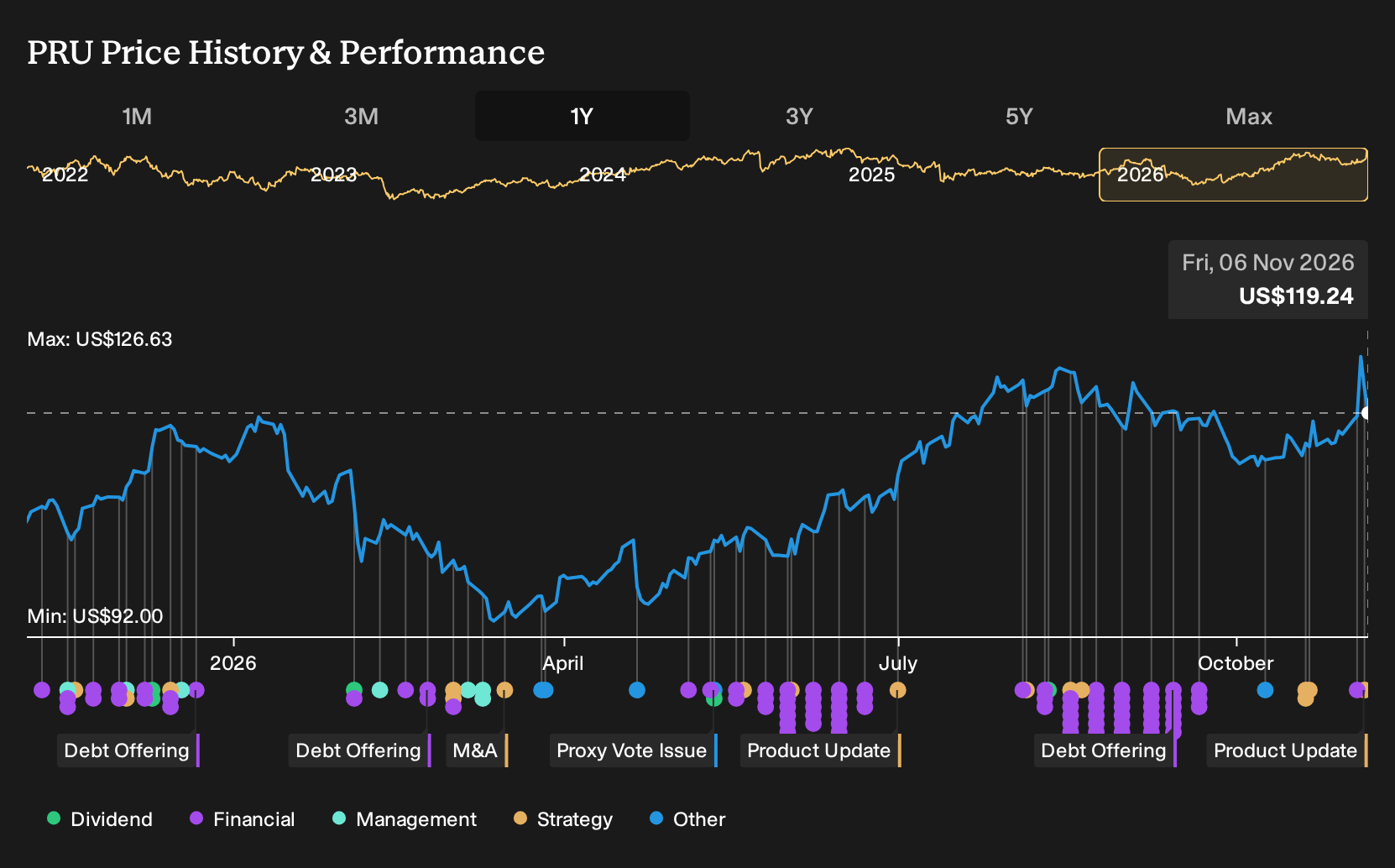
Exploring Other Perspectives
One alternate view puts very little weight on Prudential Financial’s AI tools and instead worries about how slow market exits and efficiency projects might play out. The most pessimistic analysts were working off revenue closer to US$55.5b and earnings of about US$5.2b by 2029. That is materially lower than consensus, so these forecasts could shift as the Claims Insight Assistant and Latin American exits feed into future models.
Explore 2 other Prudential Financial fair value estimates, including one that indicates there could be as much as 10% downside from the current price.
Decide For Yourself
Don't just follow the ticker. Dig into the data and build a conviction that's truly your own.
- A great starting point for your Prudential Financial research is our analysis highlighting 5 key rewards and 1 important warning sign that could impact your investment decision.
- See our latest analysis for Prudential Financial. The report includes a comprehensive fundamental analysis summarized in a single visual, the Snowflake, making it easy to evaluate Prudential Financial's overall financial health at a glance.
Looking for more investment ideas beyond Prudential Financial?
If Prudential Financial sits on your watchlist already, it can help to compare it with other businesses that match your risk, income, and quality preferences using the Simply Wall St Screener.
- If capital preservation is a priority, start with companies that score well on stability and balance sheet strength through a curated 31 resilient stocks with low risk scores.
- For investors who want income on top of potential price moves, scan a focused set of high yield opportunities screened as 7 dividend fortresses.
- If you prefer to hunt for quality that is still off most radars, broaden your search with a carefully filtered pool of 19 high quality undiscovered gems.
Have feedback on this article? Concerned about the content? Get in touch with us directly. Alternatively, email editorial-team@simplywallst.com