Citigroup Q3 holdings: Nvidia (NVDA.US) is still the number one heavy-duty stock index and technology stock options expand in both directions
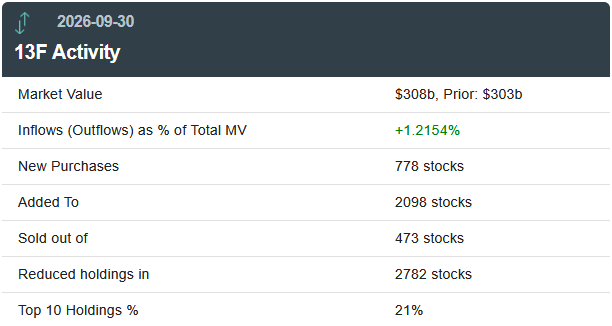
The Zhitong Finance App learned that according to the US Securities and Exchange Commission (SEC) disclosure, Citigroup (C.US) submitted a position report (13F) for the third quarter ending September 30, 2026 on November 4, 2026. Statistics show that the total market value of Citi's positions in the third quarter reached 308 billion US dollars, and the total market value of the previous quarter was 303 billion US dollars. Citi added 778 new shares to its portfolio in the third quarter and increased its holdings by 2,098 shares. Meanwhile, Citi reduced its holdings by 2,782 stocks and cleared 473 stocks. Among them, Citi's top ten holdings account for 21% of the total market value.
Top 5 major positions: Nvidia is at the top, and 5 out of the top 10 seats are eligible
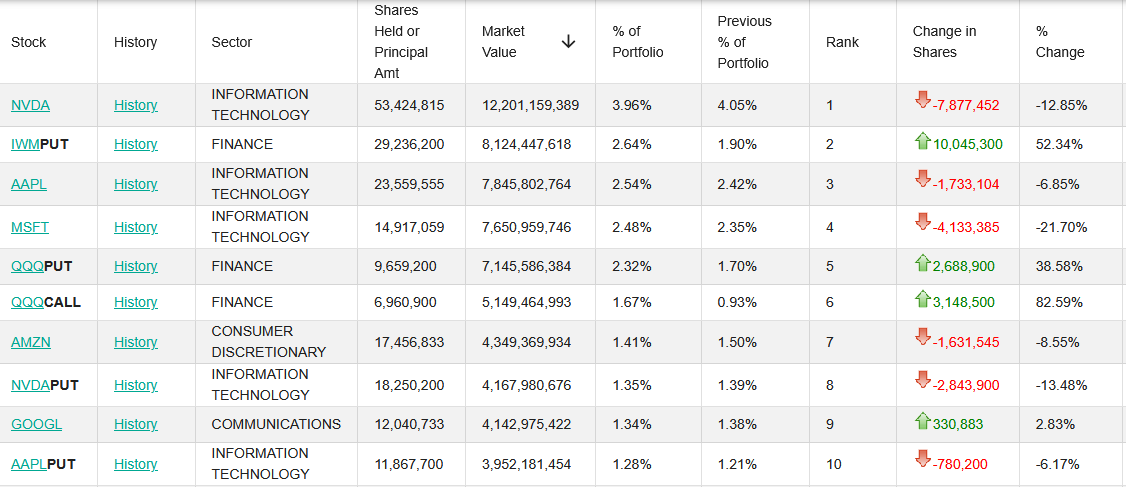
AI chip giant Nvidia (NVDA.US) ranked first, holding about 53.424,800 shares, with a market value of about US$12.201 billion, accounting for 3.96% of the portfolio. The number of holdings decreased by 12.85% compared to the previous quarter; it accounted for a decrease of 4.05% compared to the previous quarter.
The iShares Russell 2000 Index ETF (IWM.US, PUT) ranked second with a position of about 29.2362 million shares, with a position value of about US$8.124 billion, accounting for 2.64% of the portfolio. The number of positions increased by 52.34% over the previous quarter.
Consumer electronics giant Apple (AAPL.US) ranked third, holding about 235.596 million shares, with a market value of about 7.846 billion US dollars, accounting for 2.54% of the portfolio. The number of holdings decreased by 6.85% compared to the previous quarter; despite the reduction in the number of shares, its portfolio weight increased from 2.42% to 2.54%, reflecting the combined effects of changes in individual stock prices and the total market value of the portfolio.
Software and cloud computing giant Microsoft (MSFT.US) ranked fourth, holding about 149.171 million shares, with a market value of about 7.651 billion US dollars, accounting for 2.48% of the portfolio. The number of holdings decreased by 21.70% compared to the previous quarter; despite a 21.70% decrease in the number of shares, its portfolio weight increased from 2.35% to 2.48%, which also reflects the combined impact of changes in individual stock prices and total portfolio market value.
The Nasdaq 100 Index ETF (QQQ.US, PUI) ranked fifth, with a declared value of about US$7.146 billion, accounting for 2.32% of the portfolio, compared to 1.70% in the previous quarter; the number of declarations increased by 38.58% over the previous quarter.
Other heavy stocks ranked 6th to 10th were QQQ's bullish options (declared value of about US$5.149 billion, or 1.67%), e-commerce and cloud computing giant Amazon (AMZN.US) (approximately US$4.349 billion, or 1.41%), Nvidia's put options (approximately US$4.168 billion, or 1.35%), and Google's parent company Alphabet (GOOGL.US) Class A shares (approximately US$4.143 billion, or 1.34%). Apple's put options ranked 10th, with a declared value of about US$3,952 billion, or 1.28%.
Industry distribution: Mainly individual IT stocks, ETFs and their options occupy many seats
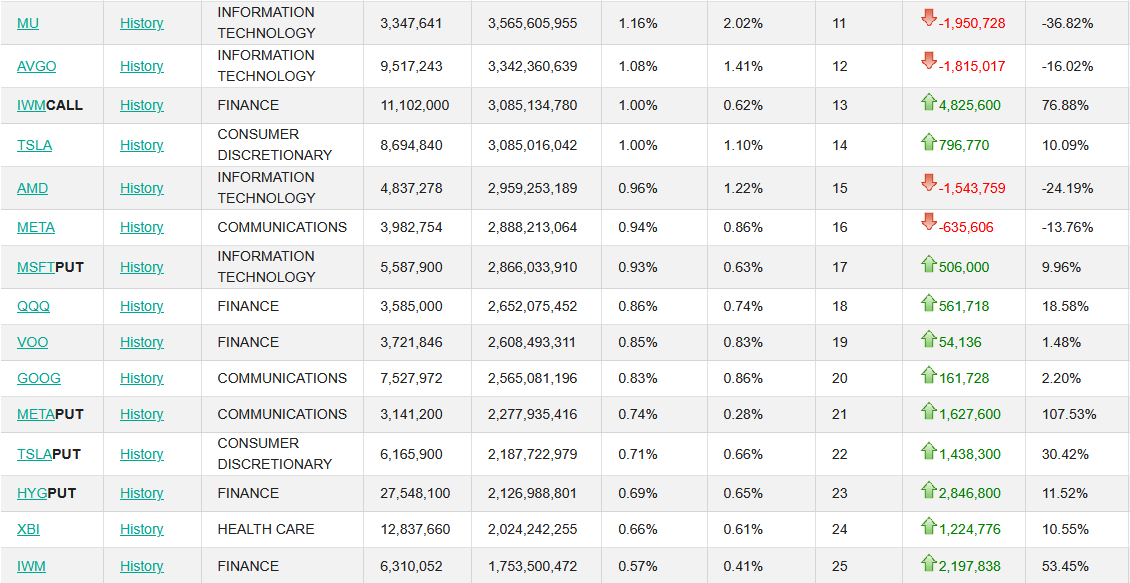
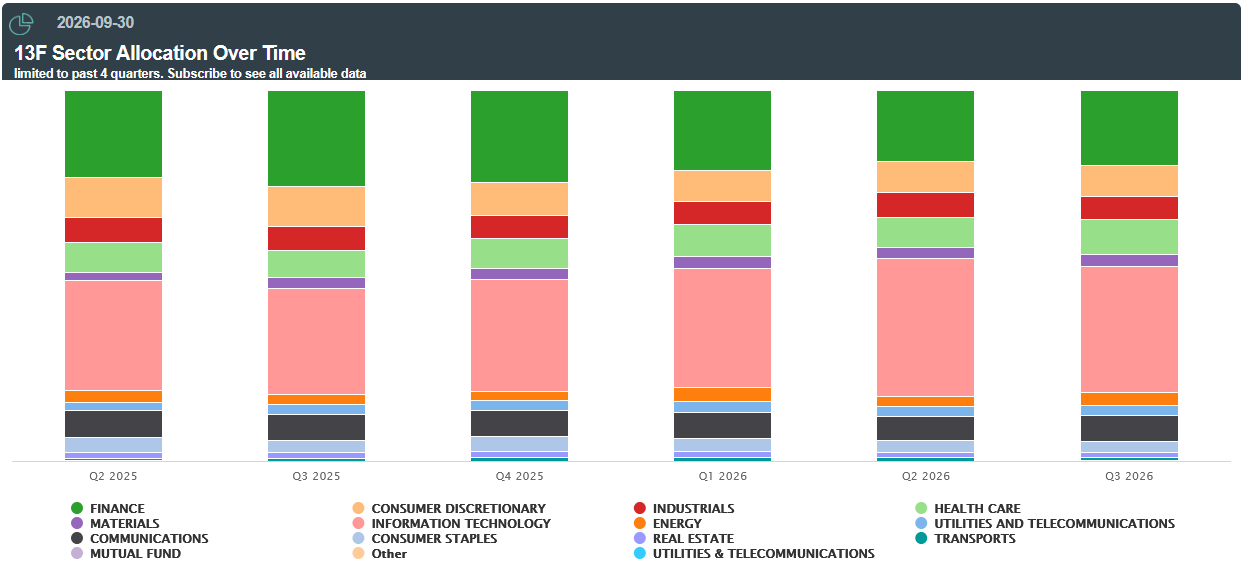
Judging from the position structure, Citi's direct shareholding is mainly in information technology companies. In addition to Nvidia, Apple, and Microsoft, memory chip maker Micron Technology (MU.US), semiconductor and infrastructure software company Broadcom (AVGO.US), chip design company AMD (AMD.US), semiconductor equipment manufacturer Applied Materials (AMAT.US), and KLA (KLAC.US) all rank in the top 20 positions.
The internet platform category includes Amazon, Alphabet, and social media giant Meta Platforms (META.US); electric vehicle manufacturer Tesla (TSLA.US) ranked 14th. At the same time, the combination holds a large number of broad-based indices and industry ETFs and their options. In addition to IWM and QQQ, they also include the S&P 500 ETF (VOO.US), SPDR S&P Biotech ETF (XBI.US), and the iBoxx High Yield Bond ETF (HYG.US). Vaneck Semiconductor ETF (SMH.US), iShares Semiconductor ETF (SOXX.US), and SPDR Gold ETF (GLD.US) are also among them.
Individual stocks and semiconductor ETFs in the semiconductor industry chain occupy multiple seats in the portfolio, and are the industry direction with the highest concentration of direct shareholding.
Options ledger: Put options account for 22.77% of the portfolio, and indices and technology stock options expand in both directions
Options are the most prominent structure in this season's filing portfolio. By the end of the third quarter, Citibank had declared a total of 533 put options, with a total declared value of about US$70.177 billion, accounting for 22.77% of the portfolio; 591 bullish options, with a total declared value of about US$29.016 billion, accounting for 9.41% of the portfolio.
The main components of the index and put options for large technology stocks: IWM's put option declaration value is about US$8.124 billion, QQQ is about US$7.146 billion, Nvidia is about US$4.168 billion, Apple is about US$3,952 billion, Microsoft is about US$2,866 billion, Meta is about US$2.288 billion, Tesla is about US$2,188 billion, and iBoxx high-yield bond ETF is about US$2,127 billion.
Looking at the direction of change, the number of bearish and bullish options increased simultaneously during the quarter: Meta's bearish and bullish option declarations increased by 107.53% and 245.82%, respectively, financial sector ETF (XLF.US) put options increased by 121.83%, 20-year US bond ETF (TLT.US) call options increased by about 388%, and the declared value of applied materials' put options increased to about US$349 million.
Other types of option positions have shrunk markedly: Vaneck Semiconductor ETF's put option claims decreased by 89.36%, Micron's put options decreased by 50.67%, GLD's call options decreased by 91.04%, and Apple's and Microsoft's call options decreased by 74.31% and 54.51%, respectively.
IWM and QQQ's common stock, put option, and call option positions existed simultaneously, and both types of options increased significantly during the quarter. This type of structure may include arrangements for hedging or volatility trading purposes, but specific strategies cannot be confirmed from 13F.
13F only discloses reportable positions that meet filing requirements, and does not disclose stocks and option shorts; the value and quantity of option entries must be verified in accordance with the SEC's current filing rules, and cannot be directly interpreted as the nominal value of the premium or subject without verification. 13F also does not disclose the option exercise price, expiration date, and quarterly trading process. Therefore, relevant analysis can only describe positions that can be observed at the time of declaration, and cannot restore the complete strategic structure or confirm the institutional trading intention based on this.
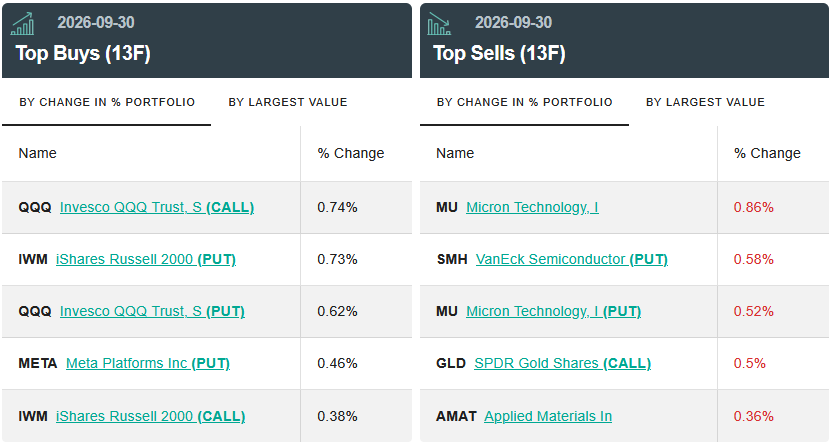
Judging from changes in position ratio, Citi's top five buying targets are: QQQ's call options, IWM's put options, QQQ's put options, Meta's put options, and IWM's call options. All of the top five major buying targets are futures options.
The top five selling stocks are: Micron Technology (MU.US), Vaneck Semiconductor ETF's put options, Micron's put options, GLD's call options, and applied materials (AMAT.US).