
3 Stocks Retail Investors Are Watching For Corporate Crisis Management Demand
A single investigation into Nvidia CEO Jensen Huang has suddenly put corporate governance, crisis playbooks, and boardroom discipline back in the spotlight. Markets are now weighing not just chip demand, but also who controls the story when leadership risk and geopolitics collide. This article breaks down three stocks tied to this news shock, outlining where some investors may see potential upside and where caution might be warranted.
The three stocks that follow are only a sample of what this governance and crisis playbook theme turns up, and the full Simply Wall St screen has uncovered 8 more companies with equally compelling business descriptions that are not covered in this article. To go deeper into this idea, analyze, compare, and identify potential high-conviction angles directly inside the Corporate Governance and Crisis-Management Service Providers screener.
Sprout Social (SPT)
Overview: Sprout Social provides an AI powered, cloud based platform that helps organizations manage social media messaging, analytics, and crisis communications across channels.
Operations: Sprout Social generates about US$491 million from internet software and services, with roughly US$392 million from the Americas and US$76 million from EMEA.
Market Cap: US$651 million
Sprout Social matters in this governance focused screen because its tools sit directly in the workflow for crisis communications and shareholder messaging, and the analyst consensus Narrative on Simply Wall St argues that its AI driven governance features could be increasingly important for regulated, risk conscious customers.
"Launches of AI powered compliance and governance style capabilities, such as Trellis based insights into social data supported by 16 years of network native data access, are still expected to widen Sprout Social's role with regulated and risk conscious customers and to sustain premium pricing that supports gross margin and earnings."
The real swing factor is how one pressure on the business model shapes future pricing power and the sustainability of those margins.
That pricing power question is exactly what sits at the heart of the full narrative for Sprout Social, where the focus is on how crisis tooling and governance demand could be decoupling from short term sentiment.

Vector (TSE:6058)
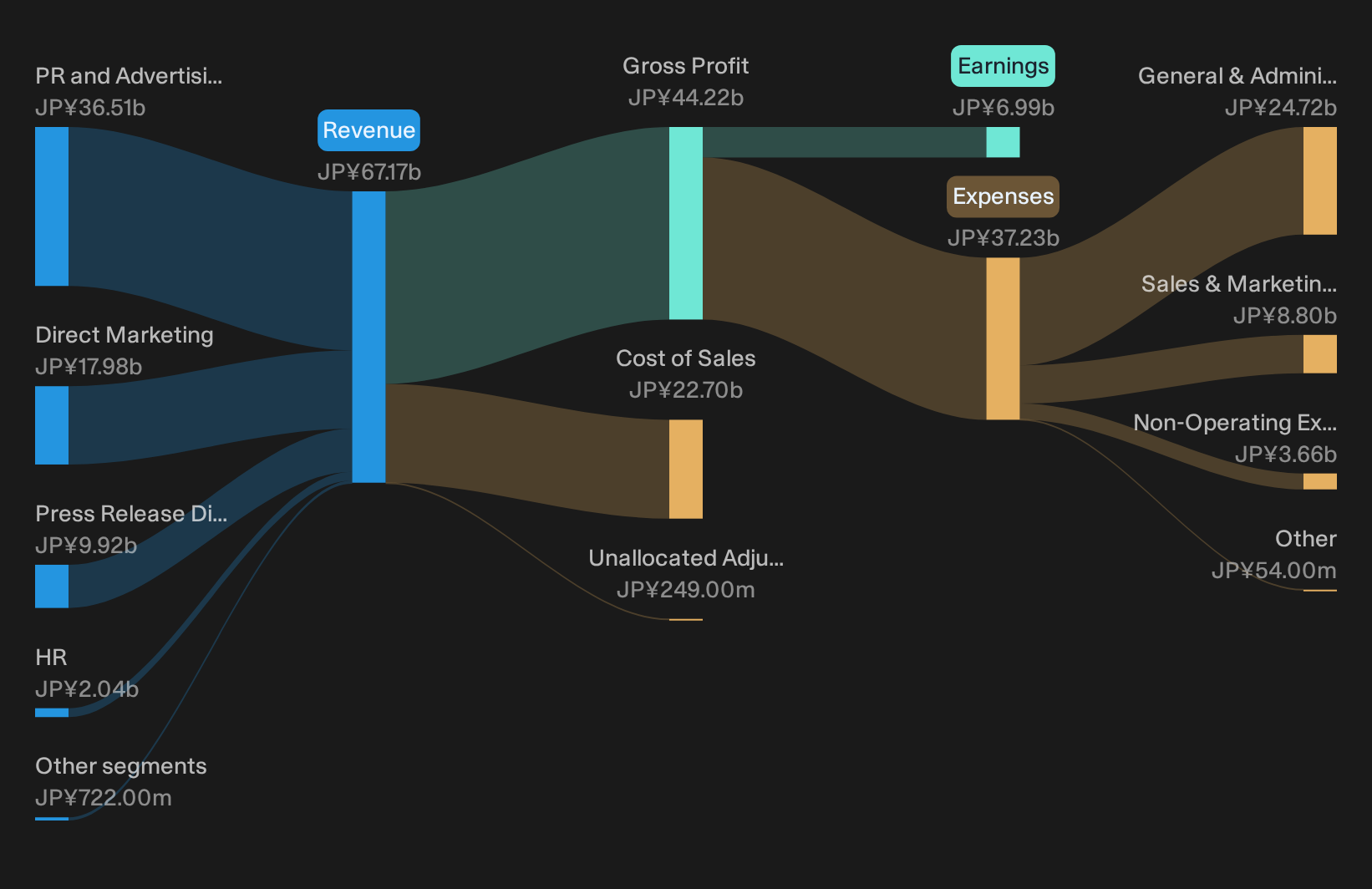
Overview: Vector provides PR, advertising, investor relations support, and crisis communication services for corporates across Japan, China, and overseas markets.
Operations: Vector generates approximately ¥36,510 million from PR and Advertising, ¥17,982 million from Direct Marketing, and ¥9,921 million from Press Release Distribution, almost entirely in Japan.
Market Cap: ¥95.9 billion
Vector provides direct exposure to corporate communications and governance messaging in Japan by combining PR, investor relations support, and risk management services in a single listed vehicle. Earnings growth, a 10.4% net margin, and a 26.2% ROE indicate that this communications platform is positioned to help clients manage reputational shocks. Outcomes will depend on how an unseen pressure shapes what boards are willing to pay for reassurance when the next crisis occurs.
That unseen pressure is exactly what the 2 key rewards and 1 important warning sign is built to unpack so you can judge whether Vector's crisis premium still looks underappreciated.
Robert Half (RHI)
Overview: Robert Half connects companies with skilled contract and permanent professionals and offers Protiviti consulting for regulatory, risk and governance challenges.
Operations: Robert Half generates about US$3.44b from Contract Talent Solutions, US$1.9b from Protiviti, and US$447 million from Permanent Placement Talent Solutions, partly offset by intersegment eliminations.
Market Cap: US$4.21b
Robert Half fits this governance and crisis-management screen because Protiviti supports clients on risk, compliance and board-level control questions. In addition, the analyst consensus Narrative on Simply Wall St frames that capability as a potential beneficiary when leadership shocks push corporates to tighten oversight.
"As businesses continue investing in digitization and business transformation, including technology modernization, AI readiness, ERP upgrades and cybersecurity, the demand for skilled technology and finance talent at Robert Half is expected to support higher placement volumes and future revenue growth."
The real tension for Robert Half is how one unresolved shift in its mix of consulting work ultimately shapes margins as governance demand evolves.
That unresolved shift is exactly what the full narrative for Robert Half unpacks, revealing where governance demand, mix changes and crisis driven hiring could be masking Robert Half's next gear.

Seeking Fresh Alternatives Before They Fly
Fresh governance stories keep breaking, and the most interesting candidates often move first. Catch potential breakout momentum while it matters, under the radar for now, and get in early.
- Spot early movers that combine smaller size with stronger balance sheets by scanning the curated 10 elite penny stocks with strong financials before the crowd starts chasing the same tickers.
- Front run the next wave in machine learning infrastructure by reviewing the hand picked 53 AI infrastructure stocks while attention is still caught on the biggest headline stocks.
- Position ahead of potential demand shifts in electrification by checking the focused 16 top copper producer stocks while the cycle story is still forming and pricing remains in flux.
Have feedback on this article? Concerned about the content? Get in touch with us directly. Alternatively, email editorial-team@simplywallst.com