
Should Earnings Beat Require Action From KKR (KKR) Investors?
- KKR & Co. Inc. reported net income of US$1,161.61m for the third quarter and US$2,267.32m for the nine months ended September 30, 2026, both above the prior year levels.
- The earnings update arrives alongside a potential sale of STT GDC India and a new board appointment with risk expertise. Together, these developments highlight how KKR is juggling capital recycling, data infrastructure exposure and governance depth.
- We will now look at how KKR's stronger third quarter net income shapes the longer term investment narrative already outlined above.
Scan how KKR's data infrastructure moves compare with peers by jumping into a curated list of 53 AI infrastructure stocks shaping the next leg of digital capacity buildout.
KKR Investment Narrative Recap
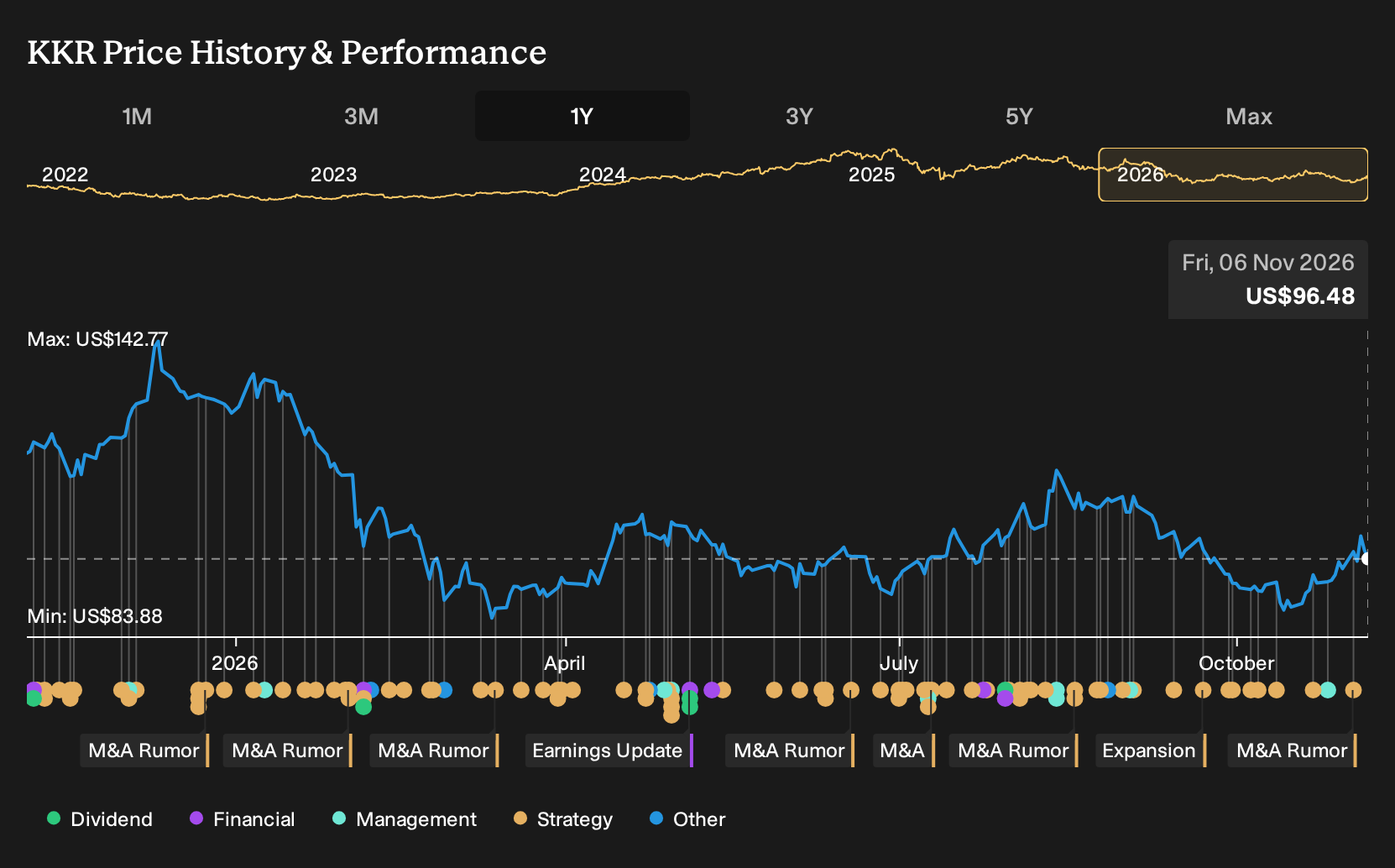
To own KKR, you need to be comfortable with a global alternatives platform that leans heavily on fee based earnings, insurance income and a large pool of long dated capital. According to kapirey, an investor in the Simply Wall St Community, the appeal rests on recurring profit streams rather than one off deal exits. The latest quarter’s higher net income and stronger net margins support that focus on profitability, while the short term share price, which has fallen about 19% over the past year, still reacts to sentiment around credit markets and fundraising.
The near term swing factor remains how consistently KKR can convert its sizeable assets under management into fee related earnings and insurance operating profit as conditions move around it. The biggest operational risk is that weaker capital markets or credit stress slow deployments or pressure fee pools, which could matter more than one quarter’s US$1,161.61m profit print. Recent results do not remove that risk, although they show the business is currently generating higher income than a year ago.
The most relevant recent update is the third quarter earnings release, which reported net income of US$1,161.61m for the quarter and US$2,267.32m for the first nine months of 2026. For an investor tracking catalysts, this confirms that KKR is currently converting its model into accounting profit, with earnings up compared to the same periods last year and net profit margins higher than a year ago at 11.6% versus 9.3%. That sits alongside data showing earnings grew 49.6% over the past year and are forecast, by analysts, to grow about 21.5% a year.
For a stock that has declined about 25% year to date and underperformed the broader US market over twelve months, this profit momentum is important because it shapes how you judge valuation and execution risk. KKR trades on a P/E of 29x, above its estimated fair P/E of 21.3x but below the US capital markets average of 36.3x, and some models see the shares around 22% below estimated future cash flow value. How you weigh those figures against the earnings trajectory and credit related uncertainties will likely drive your view on the next leg for the business.
Based on kapirey’s numbers, the KKR memo estimates a fair value of US$84.45 per share, using a model that assumes revenue increasing 7.0% per year and profits eventually stabilizing at a 13.0% margin on that larger fee and insurance base.
Uncover why KKR's fair value indicates a 12% potential downside to its current price, which leaves little room for error.
Exploring Other Perspectives
One alternate angle focuses less on credit risk and more on whether KKR’s asset management and private wealth expansion can really deliver the earnings some analysts expect. The lowest forecasters were already pencilling in revenue of about US$10.4b and earnings of US$6.2b by 2029. Those targets looked ambitious before this quarter’s news and may now be revisited.
Explore 5 other KKR fair value estimates, including one that suggests as much as 12% downside from the current price.
Form Your Own Verdict
Don't just follow the ticker; dig into the data and build a conviction that's truly your own.
- A great starting point for your KKR research is our analysis highlighting 4 key rewards that could impact your investment decision.
- See our latest analysis for KKR. The report includes a comprehensive fundamental analysis summarized in a single visual, the Snowflake, making it easy to evaluate KKR's overall financial health at a glance.
Looking for more KKR investment ideas?
If you want to stress test your view on KKR against other opportunities, it can help to scan a broader field of stocks with different risk and income profiles using the Simply Wall St Screener.
- For investors hunting for mispriced quality, compare KKR with a curated group of 40 high quality undervalued stocks that pair solid fundamentals with more modest expectations baked into the share price.
- If capital preservation ranks high on your list, weigh KKR alongside a 31 resilient stocks with low risk scores that screens for businesses with more resilient profiles and fewer financial red flags.
- Income focused readers can line up KKR against a selection of 7 dividend fortresses that aim to combine higher yields with durable payout potential.
Have feedback on this article? Concerned about the content? Get in touch with us directly. Alternatively, email editorial-team@simplywallst.com