
Rocket Lab (NASDAQ:RKLB) reports bullish Q3 2026, guides for strong sales next quarter

Aerospace and defense company Rocket Lab (NASDAQ:RKLB) reported Q3 2026 results exceeding the market’s revenue expectations, with revenue up 72.7% year on year to $267.8 million. In addition, next quarter’s revenue guidance ($280 million at the midpoint) was surprisingly strong and 5.1% above analysts’ consensus estimates. Its GAAP loss of $0.12 per share was 80.6% below analysts’ consensus estimates.
For more on Rocket Lab, read our full research report, available free.
Rocket Lab (RKLB) Q3 2026 highlights:
- Revenue $267.8 million vs S&P analysts’ consensus estimates of $258 million (72.7% year-on-year growth, 3.8% beat)
- EPS (GAAP) -$0.12 vs analysts’ consensus estimates of -$0.07 (80.6% miss)
- Adjusted EBITDA -$18.05 million (-6.7% margin, 31.3% year-on-year growth)
- Revenue guidance $280 million at the midpoint for Q4 2026, above analysts’ consensus estimates of $266.4 million
- EBITDA guidance $17 million at the midpoint for Q4 2026, above analysts’ consensus estimates of -$12.62 million
- Adjusted EBITDA margin -6.7%, up from -16.9% in the same quarter last year
- Free cash flow -$23.92 million compared to -$69.44 million in the same quarter last year
- Market capitalization $31.76 billion
Rocket Lab founder and CEO Sir Peter Beck says: “Q3 2026 was a defining quarter for Rocket Lab. We delivered a record $268 million in revenue ($34 million higher than Q2 2026) alongside a record backlog which has grown to $3.57 billion. Nearly $1 billion of that backlog comes from new launch contracts, signed in Q3 2026 alone, as well as $470 million signed for Space Systems. Our end-to-end space strategy is delivering exactly as designed: the world's most critical and ambitious missions increasingly rely on Rocket Lab for launch, spacecraft, and components, sometimes all on a single mission, and every part of our business is growing as a result.”
Revenue growth
A company’s long-term revenue performance is one signal of its overall quality. Even a bad business can perform well for one or two quarters, but a top-tier one grows for years. Over the last five years, Rocket Lab grew its revenue at a strong 77.2% compounded annual growth rate. Its growth beat the average industrials company and shows its offerings resonate with customers.
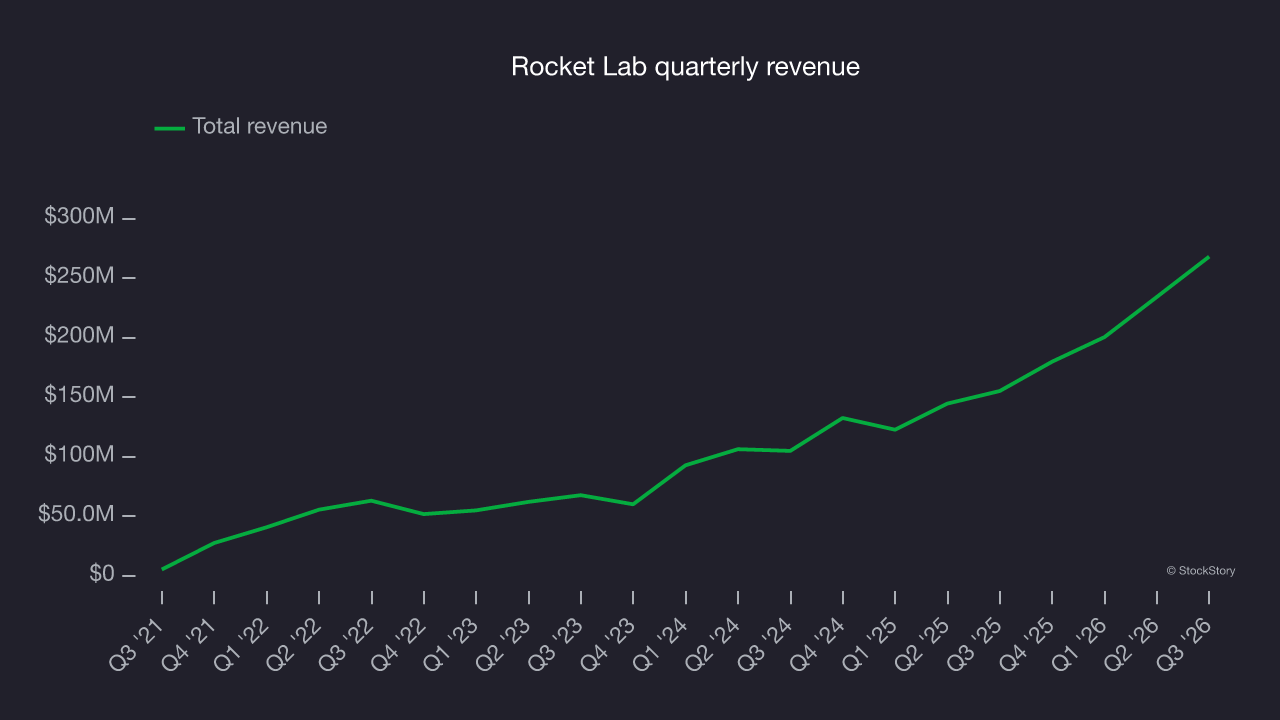
Long-term growth is the most important, but within industrials, a half-decade historical view may miss new industry trends or demand cycles. Rocket Lab’s annualized revenue growth of 55.7% over the last two years is below its five-year trend, but the results still suggest healthy demand. 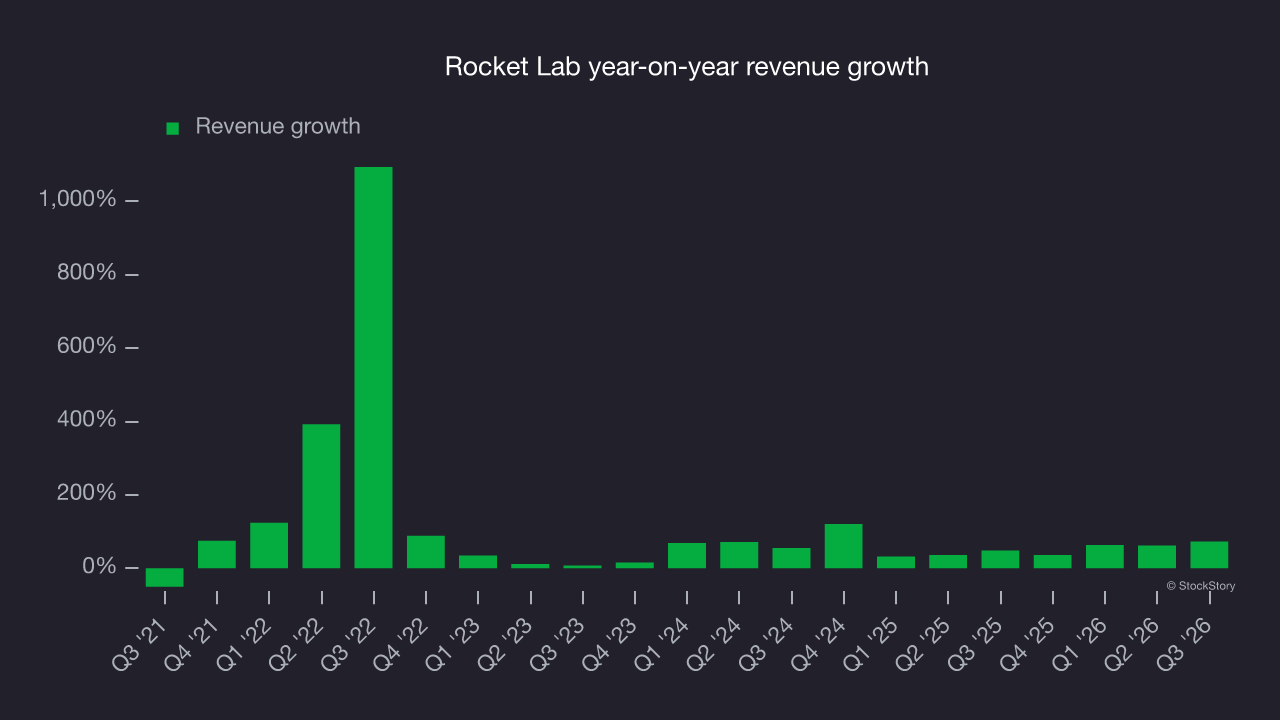
This quarter, Rocket Lab reported strong year-on-year revenue growth of 72.7%, and its $267.8 million of revenue beat Wall Street’s consensus estimates by 3.8%. Management is guiding for a 55.9% year-on-year increase in revenue next quarter.
Looking further ahead, sell-side analysts expect revenue to grow 38.1% over the next 12 months, according to S&P, a deceleration versus the last two years. Despite the slowdown, this projection is healthy and indicates the market expects success for its products and services.
Operating margin
Operating margin is one of the best measures of profitability because it tells us how much money a company takes home after procuring and manufacturing its products, marketing and selling those products and, most importantly, keeping them relevant through research and development.
Over the last five years, Rocket Lab’s operating margin rose by 37.9 percentage points. This improvement shows its costs declined relative to revenue. Its trailing 12-month operating margin was negative 27.6%.
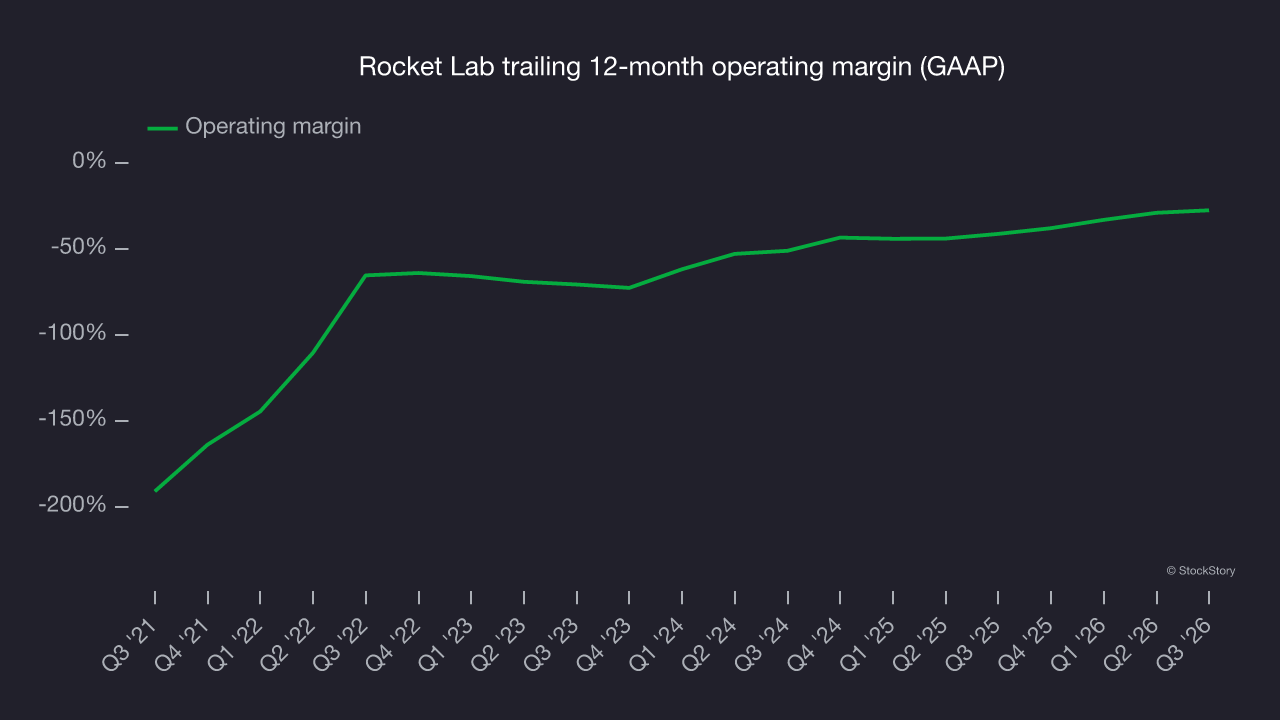
Rocket Lab’s operating margin was negative 29.6% this quarter.
Earnings per share
Revenue trends explain a company’s historical growth, but the long-term change in earnings per share, or EPS, points to the profitability of that growth. For example, a company could inflate its revenue through excessive spending on advertising and promotions.
Although Rocket Lab’s full-year earnings are still negative, it reduced its losses and improved its EPS by 18.4% annually over the last five years. The next few quarters will be critical for assessing its long-term profitability.
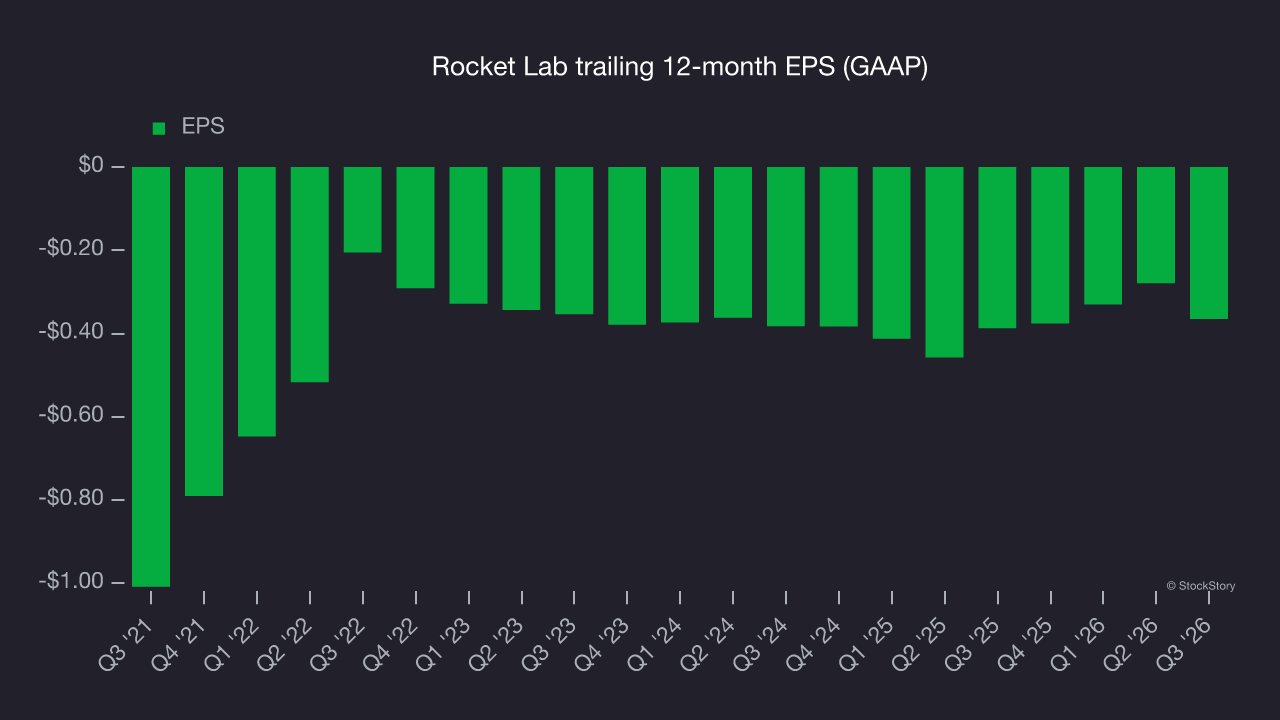
As with revenue, analyzing EPS over a shorter period can reveal changes in the business.
For Rocket Lab, its two-year annual EPS growth of 2.3% was lower than its five-year trend. This was underwhelming, but the company performed well on other measures of financial health.
In Q3, Rocket Lab reported EPS of negative $0.12, down from negative $0.03 in the same quarter last year. This result missed analysts’ consensus estimates. Over the next 12 months, Wall Street expects Rocket Lab to narrow its losses. Analysts forecast its full-year EPS will improve from negative $0.37 to negative $0.12, according to S&P.
Key takeaways from Rocket Lab’s Q3 results
Rocket Lab posted a decent Q3, with EBITDA beating Wall Street’s consensus estimates by a wide margin but EPS falling short. Its strong EBITDA guidance for next quarter also came in well ahead of analysts’ consensus estimates. Investors were likely hoping for more, as shares fell 3.8% to $56.48 immediately after the results.
Is Rocket Lab an attractive investment at its current price? When making that decision, it’s important to consider its valuation, business quality and latest quarterly results. For more on Rocket Lab, read the full research report here (it’s free).