
14x PE is not cheap! Well-known wealth management CEOs warn: if Nvidia (NVDA.US) profits are lowered by 5%, the stock price may drop by 40%
The Zhitong Finance App learned that since reaching an all-time high on October 6, the market value of Nvidia (NVDA.US) has evaporated by nearly 1.4 trillion US dollars. According to statistics, the sell-off wave on November 5 alone erased the market value of about 450 billion US dollars. On the same day, Nvidia plummeted by more than 9%, and Broadcom (AVGO.US) fell by more than 10%.
The trigger for this round of sell-off came from changes in Washington's politics. The Democratic Party took control of both houses of Congress, and candidates from both parties opposed AI data centers during the election campaign — this kind of computing power facility is the core application scenario for Nvidia chips.
Today, many investors think Nvidia's valuation is cheap enough. However, in an interview on November 6, Josh Brown, CEO of Ritholtz Wealth Management, questioned the “14 times price-earnings ratio is a bargain” and warned: “If Nvidia's profit falls 5% from our expectations in the next 12 months, the stock is likely to fall 40%.”
At the same time, he confessed, “This is the scenario I deduced, but this decline is indeed possible.” Simply put, for every 1 percentage point reduction in profit, the corresponding share price falls by 8 percentage points.
The valuation is cheap, and there is a reason
Brown's argument began with large companies that are taking advantage of the AI boom, including Broadcom and Nvidia. Over the past year, their valuation multiples have continued to shrink: “Valuation compression has been drastic. The only reason why the stock price did not collapse is that profit growth outperformed the rate of valuation contraction.”
Nvidia's earnings are indeed growing rapidly. Analysts forecast that the company's adjusted earnings per share for fiscal year 2027 (ending January 2027) would be $9.31, $15.91 in fiscal 2028, and $21.34 in fiscal 2029. Earnings forecasts for the 2028 fiscal year alone have been raised 25% since the end of June.
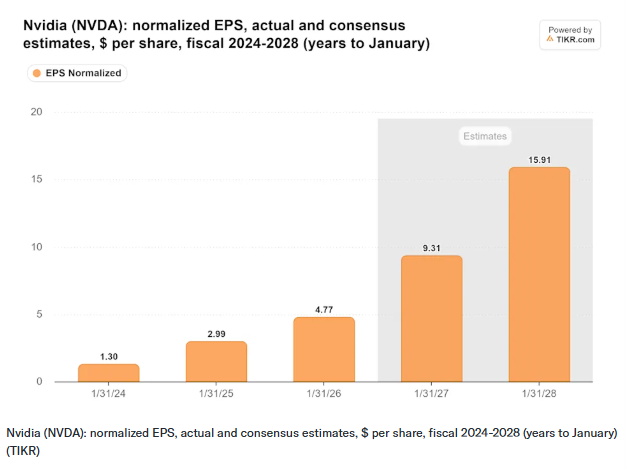
But the valuation multiples went in the opposite direction. On November 5, Nvidia's forward price-earnings ratio fell to 15 times, at the bottom of the nearly three-year range, only half of the 30 times long-term average.
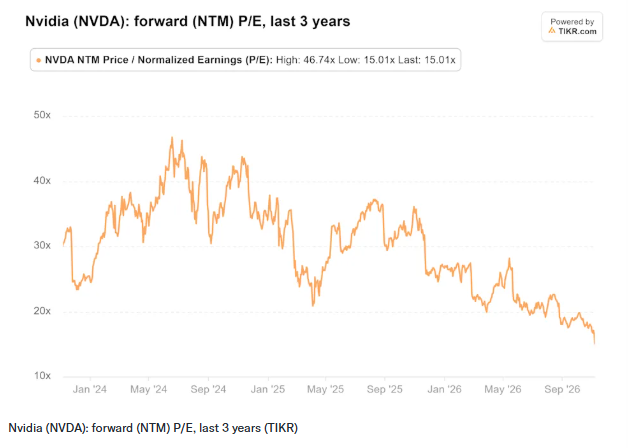
Brown's interpretation is that the market does not believe that this round of high growth will continue until 2027 and 2028. The 15 times price-earnings ratio confirms this judgment: investors have already accepted that the pricing given to Nvidia's profits for the next two years is the peak of performance. Consistent market expectations also indicate that revenue growth will fall back from 68.2% in FY2028 to 30.5% in FY2029.
How could there be a 40% drop?
Under the premise of 15 times forward PE, if the valuation remains unchanged, a 5% reduction in earnings will only drive the stock price down 5%. To achieve a 40% decline, the valuation multiplier would need to be simultaneously reduced to about 9.5 times (calculation: 15 × 0.6 ÷ 0.95).
According to statistics, Nvidia's quarterly forward price-earnings ratio data can be traced back to 2014, and it has never fallen below 14 times in history.
Therefore, for Brown's projected 40% drop to come true, it is not enough to slightly lower profit expectations; investors also need to agree that Nvidia's growth will come to a standstill after fiscal year 2028.
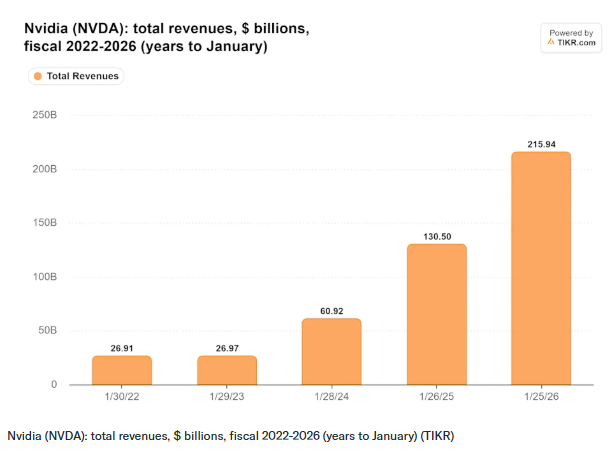
Nvidia investors have not experienced a slowdown in growth. In fiscal 2023, the company's revenue remained flat at $27 billion, and GAAP operating margin fell from 37.3% to 15.7%. As the AI wave exploded, revenue doubled eight times over the next three years to reach US$215.9 billion.
Venture capitalist Tomasz Tunguz believes history is likely to repeat itself. He said in a program that the current phenomenon of chips being piled up in warehouses is the root cause of insufficient electricity supply to support computing power deployment. He warned: “At a certain point, Nvidia's order growth will come to a standstill, simply because the US does not have sufficient conditions to implement these computing power; at that time, the relevant individual stocks will experience a severe impact.”
Once the dust settles on the general election, this concern is even harder to ignore. In fiscal year 2026, Nvidia's revenue from customers in the US was $149.6 billion, accounting for 69.3% of total revenue.
FY2028 itself is not a source of risk
In the short term, earnings may not necessarily decline over the next 12 months. The company indicated a 70% year-on-year increase in revenue for fiscal year 2028, and said that the upper supply limit is the core factor limiting revenue; at the same time, demand forecasts given by customers show that there is still room for growth to double. Nvidia's revenue has exceeded the guideline limit for the past three quarters.
On November 5, Jim Cramer, a well-known financial presenter, gave the logic of watching more on his program: if Nvidia's performance is just in line with expectations, “this stock with a 70% growth rate is less than 12 times the valuation corresponding to next year's profit.” The market's unanimous expectations also supported this judgment of the growth rate: earnings per share rose from $9.31 to $15.91, an increase of just 71%.
Cramer also added the risk premise: “But if growth completely stalls next year, then it won't be cheap — provided the US is approving new data centers at a pace that doesn't keep up with the current pace.”
According to Brown, the risk-return on this deal is indeed asymmetrical. However, cutting earnings by 5% next year alone will not knock Nvidia down 40%; what can actually trigger this level of decline is the downturn in earnings expectations for fiscal year 2029, which is the time window that Cramer and Tunguz are both concerned about. Currently, 15 times PE has been priced to a large extent this serious concern. As long as the performance guidelines for fiscal year 2028 remain unchanged, this undervaluation itself forms a buffer.
Of course, the first test will be on November 17 EST. Nvidia will release its three-quarter report. The company previously gave a revenue guidance range of 108 billion US dollars, fluctuating 2% up and down. Compared to the single-quarter results, management's statement on fiscal year 2028 and whether data center customers in the US have begun to reduce orders may be more critical points.