
Chugoku Electric Power (TSE:9504) Could Be 27% Overvalued After Guidance And Dividend Lift
Chugoku Electric Power (TSE:9504) has moved into focus after lifting its earnings guidance for the year to March 2027 and raising dividend forecasts under a new dividend on equity framework.
The raised guidance and richer dividend outlook come on the back of a strong run, with Chugoku Electric Power’s 30 day share price return of 9.01% and 90 day gain of 20.25%. This points to building momentum from investors who are reassessing its earnings power and dividend profile.
See how Chugoku Electric Power’s dividend decision compares with other income-focused utilities by reviewing the hand picked 27 dividend fortresses currently available in the market.
After a 20.25% move over 90 days and richer dividend guidance, the real question on Chugoku Electric Power is simple: Is meaningful upside still ahead, or has most of the opportunity already been priced in as valuation now suggests?
Preferred Price-to-Sales of 0.3x: Is it justified?
On current data, Chugoku Electric Power trades on a P/S of 0.3x, which sits in line with its estimated fair P/S of 0.3x and below the broader Asian electric utilities average of 0.9x. Against a last close of ¥1,101.5 and with the shares already ahead of some analyst and cash flow estimates, the valuation signal from revenue multiples is restrained rather than euphoric.
The P/S ratio compares the market value of the equity to annual sales, so it tells you how much investors are paying for each unit of revenue. For a utility group like Chugoku Electric Power, where earnings can be influenced by fuel costs, regulation, and hedging, looking at sales instead of profit gives a cleaner read on how the market values the underlying franchise.
Here the picture is clear. The stock trades at a steep discount to the Asian electric utilities industry average P/S of 0.9x. This suggests investors value Chugoku Electric Power’s revenue stream materially lower than regional peers. Yet the current P/S sits exactly at the estimated fair P/S of 0.3x. This strongly signals that, based on Simply Wall St’s fair ratio work, the valuation multiple is already at a level the market could reasonably move around rather than away from.
Explore the SWS fair ratio for Chugoku Electric Power.
Result: Price-to-Sales of 0.3x (ABOUT RIGHT)
Still, Chugoku Electric Power faces real pressure from its recent share price strength relative to some analyst targets, as well as from ongoing losses at the net income line.
Find out about the key risks to this Chugoku Electric Power narrative.
Another View: SWS DCF model points to a richer price
While the market is paying roughly a fair 0.3x P/S for Chugoku Electric Power, the SWS DCF model tells a different story. At ¥1,101.5, the shares trade materially above an estimated future cash flow value of ¥869.08, which implies less of a margin for error if expectations wobble.
For investors who want to see how this cash flow view is built from the ground up, Look into how the SWS DCF model arrives at its fair value.
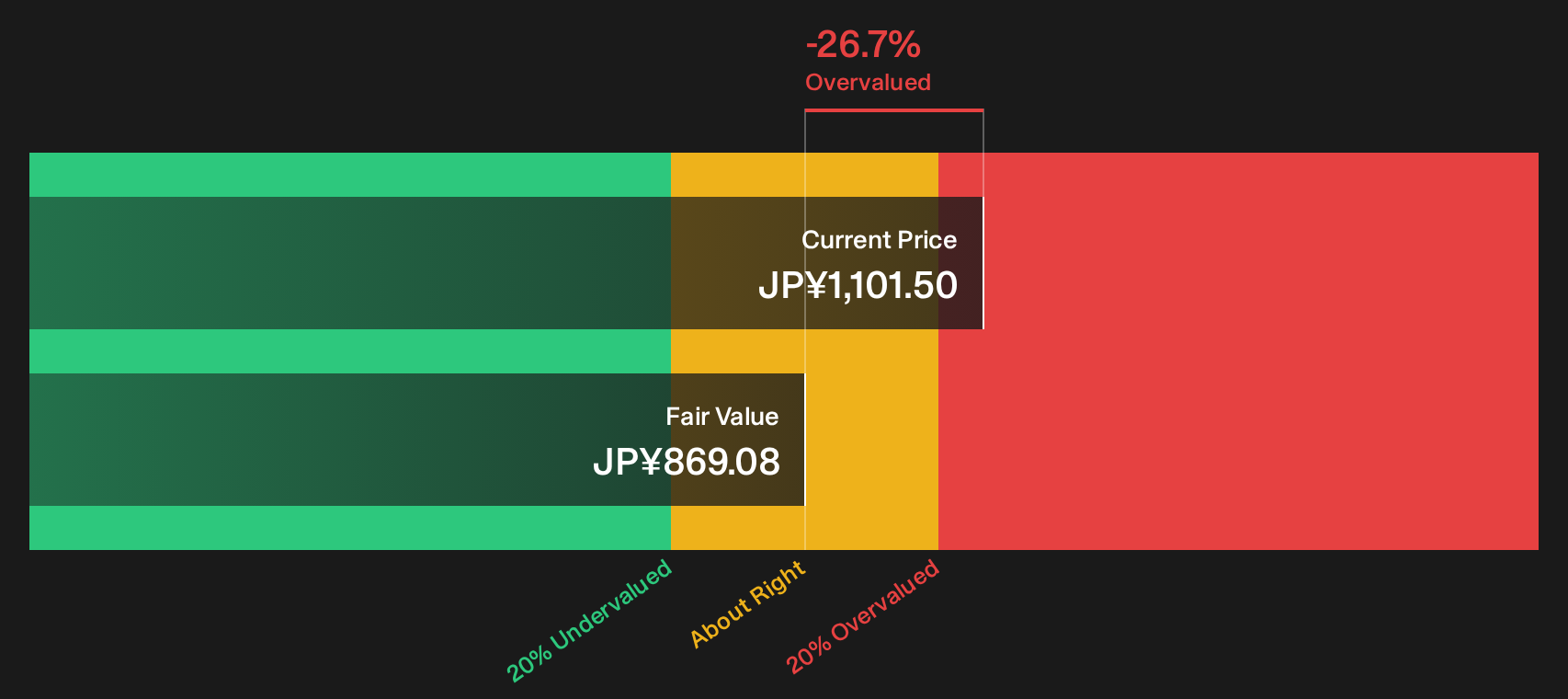
Simply Wall St performs a discounted cash flow (DCF) on every stock in the world every day (check out Chugoku Electric Power for example). We show the entire calculation in full. You can track the result in your watchlist or portfolio and be alerted when this changes, or use our stock screener to discover 20 high quality undervalued stocks. If you save a screener we even alert you when new companies match - so you never miss a potential opportunity.
Next Steps
Mixed signals on Chugoku Electric Power so far, right. If you want to move quickly and decide where you stand, start by weighing its 2 key rewards and 3 important warning signs
Looking for more investment ideas beyond Chugoku Electric Power?
If you stop your research with Chugoku Electric Power, you risk missing other opportunities that may better fit your goals, risk comfort, and income needs.
- Target reliable payers by scanning a curated pool of income heavyweights using the 27 dividend fortresses.
- Hunt for quality at a discount by reviewing the 20 high quality undervalued stocks, which combines strong fundamentals with appealing pricing.
- Prioritise resilience by focusing on companies with strong financial footing through the list of solid balance sheet and fundamentals (23 results).
Have feedback on this article? Concerned about the content? Get in touch with us directly. Alternatively, email editorial-team@simplywallst.com