The $325 target price sends a strong bullish signal! Bernstein backs up Oracle (ORCL.US): AI business value may be seriously underestimated
The Zhitong Finance App learned that investment bank Bernstein said in a newly released research report that as investors' concerns about artificial intelligence (AI) may disrupt the software industry increase, the bank believes that Oracle (ORCL.US) should be one of the targets investors focus on, because the company has both an AI data center business and a core database business, and the latter is also expected to become a beneficiary of AI development.
Bernstein stressed that Oracle has always been the most controversial stock within the bank's coverage, and it is also the stock that investors actively call for inquiries among the companies it covers. Investors have seen the potential value of the stock, but are still trying to determine how likely and when this potential will be realized.
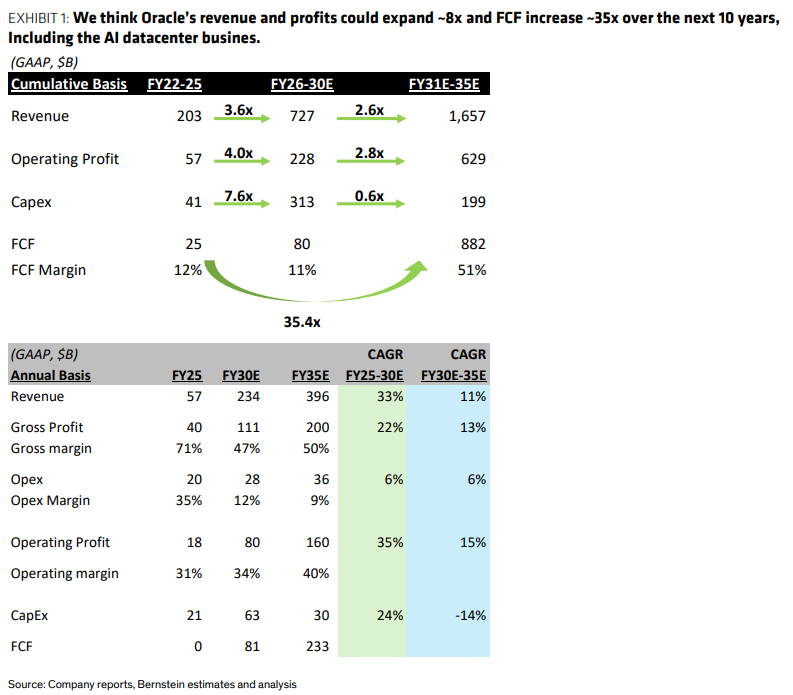
However, Bernstein believes the market's perception of Oracle will change as more data verifies the quality of its business. The bank said that the economic benefits of Oracle's business were actually better than its previous expectations. The bank also updated Oracle's financial model for the next 10 years, incorporating information recently disclosed by management and performance guidelines, and showing how much value management is creating for the company.
Bernstein pointed out that Oracle currently has two potential catalysts worth watching: 1) OpenAI's initial public offering (IPO). The bank believes this will significantly raise market awareness of OpenAI and the broader generative artificial intelligence (Gen AI) industry's ability to pay for its promised computing power costs. 2) Oracle is expected to regain positive free cash flow (FCF) in the second half of fiscal year 2028 as early as the second half of fiscal year 2028.
Bernstein believes that the potential increase in Oracle's stock price far exceeds the downside risk. Over the next few quarters, as more data and information is gradually revealed, Oracle's stock price should rebound. The bank gave Oracle an “outperforming market” rating, with a target price of $325, with 171% upside compared to the stock's closing price of $119.79 on Monday.
Below is Bernstein's detailed analysis in the research report.
Bernstein said Oracle is in a unique position in many dimensions, not only among the companies it covers, but also in the software and technology industry as a whole. The stock is currently trading at a sharp discount from its recent all-time high, and the stock price continues to be under pressure, even though management met almost all of Wall Street's requirements and even provided more information on the recent Financial Analyst Day (Financial Analyst Day).
However, Oracle and its share price are still full of controversy. For many years, the market believed that Oracle was lagging behind its competitors in the cloud computing field, or even a loser in the cloud computing field. But now, the situation has changed, mainly reflected in the following aspects:
1) Oracle's SaaS business continues to grow strongly, mainly led by Oracle Fusion and NetSuite;
2) The Oracle database business is moving to the cloud. The multi-cloud database business achieved three-digit growth, mainly driven by its traditional rivals Microsoft, Amazon, and Google.
3) The second-generation Oracle Cloud Infrastructure (OCI Gen 2) business is growing strongly, thanks to its unique technology and widespread adoption by sovereign cloud customers; related technologies are embedded in third-party IaaS/PaaS products through original equipment manufacturer (OEM) cooperation models, and are also being adopted by private cloud customers.
Additionally, there is the OCI AI business, which has always been at the core of most bearish Oracle views. Even if the company gave a direct response, and in many cases even provided accurate figures, it was not possible to dispel the market's bearish arguments, because Oracle is at the center of several AI disputes to some extent, including: Is the AI infrastructure construction boom a bubble? Is building an AI data center a good business? Can AI Labs Succeed?
So why is Bernstein still optimistic about Oracle? The bank listed the main reasons why the market is bearish on Oracle and made rebuttals, including:
1) “The AI data center business is a terrible business”
Bernstein pointed out that Oracle explained at the financial analyst conference that although the gross margin of the AI data center will be lower than the gross profit margin of the company's traditional business, the operating profit margin of its AI data center business will reach about 34%. As data center construction is completed, the impact of related business on the company's overall operating profit margin will rebound. The impact of AI data centers on the company's operating profit margin will be relatively limited, and free cash flow will turn positive starting in fiscal year 2028, and will continue to grow thereafter.
2) “Can Oracle raise the capital necessary to build the required AI data center capacity?”
Bernstein's model shows that the amount that Oracle needs to raise in the future will gradually decrease. Based on additional data provided by the company on Financial Analyst Day, the bank indicated that after recently completing $10 billion equity financing and $10 billion debt financing, Oracle will no longer need any additional financing and is expected to achieve positive free cash flow in fiscal year 2028.
3) “Single customer concentration risk (OpenAI-related business exposure)”
Bernstein said that the $300 billion contract amount promised by OpenAI accounts for less than 48% of Oracle's current remaining performance obligations (RPO). In terms of annual revenue, this ratio is much lower. Despite this, investors are still concerned, but the bank expects these concerns will gradually subside as OpenAI submits S-1 registration documents and goes public.
Bernstein also discussed downside risks in another scenario: if all contractual commitments listed in the RPO are not fulfilled, including those of Meta, xAI and other customers, then what kind of risk Oracle will face. The bank's analysis shows that given the stock's current valuation level, its potential downside risk is relatively limited.
4) “Mismatch of contract term”
The market is also concerned that Oracle needs to commit to a physical data center contract period of 10 to 15 years, while the AI customer contract period is only 5 to 6 years. There may be a mismatch between the two. The market is concerned that if Oracle's revenue contract is terminated or failed to be renewed, the company may leave idle physical data center capacity. However, Bernstein believes this is extremely unlikely to happen because there are few suppliers that can replace Oracle. Also, for a growing company, why invest in the infrastructure needed to run the business (even if it saves some costs) rather than using the money to drive business growth more effectively?
Finally, as to what level of economic benefits Oracle may reach in the near and long term, Bernstein believes that according to its updated 10-year financial model, Oracle is much closer to achieving a significant return on investment to date than many people realize:
1) Revenue: Oracle's fiscal year 2030 revenue is expected to reach US$234 billion, higher than the bank's previous forecast of US$211 billion. From fiscal year 2025 (the year in which major deals were announced, including with OpenAI) to fiscal year 2035, Oracle's revenue is expected to increase approximately 8 times.
2) Operating profit: Oracle's operating profit is expected to increase from US$18 billion in fiscal year 2025 to US$80 billion in fiscal year 2030, and reach US$160 billion in fiscal year 2035.
3) Capital expenditure: Capital expenditure will increase from US$21 billion to approximately US$46 billion in fiscal 2028. The previous capital expenditure of $21 billion was mainly used for SaaS business and second-generation OCI CPU-related business. The $46 billion mentioned above does not include the estimated $94 billion in alternative non-cash capital expenditure financing. Overall, capital expenditure is expected to begin to decline after fiscal year 2028.
4) Free cash flow: Oracle is expected to achieve positive free cash flow in fiscal year 2028 and reach approximately US$30 billion in fiscal year 2029 (the bank takes a more conservative estimate of US$28 billion), and continues to grow thereafter, reaching US$80 billion in fiscal year 2030 and US$233 billion in fiscal year 2035.