
Learn Why The Bull Case For Public Service Enterprise Group Stock Could Change Following Weaker Quarterly Earnings
- Public Service Enterprise Group reported third quarter 2026 sales of US$3,020 million and net income of US$376 million, both below the prior year period, alongside a nine month net income of US$1,451 million and per share earnings of US$2.91 from continuing operations.
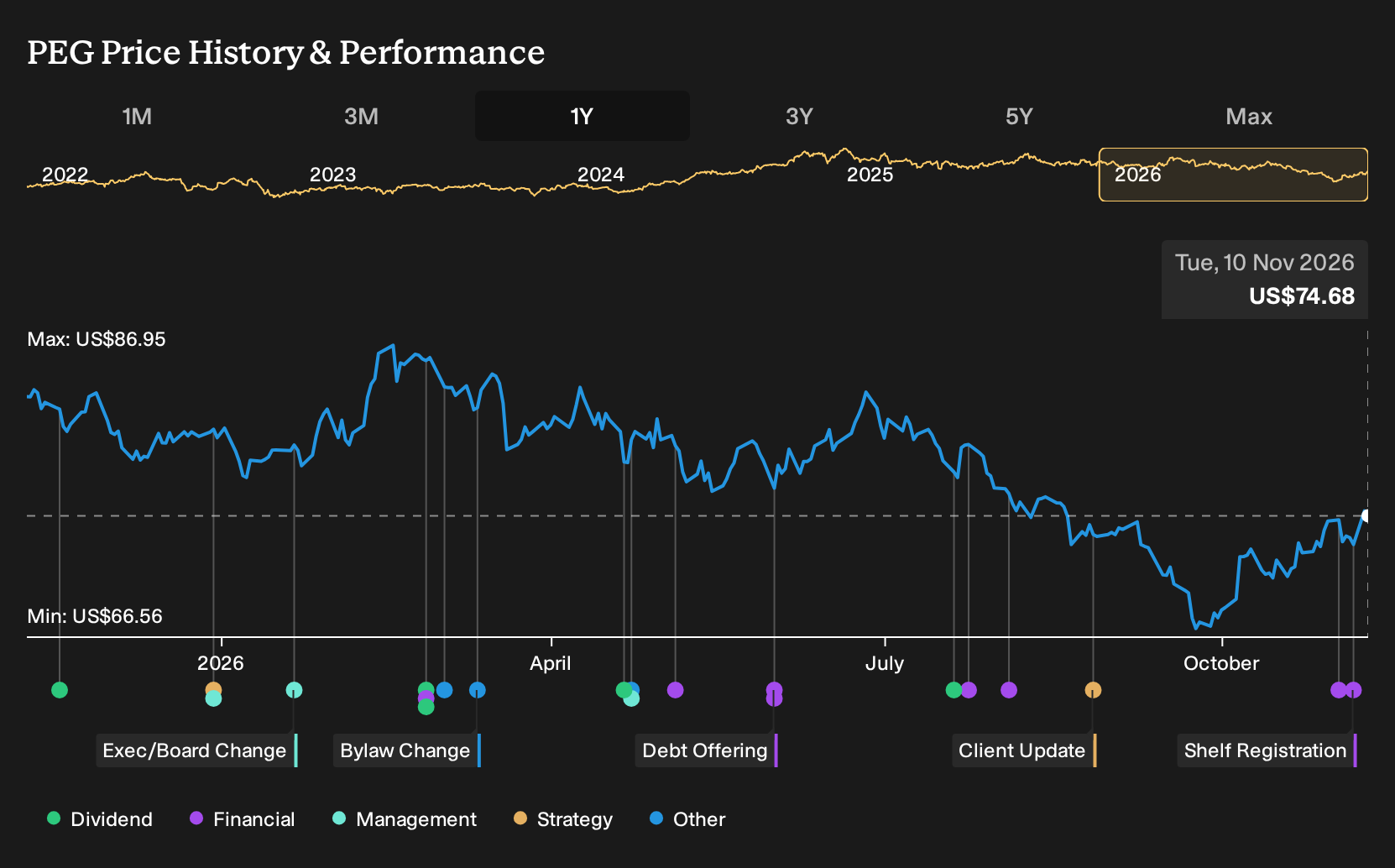
- The company also filed an omnibus shelf registration covering equity and debt securities, giving Public Service Enterprise Group financial flexibility that now sits against a backdrop of softer quarterly earnings.
- The focus now turns to how Public Service Enterprise Group's long term investment narrative absorbs a quarter of lower earnings from continuing operations.
Scan beyond Public Service Enterprise Group and compare how other utilities-focused businesses are handling similar earnings pressure and funding flexibility with our curated 42 power grid technology and infrastructure stocks
Public Service Enterprise Group Investment Narrative Recap
To stay invested in Public Service Enterprise Group, you need to be comfortable with a utility that bases its story on large regulated capital plans and long dated power demand from data centers and grid reliability work, as described in the analyst consensus narrative on Simply Wall St. The weak third quarter from continuing operations puts more attention on execution quality rather than changing that basic premise.
The most important short term catalyst remains how well management advances PJM related reliability projects and New Jersey focused grid and clean energy programs within allowed returns. The biggest near term risk is pressure on earnings and cash generation if customer friendly rate decisions and potential RTO incentive changes compress margins further.
The recent omnibus shelf registration is particularly relevant here. Public Service Enterprise Group now has a framework in place to issue common stock, preferred stock, stock purchase contracts and units, and multiple forms of debt securities as needed. That structure can support a multibillion dollar capital plan without requiring a new registration each time funding is tapped.
For catalysts tied to large capital spending and potential PJM Reliability Backstop Procurement projects, the shelf provides the business with flexibility to match financing tools with project timing and regulatory outcomes. However, interest costs are already identified as a weakness, and any sizeable use of new debt or equity could affect the earnings path, dividend coverage and P/E based valuation that investors are watching closely.
Public Service Enterprise Group's narrative projects US$14.1b revenue and US$2.6b earnings by 2029. That profile assumes 4.0% yearly revenue growth and an earnings increase of about US$600m from current earnings of US$2.0b.
Uncover why Public Service Enterprise Group's fair value indicates a 9% potential upside to its current price, which could narrow quickly.
Exploring Other Perspectives
Three fair value estimates from the Simply Wall St Community cluster tightly between US$81.21 and US$82.91, yet they were all set before the weaker third quarter and the fresh shelf registration from Public Service Enterprise Group. You can weigh those earlier views against funding flexibility, data center demand risk and regulatory outcomes, then compare several alternative opinions.
Explore 2 other Public Service Enterprise Group fair value estimates, including one that suggests there may be as much as 10% upside from the current price.
Reach Your Own Conclusion
Don't just follow the ticker. Dig into the data and build a conviction that's truly your own.
- A great starting point for your Public Service Enterprise Group research is our analysis highlighting 2 key rewards and 3 important warning signs that could impact your investment decision.
- See our latest analysis for Public Service Enterprise Group. The report includes a comprehensive fundamental analysis summarized in a single visual, the Snowflake. This makes it easy to evaluate Public Service Enterprise Group's overall financial health at a glance.
Looking for more investment ideas beyond Public Service Enterprise Group?
Once you have a view on Public Service Enterprise Group, it can help to compare it with a wider field of opportunities using the Simply Wall St Screener. This allows you to assess risk, balance sheet strength and potential income across different businesses instead of focusing on a single ticker.
- If capital preservation is a priority, you can start with a group of resilient companies that screen well on stability and risk using our 30 resilient stocks with low risk scores.
- If dividend income is important, you can focus on businesses with higher yields and an emphasis on resilience with this curated set of 6 dividend fortresses.
- If you want to pair quality fundamentals with what you consider sensible pricing, you can review a hand picked pool of 33 high quality undervalued stocks that meet specific balance sheet and cash flow checks.
Have feedback on this article? Concerned about the content? Get in touch with us directly. Alternatively, email editorial-team@simplywallst.com