
Is Jung Kook Holiday Campaign Altering The Investment Case For PVH (PVH)?
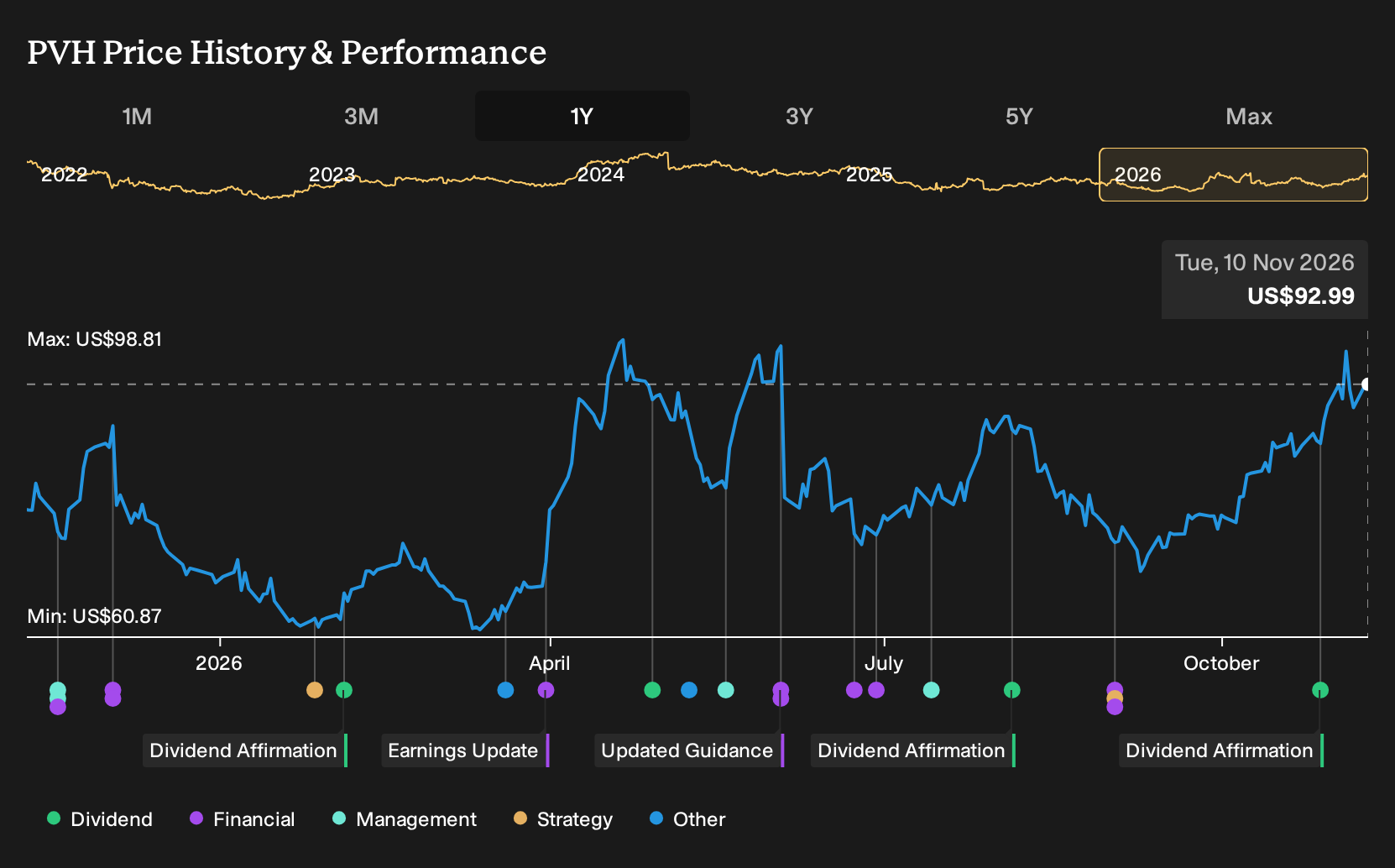
- PVH Corp. confirmed a quarterly cash dividend of $0.0375 per share, declared by the Executive Committee and paid on December 16, 2026, to shareholders of record as of November 25, 2026.
- Calvin Klein's Holiday 2026 collection, curated with global brand ambassador Jung Kook of BTS, highlights PVH's direct-to-consumer reach, key product categories and marketing capabilities during a major seasonal selling period.
- The next step is to observe how PVH's investment narrative is influenced by the Jung Kook led Calvin Klein Holiday 2026 campaign.
Scan how PVH’s dividend move and Calvin Klein campaign compare with peers by reviewing our handpicked 20 high quality undiscovered gems that could be flying under the radar this season.
PVH Investment Narrative Recap
To own PVH, you need to believe the Calvin Klein and Tommy Hilfiger engines can keep pulling more through higher margin direct to consumer channels while macro pressure in EMEA slowly stabilises. The analyst consensus narrative on Simply Wall St leans on cost discipline, tariff refunds in 2026 and store plus e commerce investment as key near term supports.
The biggest short term swing factor is execution in Europe and the Middle East, where weaker demand has already weighed on recent revenue. The main risk is that higher average unit retail and strong hero categories fail to convert into broad volume gains, which could leave operating margin and earnings recovery looking fragile.
The most relevant update here is the Jung Kook fronted Calvin Klein Holiday 2026 campaign. That push lines up closely with PVH’s focus on cultural collaborations and hero products in denim, underwear, knits and outerwear, and it lands in a critical seasonal window for direct to consumer and e commerce channels.
If the collection resonates with Calvin Klein shoppers, it could support higher margin online and brand owned retail sales and reinforce pricing power in a similar way to recent denim and knitwear trends. If uptake is muted, it would highlight the risk that headline campaigns and higher average unit retail do not fully offset softer wholesale demand in EMEA and other pressured regions.
PVH's current analyst storyline points to about US$9.4b in revenue and US$647.0m in earnings by 2029, built on 1.7% yearly revenue growth and an earnings swing of roughly US$816m from a loss of US$169.0m today.
Uncover why PVH's fair value indicates it is roughly in line with its current price.
Exploring Other Perspectives
Some of the lowest PVH analysts focus on the risk that higher marketing spend, near 6% of sales in their view, could eat into profit even if campaigns like Jung Kook’s Holiday 2026 push attract attention. Before this news, they were assuming roughly US$9.0b of revenue and about US$703.7m of earnings by 2029. That is a more pessimistic narrative on valuation than the consensus, even though the earnings figure is higher, because it leans on a much lower P/E of 6.5x. Use this spread in expectations as a reminder that reasonable people can see the same data very differently and treat today’s dividend and campaign headlines as potential triggers for those stories to shift.
Explore 2 other PVH fair value estimates, including one that suggests it could be worth just $90.83.
Form Your Own Verdict
Don't just follow the ticker. Dig into the data and build a conviction that's truly your own.
- A great starting point for your PVH research is our analysis highlighting 3 key rewards that could impact your investment decision.
- See our latest analysis for PVH. The report includes a comprehensive fundamental analysis summarized in a single visual, the Snowflake, making it easy to evaluate PVH's overall financial health at a glance.
Looking for more PVH sized investment ideas?
Once you have a view on PVH, it helps to line it up against other potential opportunities so your portfolio is shaped by clear choices rather than headlines alone.
- If you want potential mispricing with quality at the core, start with our 35 high quality undervalued stocks that pair stronger fundamentals with appealing valuations.
- For investors who care most about resilience, stress test your watchlist against our 30 resilient stocks with low risk scores that screen for sturdier balance sheets and milder risk profiles.
- Income focused readers can round out their research with a 5 dividend fortresses that combine higher yields with more robust cash generation.
Have feedback on this article? Concerned about the content? Get in touch with us directly. Alternatively, email editorial-team@simplywallst.com