
3 U.S. Bank Stocks Worth Watching As Higher Rates Reshape Margins
Inflation just surprised on the hot side again, the Fed is talking tougher, and bond yields have jumped, yet large U.S. bank stocks are still holding investor attention. That mix of higher rate expectations and resilient equity appetite can reshuffle which financial firms look positioned to benefit and which could feel pressure. This article walks through three large-cap U.S. bank stocks exposed to these cross-currents and what that might mean for your watchlist.
The three stocks covered next are just a starting sample, and the full screen surfaced 41 more large U.S. financial companies with equally compelling stories that are not covered here. If you want to quickly identify potential high-conviction ideas across that wider group, head straight to the U.S. Large-Cap Bank Stocks screener.
Valley National Bancorp (VLY)
Valley National Bancorp fits the large cap U.S. bank screener well, with a broad mix of lending, deposits, and fee income that ties directly to net interest margins. The analyst consensus Narrative on Simply Wall St highlights why that mix may matter more if higher policy rates persist.
Valley National Bancorp runs a full service U.S. banking platform across commercial, consumer, wealth, and insurance lines. It generates about US$1.5b from Commercial Banking, US$428m from Consumer Banking, and US$198m from Treasury and Corporate Other, and carries a market value of roughly US$7.9b.
Valley National Bancorp's accelerating growth in commercial and specialty deposit accounts is now underscored by about US$4.5b of new core deposits over the 12 months to Q2 2026 and the expected addition of US$2.1b of low cost Bluevine small business deposits. This supports a lower loans to deposit profile and can lift net interest margin and net interest income as higher cost brokered funding is replaced.
What happens to future returns if a single pressure point on funding costs and pricing power shifts in the opposite direction investors expect?
If that funding pivot is on your radar, read the full narrative for Valley National Bancorp to see how Valley National Bancorp’s deposit engine and risk profile could be mispriced.

Hope Bancorp (HOPE)
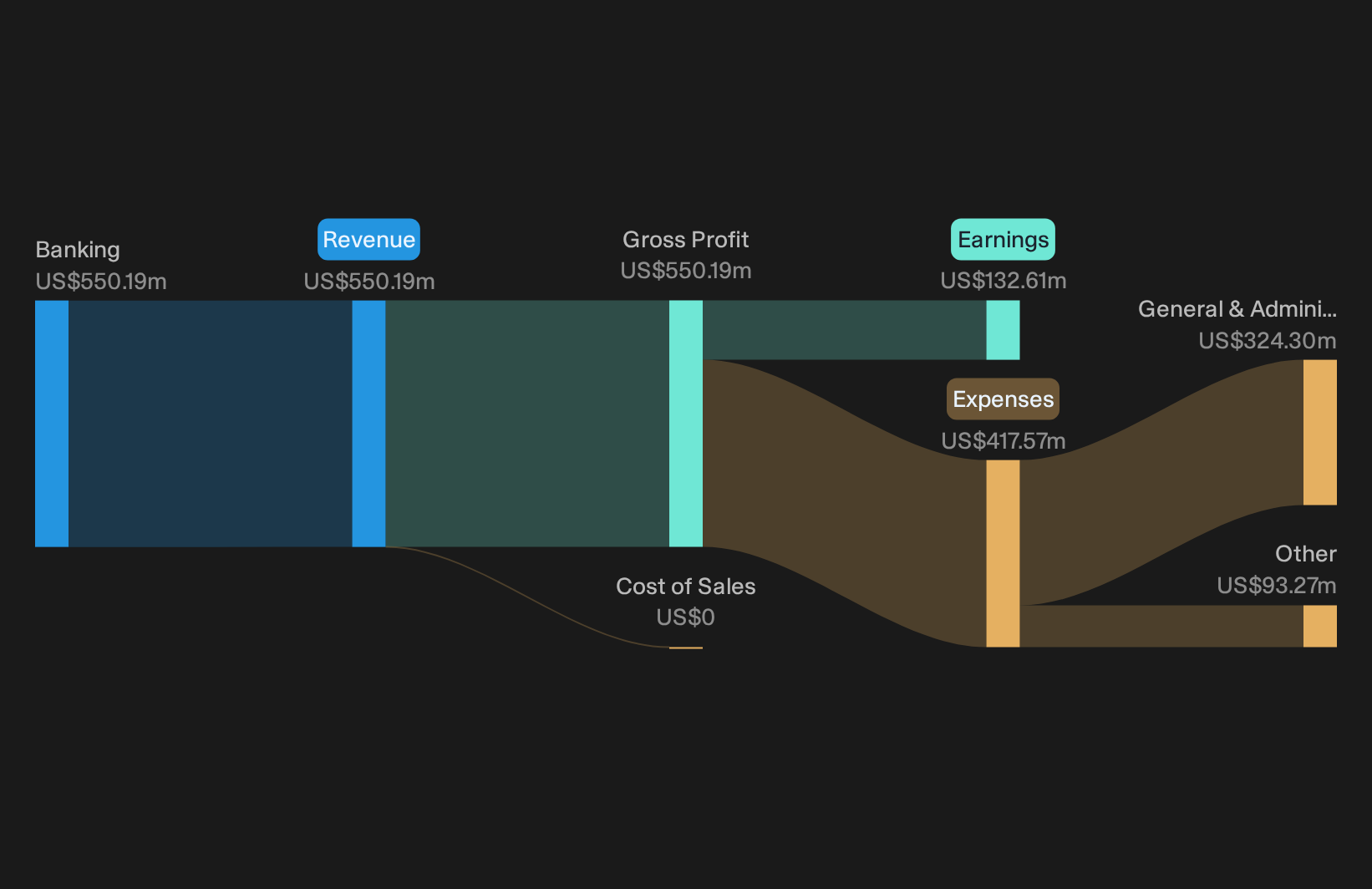
Hope Bancorp is a U.S. large cap bank holding company for Bank of Hope, tying directly into the screener’s focus on sizable lenders whose earnings often move with interest rate shifts. It generates about US$550 million from banking activities in the United States and carries a market value near US$1.7b.
For the U.S. Large-Cap Bank Stocks theme, Hope Bancorp brings what you would expect investors to look for right now: a focused U.S. lender where the analyst consensus Narrative on Simply Wall St sees rate moves feeding directly into loan pricing, funding costs, and net interest margins.
The SMBC MANUBANK commercial banking unit acquisition is expected to add roughly US$2.3b to US$2.7b of loans and US$2.6b to US$2.7b of largely non CD deposits, which could lift Hope Bancorp’s future net interest income and earnings once the book is integrated and repriced.
What happens to that earnings path if one still underappreciated cost and credit lever pulls the other way just as higher rates filter through?
That underappreciated lever is exactly where the full narrative for Hope Bancorp digs in, laying out how Hope Bancorp’s earnings story could accelerate or stall from here.
Walker & Dunlop (WD)
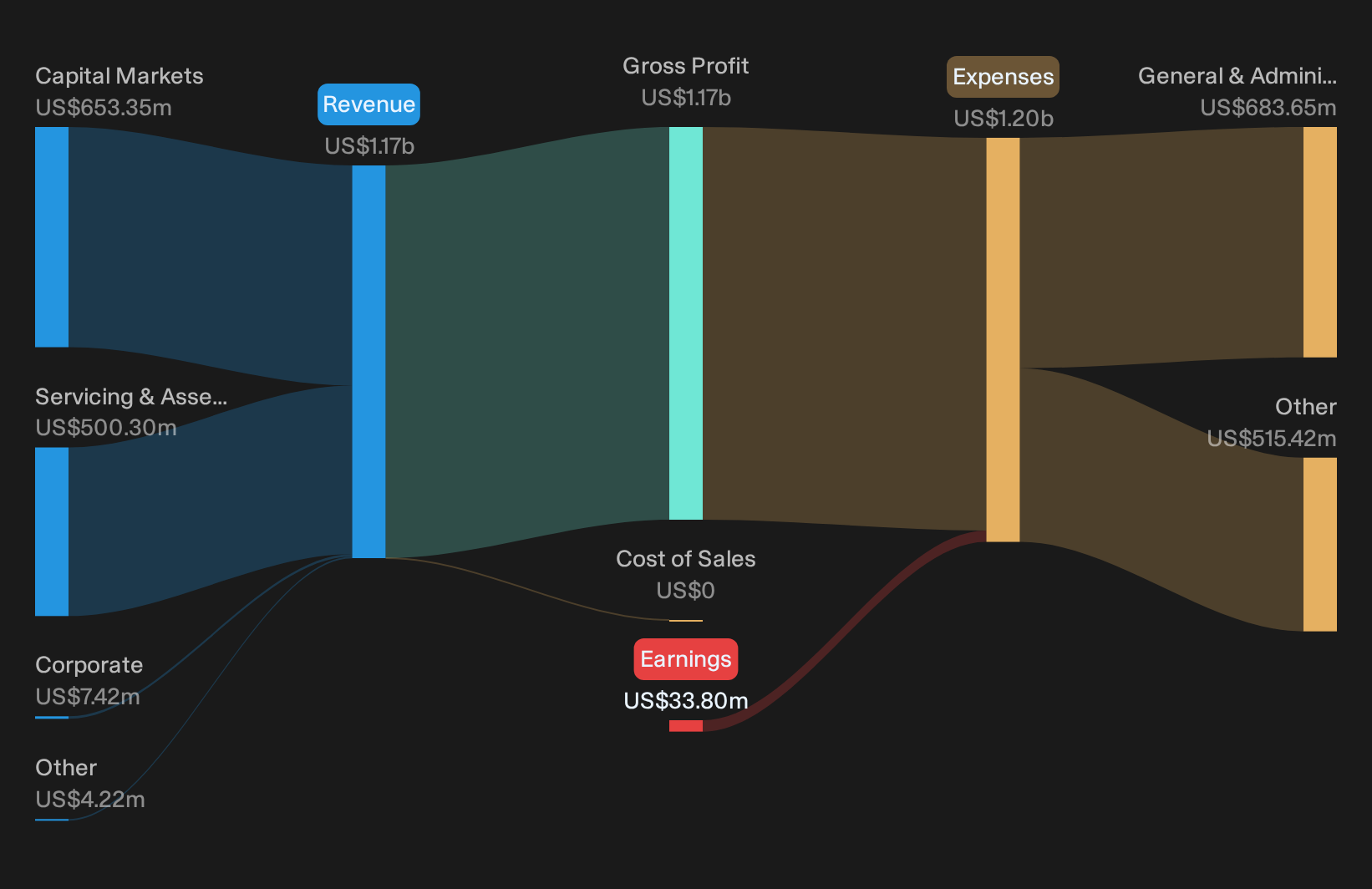
Walker & Dunlop plugs into the U.S. Large-Cap Bank Stocks theme as a rate-sensitive commercial real estate financier, originating, brokering, and servicing loans across apartments and other income properties. Capital Markets produced about US$653 million, Servicing & Asset Management about US$500 million, and Corporate roughly US$7 million, with the business valued around US$1.4b.
For investors watching how higher yields ripple through U.S. financials, Walker & Dunlop offers a different angle on rate sensitivity, with the analyst consensus Narrative on Simply Wall St highlighting how its commercial real estate fee streams could respond.
Ongoing refinancing and construction activity in a higher rate setting, including recent large multifamily, mixed use, office and workforce housing deals in Miami, Manhattan, Jersey City and other markets, keeps Walker & Dunlop positioned to generate fee income from a recapitalization cycle that can support revenue and earnings.
The key variable is whether one pressure point in its funding and credit cycle eases in its favor or tightens further on margins.
If that margin tug of war is on your radar, go straight to the full narrative for Walker & Dunlop for details on how Walker & Dunlop’s fee engine could surprise optimists.
Seeking Alternatives Before Momentum Flies
Fresh ideas rarely stay under the radar for long. Breakout themes build momentum, laggards keep dropping, and information decays fast. Scan what others miss and get in early.
- Spot cash generative compounders before they get crowded by running the 35 high quality undervalued stocks while it matters and before valuations get fully caught up.
- Track where robots, automation, and productivity gains are quietly reshaping entire supply chains through the curated 89 robotics and automation stocks and position ahead of the next wave of demand.
- Explore the potential wiring upgrade of the economy by scanning the 41 power grid technology and infrastructure stocks while many investors still overlook these critical infrastructure plays.
Have feedback on this article? Concerned about the content? Get in touch with us directly. Alternatively, email editorial-team@simplywallst.com