
Lisa Su Just Delivered Fantastic News for AMD Investors
Key Points
AMD's data center segment growth decelerated from last quarter, but the stock isn't acting like that occurred.
AMD is pricey compared to other stocks in its industry.
AMD (NASDAQ: AMD) CEO Lisa Su has a great track record. She resurrected the company from irrelevance and is now leading it into the age of AI. The stock has had a rough few weeks, as it reached an all-time high in early October, then proceeded to sell off by about 25%. However, it got a bit of a bounce after it delivered its latest earnings report on Nov. 3, and that's all thanks to some items that Su has positioned AMD to take advantage of, as well as some forward-looking comments she gave.
Missed Nvidia in 2009? This Rare Signal Is Flashing Again. In 2009, a "Double Down" signal flashed for a little-known chipmaker called Nvidia. For the first time in years, that same "Total Conviction" signal is flashing for a company 1/100th the size of Nvidia. Continue »
But does that make AMD a buy right now? Let's take a look.

AMD CEO Lisa Su. Image source: Advanced Micro Devices.
AMD's Q3 was impressive
AMD makes an array of types of computing chips. Whether you're talking about central processing units (CPUs) for personal computers or GPUs for gaming or data centers, AMD is in those markets. Compared to rival Nvidia (NASDAQ: NVDA), AMD is far more diversified in terms of its end markets, which has hurt it given how much of the tech sector's recent growth has been coming from data centers. However, AMD has taken steps to improve its position in that market, and is now seeing impressive data center growth.
In Q3, revenue in that segment was up 97% year over year to $8.5 billion. Still, that was a deceleration from the 107% year-over-year growth it experienced during Q2. Normally, a result like that might have prompted a negative stock reaction, but Su stepped in to save the day on the earnings call. She noted that AMD expects server revenue to double year over year in 2027, and reported that AI-related growth was accelerating compared to where management thought it would be last quarter. That's huge news for investors, but what does it mean for the rest of AMD's business?
While its data center business provides the majority of its revenue now, AMD's other segments still play large roles. However, they were quite weak. Revenues from its client and gaming division (consumer hardware) were down 8% year over year. Its embedded division saw revenue rise 29% year over year, but it only generated $1.1 billion in revenue, versus client and gaming's $3.7 billion and data centers' $8.5 billion. The 45% companywide growth rate is impressive, but the lackluster results from the consumer division are still a drag on that figure.
The problem is, AMD is being valued like it's only a data center investment.
AMD's stock is far from cheap
AMD's stock has had a great year overall, but I think investors must understand that the business's results are lagging behind the stock's performance. Over the year, AMD's valuation has stayed quite lofty.
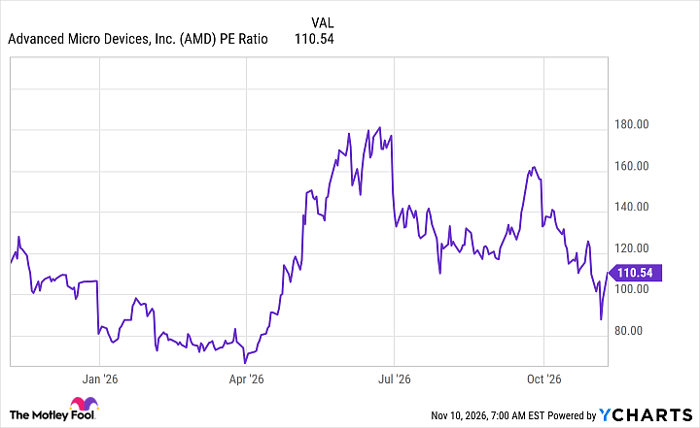
AMD PE Ratio data by YCharts
At about 110 times earnings, AMD trades at a massive premium to most big tech stocks. However, I'd say this is a poor valuation measure for a company growing as rapidly as AMD is. For a company like this one, the 1-year forward price-to-earnings ratio is a much smarter way to measure valuation.
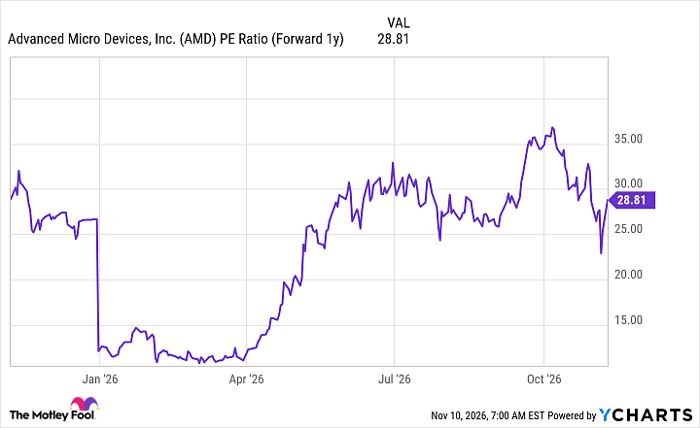
AMD PE Ratio (Forward 1y) data by YCharts
At 29 times next year's expected earnings, this seems like a far more reasonable price tag. However, AMD shareholders must be OK with the stock staying flat from now until the end of next year for this number to reflect real trailing earnings. While some may not find that a big deal, especially after the year AMD has had so far, its industry peer, Nvidia, trades at just 11 times next year's earnings and 23 times trailing earnings. While there are some other events influencing Nvidia's stock price right now, the reality is that Nvidia's data center business is still larger and far more dominant than AMD's.
Nvidia's stock is cheaper now than AMD will be even after the 2027 growth that is priced into the stock arrives. That's a huge mismatch, and investors need to be aware of it. Nvidia reports its next set of quarterly results later this month, and it should report a faster pace of growth than AMD due to its concentration in data centers. I think this makes Nvidia a far better stock to own, as the two are driven by the same catalyst, but one is more affected by it than the other and is far cheaper to boot. It's possible that AMD may be able to steal some more market share from Nvidia due to its recently revealed misstep. However, given how large a lead Nvidia has and how much cheaper it is, I don't think that possibility is enough to make AMD the better pick. AMD is doing far better than it was, but it still hasn't come close to reaching Nvidia's levels of performance.
Keithen Drury has positions in Nvidia. The Motley Fool has positions in and recommends Advanced Micro Devices and Nvidia. The Motley Fool has a disclosure policy.