
Pearson (LSE:PSON) Wins Westermann Deal On A Fair Value Debate
Pearson (LSE:PSON) drew fresh attention after announcing a collaboration with German publisher Westermann. The agreement will roll out PTE Academic and Versant English assessments across thousands of schools starting January 2027.
The collaboration news lands while Pearson shares trade at £12.94, with momentum mixed in the short term as the 7 day share price return declined 1.75% and the 30 day share price return slipped 0.77%. Over a longer horizon, performance has been stronger, with a 90 day share price return of 8.51%, a year to date share price return of 26.92%, and a 5 year total shareholder return of 131.78%, which suggests that investors have been gradually rewarding the education group as it secures partnerships like Westermann and builds out its assessment footprint.
Scan 5 high quality undiscovered gems, which, like Pearson's Westermann tie up, aims to turn niche education strengths into broader market momentum across the sector.
Pearson now carries a solid recent track record and a fresh German partnership story, but after such a strong multi year run, does the balance of risk and reward still lean toward buyers at £12.94?
Most Popular Narrative: Fairly Valued
At £12.94, Pearson trades almost exactly in line with the analyst fair value narrative of £12.89. The story here is therefore less about a big valuation gap and more about whether the business can deliver on the growth and margin roadmap set out in the analyst consensus Narrative on Simply Wall St.
“The numbers and recent broker downgrades on valuation grounds imply that Pearson's current share price already prices in much of the near term operational progress. Future returns therefore depend heavily on continued delivery against the mid single digit growth and margin expansion ambitions.”
See why 18 investors see Pearson as 0% overvalued.
Result: Fair Value of £12.89 (ABOUT RIGHT)
Still, Pearson’s fair value story could shift quickly if FX swings hit reported earnings or if pressures in English Language Learning and Higher Education deepen.
Find out about the key risks to this Pearson narrative.
Another View: Pearson Through A Cash Flow Lens
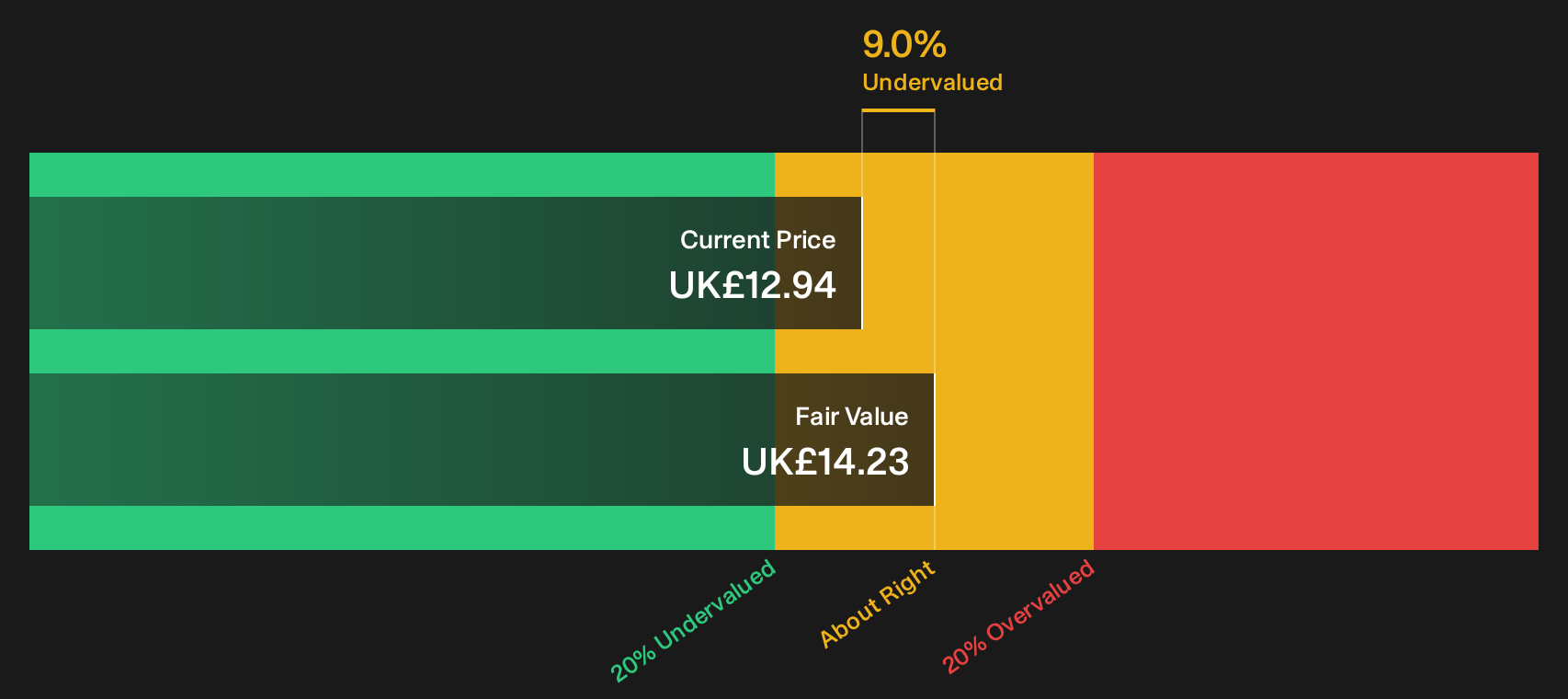
While the analyst narrative pins Pearson close to fair value on earnings based metrics, the Simply Wall St DCF model tells a different story. On that measure, the shares at £12.94 sit about 9% below an estimated future cash flow value of £14.23, raising the question of whether the market is putting enough weight on long term cash generation.
For readers who want to see how this cash flow view is built line by line, Look into how the SWS DCF model arrives at its fair value..
Simply Wall St performs a discounted cash flow (DCF) on every stock in the world every day (check out Pearson for example). We show the entire calculation in full. You can track the result in your watchlist or portfolio and be alerted when this changes, or use our stock screener to discover 17 high quality undervalued stocks. If you save a screener we even alert you when new companies match - so you never miss a potential opportunity.
Next Steps
If this combination of fair value arguments and potential cash flow upside leaves you undecided, consider taking a closer look and testing the numbers yourself. To understand why some investors still focus on Pearson's potential strengths, review the 2 key rewards
Looking for more investment ideas beyond Pearson?
If Pearson's story has sharpened your thinking, do not stop here. The best opportunities usually emerge when you compare several strong candidates side by side.
- Target potential mispricings by scanning the 17 high quality undervalued stocks and see which businesses currently trade below what their fundamentals may justify.
- Strengthen your income stream by reviewing the 4 dividend fortresses and focus on companies offering higher yields with supporting fundamentals.
- Reduce portfolio stress by filtering for resilient businesses through the 5 resilient stocks with low risk scores so you are not caught off guard when conditions change.
Have feedback on this article? Concerned about the content? Get in touch with us directly. Alternatively, email editorial-team@simplywallst.com