
Nvidia (NVDA.US) governance crisis escalates: Wong In-hoon reveals his affair again, the board of directors is preparing to step down, Wall Street begins pricing the “no Jensen” scenario
The world's highest-capitalized semiconductor company is experiencing the worst corporate governance crisis since its inception.
The Zhitong Finance App learned that after admitting that Nvidia (NVDA.US) CEO Wong In-hoon had an extramarital relationship with a foreign woman, it was also revealed in related reports on Wednesday that he had another undisclosed close relationship with a female executive within the company who directly reported to him. Meanwhile, according to people familiar with the matter, Nvidia's board of directors is preparing to remove Hwang In-hoon from the position of CEO. A meeting was held as early as Wednesday local time to decide where to stay.
Affected by this, Nvidia's stock price fell sharply by 9% after the market.
Since Hwang In-hoon admitted her first affair to employees on Sunday, Nvidia has accumulated a cumulative decline of about 10% in just two trading days up to Tuesday, and its market value has evaporated by more than US$420 billion. Meanwhile, after the midterm elections, the Democratic Party swept through both houses of Congress, and several local referendums that may raise the threshold for data center construction passed simultaneously. AI infrastructure transactions are still under widespread systemic pressure. The dispute over Hwang In-hoon's private conduct brought Nvidia's long-overlooked “single point of dependency on the founder” issue to the pricing front desk at an already weak market node.
The nature of the second relationship is different from the first
According to media reports, citing five people familiar with the matter who worked for Nvidia, Wong In-hoon had an extramarital relationship with Kimberly Powell (Kimberly Powell), vice president of Nvidia's healthcare business. Powell is one of about 60 executives reporting directly to Hwang In-hoon. He has been in charge of Nvidia's healthcare business since 2017 and has been with the company for over 18 years.
Two people familiar with the matter said that during the GTC conference in San Jose in March this year, Wong In-hoon and Powell were seen behaving closely at a local hotel, and a bystander recorded the relevant scene with a mobile phone; however, the media reporting the news clearly stated that the reporter himself had not viewed the video. Currently, the details of the report mainly rely on anonymous sources, and have not been publicly confirmed by independent video evidence.
Huang Renxun hung up after receiving a call from the reporter. Neither Nvidia nor Powell commented.
Unlike the first paragraph, which involved external businessmen, the Powell case directly touched on the core prohibited areas of the company's code of conduct. Nvidia's code of conduct requires employees to avoid personal relationships that may cause conflicts of interest, and the reason why close relationships between executives and direct subordinates are widely regarded as a red line of governance is that the two parties have structural unequal power, which may pollute the impartiality of salary decisions, promotion evaluations, and personnel arrangements.
Current reports have yet to prove that Hwang In-hoon specifically interfered in Powell's personnel arrangements, but the fact of “reporting internal relationships” itself is enough to move the dispute from the field of private morality to the level of board supervision effectiveness.
According to a former employee who requested anonymity due to the sensitive nature of the matter, rumors about an affair between Hwang In-hoon and Powell have been circulating for many years, partly due to Powell's lack of medical or scientific background.
Hwang In-hoon admitted “being unfaithful to his wife” in an internal memo last Sunday, saying “my actions hurt her and our children, and there is no excuse for this,” but did not disclose specific details. According to information, most of Huang Renxun's Nvidia shares are jointly held with his wife Lori Huang (Lori Huang) and held in a trust fund. These trusts hold approximately 800 million shares. Huang Renxun personally holds about 70 million shares and has limited control over the company's economy.
Currently, Nvidia's board of directors has hired Wachtell, Lipton, Rosen & Katz to lead an independent investigation into Hwang In-hoon, a former acting federal attorney for the Southern District of New York, led by Joon H. Kim.
Additionally, a shareholder has filed a class action lawsuit in California's San Jose federal court, accusing Nvidia and Wong In-hoon of concealing their relationship with Alice Huang, misleading investors, and constituting fraud.
“This is going to be a very challenging situation,” said Michael O'Rourke, Jonestrading's chief market strategist. “Hwang In-hoon previously predicted a 70% increase in sales this year. “Given supplier financing and aggressive strategies, his successor will have to spend the next year busy fighting fires and cleaning up the mess.”
“If these allegations are confirmed by an independent investigation, one can only expect the board to dismiss them. This is the standard for corporate governance today. What's worse is that it's a pattern,” he added.
After the market, it fell below $160, and Wall Street began pricing “Nvidia without Wong In-hoon”
Before the recall report came to fruition, Nvidia had recorded a 2.9% increase during the regular trading session, closing at $173.73, indicating that some funds were trying to bottom out after a continuous decline. However, post-market news completely reversed sentiment: Nvidia's stock price once fell more than 9% to $160. As of press time, the stock price was $160.13, a decrease of 7.83%.
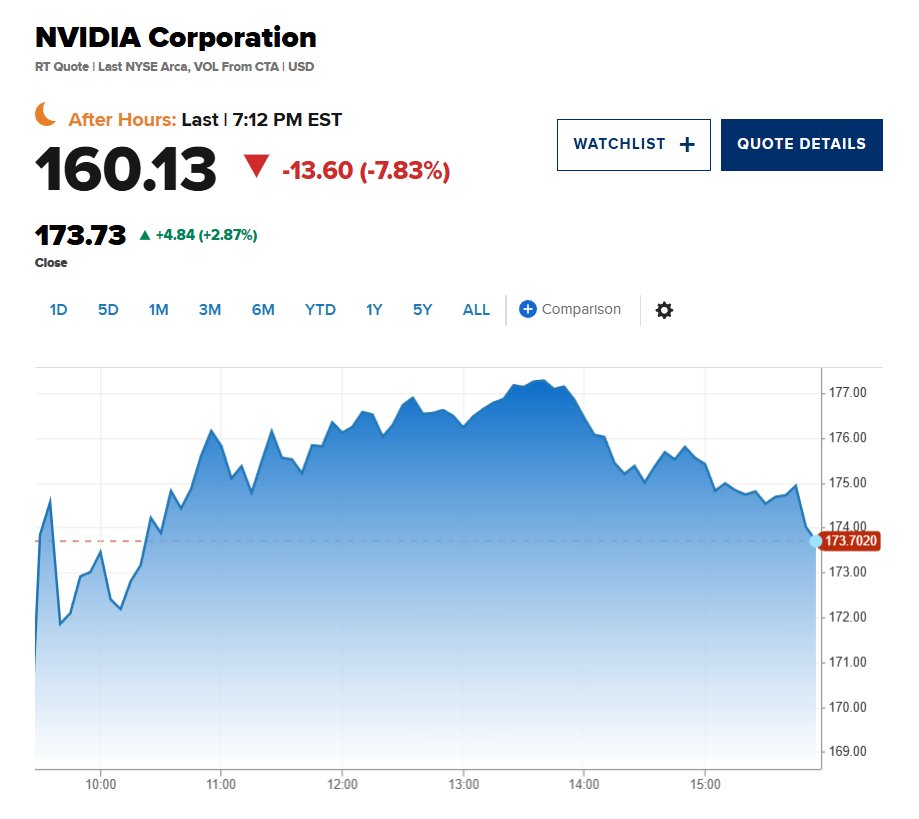
In the previous two trading days, Nvidia had a cumulative decline of more than 9.5% from the level before the scandal came to light, shrinking its market capitalization by more than US$420 billion, and giving way to Microsoft (MSFT.US), which had the second largest market capitalization in the world.
The signals in the options market are also worth watching out for. According to reports, while stock prices were under pressure, some traders bought 52,000 call options with an exercise price of 195 US dollars due in February 2027, and sold the same amount of 245 US dollar call options at the same time, making a net payment of about 47 million US dollars in premium.
This spread trade can only achieve break-even if Nvidia rises above about $204 before the deadline, which is about 14% higher than Monday's closing price. According to SpotGamma's analysis, the trader may also be closing out old positions and increasing sensitivity to the rebound by shifting the price downwards. It has an obvious “takeover knife” nature rather than confirming short-term trends.
SLC Management's Dec Mullarkey said that Nvidia “will handle next week's earnings call is worth watching. Their chief financial officer can handle digital issues, but the market wants more information on changes in governance”. Nvidia is scheduled to announce quarterly results on November 17 EST.
“It's hard to imagine him quitting, but it's also hard to imagine how he can stay in office. I think the board will eventually be forced to oust him and establish a more traditional organizational structure. Judgment flaws can be difficult to fix with key customers.” According to information, the headhunting company has reportedly begun searching for potential successors. Rumored external targets include AMD (AMD.US)'s Su Zifeng and Arm (ARM.US)'s Rene Haas.