
AI computing power and semiconductors are staging a major counterattack. Why is Wall Street cautious about US stocks? Key metrics reveal that it hasn't bottomed out
Zhitong Finance App learned that by the close of the US stock market on Wednesday, the strong rebound in the AI computing power industry chain was supported by new operating data from Xinyun leader CoreWeave — in particular, the company's higher-than-expected earnings report and customer advance payment outlook mitigated market concerns about computing power expansion financing, and AI application-side explosive revenue expectations and procurement and leasing commitments associated with large-scale AI computing infrastructure of over 900 billion US dollars, as shown in Anthropic's latest prospectus and IPO roadshow. Expected expansion in computing power demand and market confirmation are still signs at three different levels, and they have yet to re-establish a positive bullish correlation with each other.
The US East closed on November 11, and the Nasdaq 100 Index rose 2.28%. The Philadelphia Semiconductor Index, which has the title of “Global AI Computing Power Trading Trend Vane,” also rose sharply by about 5.7%, and all constituent stocks closed higher. Micron and SanDisk surged 11.89% and 13.69% respectively, Nvidia rose about 2.9%, and Broadcom rose about 4%; Coherent and Lumentum in the field of optical interconnection rose 9.25% and 10.67% respectively. This round of the market shows that retail investors or institutional investors focusing on the “buy on bargain” strategy are re-buying core AI computing power infrastructure such as AI chips, storage, and high-speed optical interconnection of data centers.
However, as the level of congestion in global technology stocks dominated by AI computing power and the semiconductor sector declined sharply, these positive fundamental developments provided some support for a return in buying, but position details, option pricing, and technical trends have yet to give a consistent signal that technology stocks have bottomed out.
Behind the strong counterattack of AI computing power leaders: Expected demand for AI computing power is heating up, and concerns about AI financing costs are easing
The Philadelphia Semiconductor Index rose about 5.7%, and the Nasdaq 100 Index rose 2.28%, which together highlighted that the AI computing power industry chain ushered in a strong rebound, and that the logic behind this strong rebound showed that the bullish sentiment of the AI computing power industry chain was supported by operating data.
CoreWeave's performance exceeded expectations, and it is expected to receive about 9 billion US dollars in advance payments and security deposits from customers over the next three months, easing market concerns about computing power expansion financing. Anthropic's revenue grew rapidly in the third quarter, providing verification of the payment demand for AI applications. The US$909 billion annual procurement and leasing commitment disclosed in its prospectus increased the visibility of long-term computing power demand.
The level of congestion in technology stock holdings has declined, and the implied correlation has increased only moderately, indicating that the market's expectations for the sell-off to spread to other sectors are still limited. However, the skewed indicator measuring the relative demand for put options was still in the middle of the past 13 years, and QQQ (an ETF product tracking the Nasdaq 100 Index) had not broken through the downward trend since the end of October at the time. Whether the rebound evolves into a trend reversal depends on whether the index can break through the downward trend and whether buying can expand to more sectors in the short term, and whether hashrate orders can be delivered on schedule and efficiently and converted into cash flow in the medium term.
Anthropic's incremental information provides revenue verification from the application side for computing power requirements. According to the prospectus, the company's third-quarter revenue reached 16.956 billion US dollars, up about 1127% year on year and 46.7% month on month; the annualized revenue operating rate reached 81 billion US dollars at the end of October, an increase of 10 billion US dollars over the end of September. However, this operating rate reflects the recent scale of business and is not a yearly revenue guide.
There is also a longer-term growth forecast from Anthropic's core underwriting agency: According to the Financial Times, the Goldman Sachs model expects Anthropic's revenue to reach 52 billion US dollars and 136 billion US dollars respectively in 2026 and 2027, and also anticipates a net free cash flow outflow of 65.7 billion US dollars in 2027, indicating that commercial expansion and infrastructure investment will continue to accelerate at the same time.
The vast majority of the US$909 billion procurement and leasing commitments recently disclosed by Anthropic are related to computing power and infrastructure. Of this, approximately US$451.6 billion is expected to occur before the end of 2030, US$70.7 billion will expire within 12 months after the end of September 2026, and the rest is mainly distributed between 2031-2045.
According to reports, its Anthropic Direct model arranges computer room capacity separately from chip leasing, first targets facilities with a long construction cycle, and then determines large-scale accelerator investment according to demand. It is undoubtedly a high-intensity positive catalyst for the global AI computing power industry chain. This means that AI computing power demand is sustainable over a long period of time, and revenue recognition still depends on the specific delivery rhythm: GPU and ASIC undertakes computation, HBM provides high-bandwidth data supply, optical interconnection supports cluster communication, and power supply and cooling determine whether the equipment can actually be put into operation. Long-term procurement commitments support demand expectations, and on-time delivery and continuous utilization determine when these expectations translate into supplier profits.
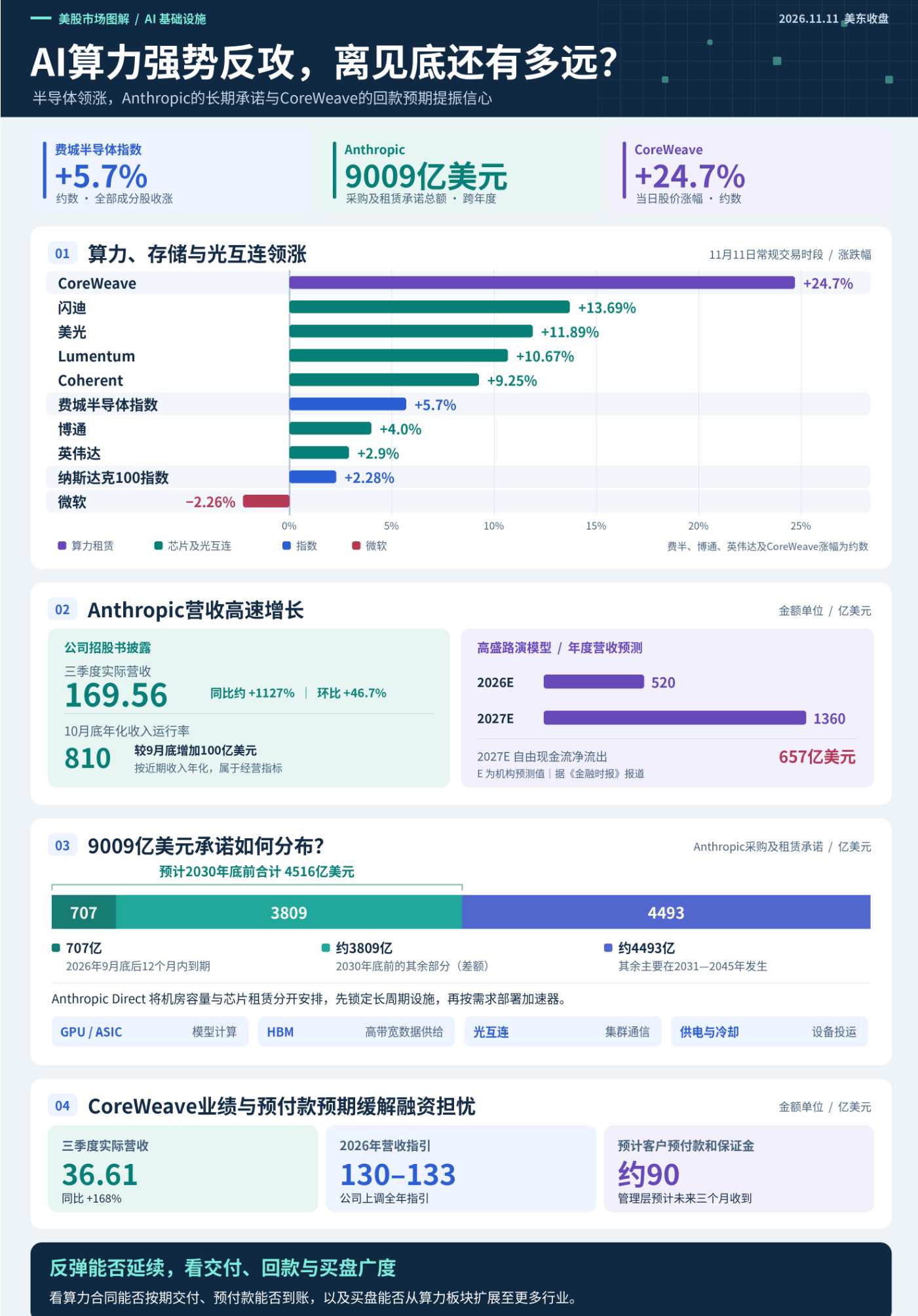
Wednesday's more direct market catalyst came from CoreWeave. The company's third-quarter revenue was US$3.661 billion, up 168% year on year, raising its annual revenue guidance to US$13 billion to US$13.3 billion, and is expected to receive approximately US$9 billion in advance payments and security deposits from customers over the next three months, driving up the stock price by about 24.7%. This information simultaneously responds to concerns about “whether demand can be met” and “where will the expansion capital come from”. The team, led by senior Bernstein analyst Madison Rezaei, believes that the company's performance is strong and has responded to financing concerns. A series of dynamic repayment arrangements for new cloud-type AI computing power leasing/sales companies can be described as becoming an important link between upstream hardware demand and capital market confidence.
Crowded trading has cooled down, but key indicators have yet to jointly confirm the bottom
According to exclusive statistics from Deutsche Bank, technology stock positions have fallen below the low point during the “Liberation Day” shock in April 2025. The agency's senior strategist Parag Thatte (Parag Thatte) attributed the recent decline mainly to being forced to reduce positions and maintain the position of oversized technology stocks. At the same time, the market's expectations for the degree of simultaneous future fluctuations in stocks have risen only moderately. Rocky Fishman (Rocky Fishman), founder of Asym Research, believes that this shows that investors still mainly understand the sell-off as an adjustment at the industry level, and there is no widespread pricing to impact a pessimistic economic downturn that has impacted most industries.
The options market, on the other hand, shows that speculation fervor has not subsided to the extent of extreme pessimism. The activity of households to buy bullish options for individual AI stocks has declined markedly, changing the trading momentum that previously supported stock prices. In a situation where market makers undertake to sell bullish options and hedge by buying stocks, the decline in bullish demand and falling stock prices may cause them to reduce stock hedging and increase selling pressure.
Furthermore, it is worth noting that the one-month standardized bearish - bullish option bias indicator, which only returns to the middle of the past 13-year range — can be described as highlighting the short-term decline in congestion, which is beneficial to restoring balance to the market, but it is not enough to judge that the market is already bottoming out based on positions alone.
In terms of key technical indicators, QQQ has not broken through the downward trend since the end of October, nor has there been any signs of Demark's trend exhaustion. Wednesday's rise further improved price performance, but there is still differentiation within the market: the total market volume was 14.74 billion shares, lower than the average of 18.68 billion shares over the past 20 trading days; the NASDAQ market hit a 52-week low of 159 stocks, more than the record high of 77.
As a result, this round of rebound has received support from the growth prospects of AI computing power demand and mitigation of financing concerns. Its sustainability also depends on whether the rise can expand from AI core weighted stocks to more stocks, and whether AI computing power industry chain leaders, cloud computing giants, and software leaders focusing on AI application software can continue to offset the valuation pressure brought about by high interest rates/long-term US bond yields.
After the US market experienced a sharp decline in technology stocks, there are various signs that it is too early to assert that the worst is completely over
The Nasdaq 100 Index, which is dominated by technology stocks, hit a record high in early October. The sharp decline in the following weeks made technology stocks and AI-related stocks about 10% lower than recent highs, but recently there have been signs of stabilization.
Technology stock holdings, stock correlation, option demand, and technical charts, these four indicators provide an observation list to determine whether the market is once again close to an inflection point. Analysts said that two of these are encouraging; one is showing a mixed situation, while the technical side shows that we cannot let our guard down yet.
“The market fell 5% in a single day and closed at a low level. You can't just think that a low point has already occurred.” Mark Newton, head of technology strategy at Fundstrat Global Advisors, said in an interview with the media.
“I think this will be a great buying opportunity. But this is no reason to assume that the market has officially bottomed out.” he said.
The overheating that these metrics track is nothing new. Investors are highly focused on AI trading, continued upward betting on individual stock options, and overextended momentum indicators, which have been prominent features of the market for months.
At the beginning of October, as investors began to worry about AI infrastructure spending and expected returns, AI stock gains that have continued for many years were hampered, and some indicators began to fall.
Subsequently, the hyperscale cloud service provider that built the data center released third-quarter results, revealing signs of project delays and a slowdown in capital expenditure growth. As a result, investors sold shares and bonds of Nvidia-supported AI infrastructure company CoreWeave.
The latest catalyst was the US midterm elections. The strong performance of the Democratic Party has once again raised concerns about slowing growth, and AI stocks have been hit hard. Stock prices have stabilized in recent trading days, recovering some of the post-election declines.
Prior to the recent round of retracement, some investors had begun to worry about the market's reliance on tech stocks and AI stocks. Large market capitalization growth stocks and technology stocks have led the bull market for a long time. Investors' high allocation of these stocks has been a topic of concern in the market for several months. Some people believe that the current position situation may mean that the market already has the conditions to stabilize.
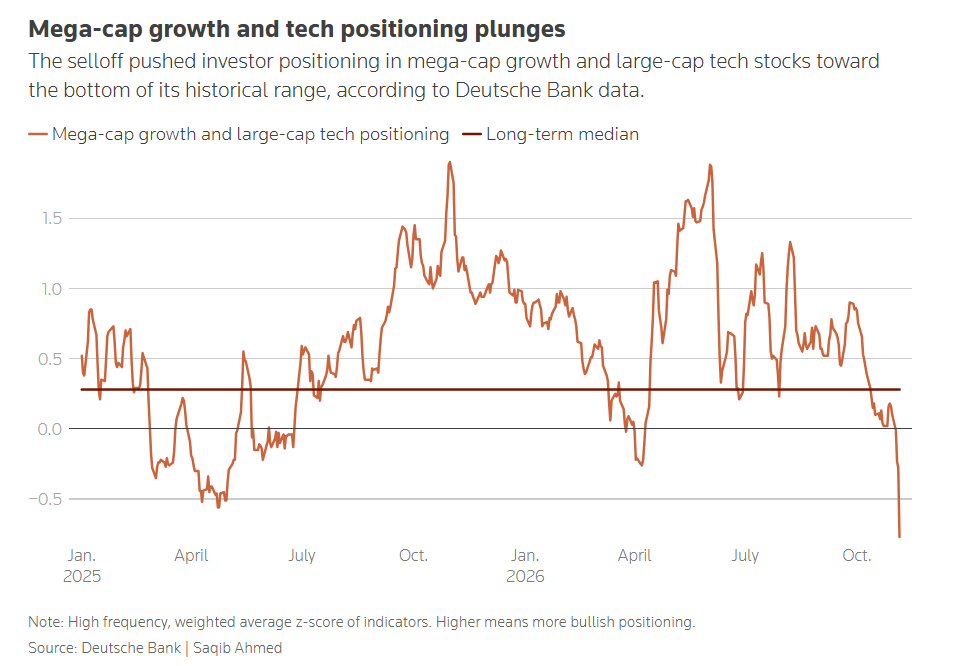
Investors have been cutting their exposure to these stocks since late September, while turning to other sectors, according to Deutsche Bank data. The bank said last week's sell-off brought technology stock positions below the low during “Liberation Day” in April 2025.
“We believe this recent round of sell-offs was driven by forced liquidation.” Deutsche Bank strategist Parag Tart said.
“Positions have just fallen below the lower end of their long-term fluctuation range, and the relative performance of technology stocks has just fallen below the lower edge of their long-term trend channel. Previously, technology stocks had rebounded from these levels.” Tart said and pointed out that the bank is currently overequipped with the technology sector.
Anthropic's initial public offering in the next few days will test Wall Street's confidence in the AI boom.
The internal trend of the US stock market is not synchronized
Another encouraging factor for bulls is the relatively moderate increase in investors' expectations of stock market correlation. Correlation refers to the tendency of stocks to fluctuate simultaneously rather than operate independently of each other.
The AI boom has changed how stocks relate to each other. Barclays strategists said in an October 27 report that the 50 largest stocks in the S&P 500 index have achieved a three-month correlation drop to an all-time low in late September.
They attributed this phenomenon to strong individual stock specific themes, “AI in particular,” which played a role in combination with macro-drivers such as interest rates, inflation, and oil prices.
Last week's sharp sell-off raised the market's expectations for the degree to which the stock trend would synchronize in the next few months, but the increase was limited.
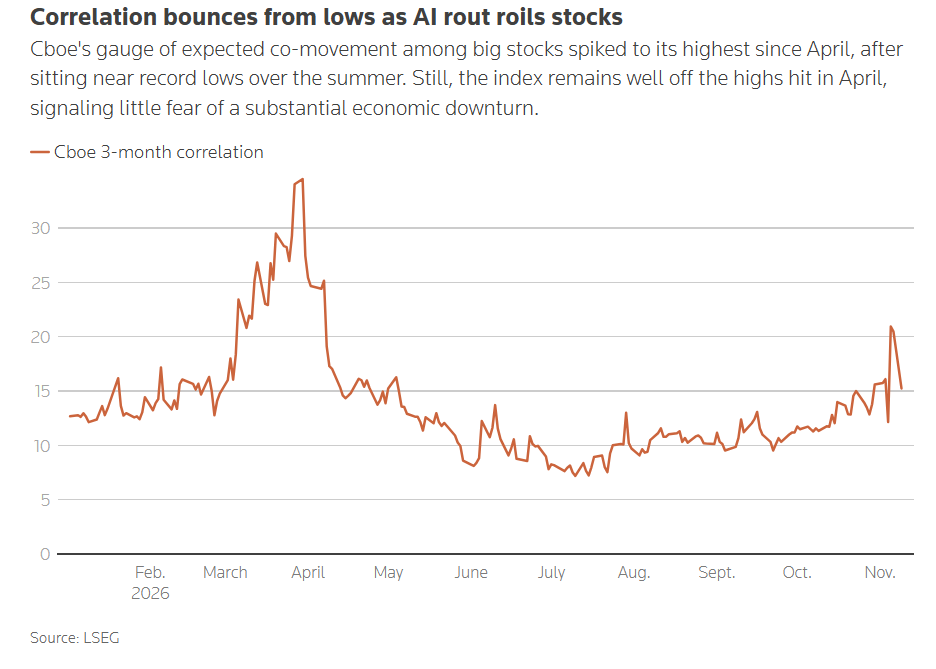
“The implicit correlation did not show a larger jump, indicating that investors think this is more like a sell-off in a specific sector rather than affecting a significant economic downturn in most or all sectors.” Rocky Fishman, founder of Asym Research, said.
Options trading reversal
The sharp increase in demand for call options has always been an important characteristic of this round of stock market gains. A call option gives the holder the right to buy a stock at a fixed price, while a put option gives the holder the right to sell the stock. This market is sending mixed signals.
According to Carrick Lane's data, retail investors bought a record number of individual stock call options this year. This helps support stock prices because market makers — usually large banks and trading companies that take on the other side of these transactions — buy stocks to hedge their exposure.
John Marshall, partner of Carrick Lane, who manages active trading options strategies, said that last week, this mechanism was reversed, which intensified the sell-off.
“Last week, retail activity to buy AI stock call options declined sharply. Our data shows that this was the most significant change in positions behind the sell-off during the election week.” Marshall said.
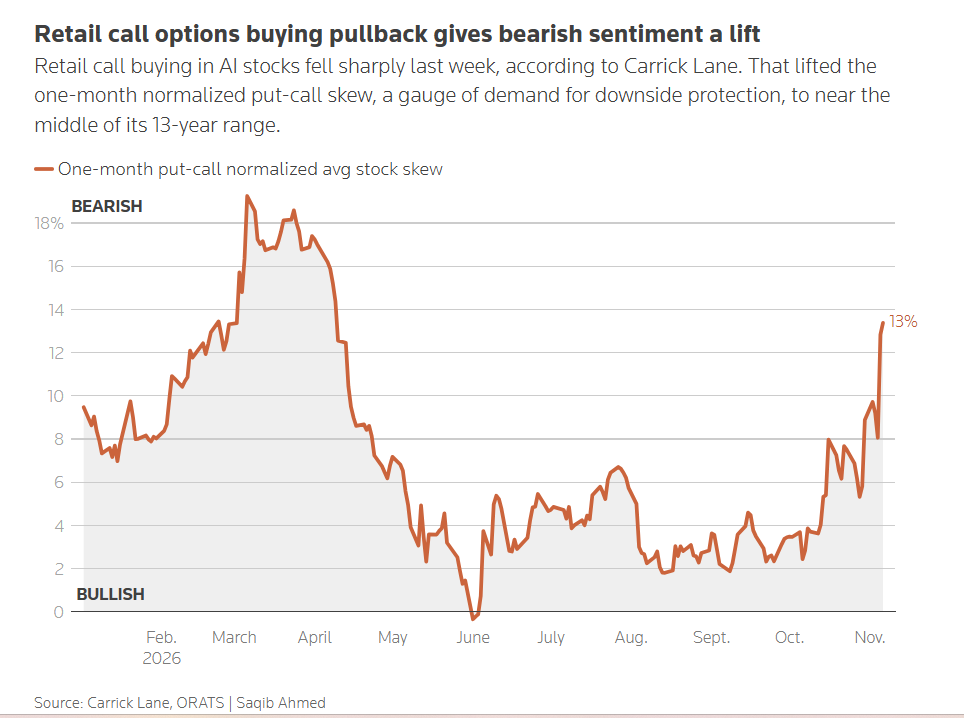
He said the change brought the one-month standardized bearish - call option bias indicator back near the middle of its past 13 year range. The indicator is used to measure the relative demand for put options, so it presents a mixed picture.
“The good news is: AI transactions won't seem crowded in the short term. The bad news is: the degree of liquidation of positions reflected in this indicator is not enough to support buying stocks based on position factors alone.” Marshall said.
The technical side still shows a cautious wait-and-see attitude of funding
While the rebound in tech stocks helped them recover some of their losses from post-election sell-offs, tech strategists remained cautious.
“We haven't really seen evidence that the market is fully clear.” Newton from Fundstrat said. Newton said that the rebound of the Invesco QQQ ETF, which tracks the Nasdaq 100 index, was blocked slightly below the downward trend line since the end of October.
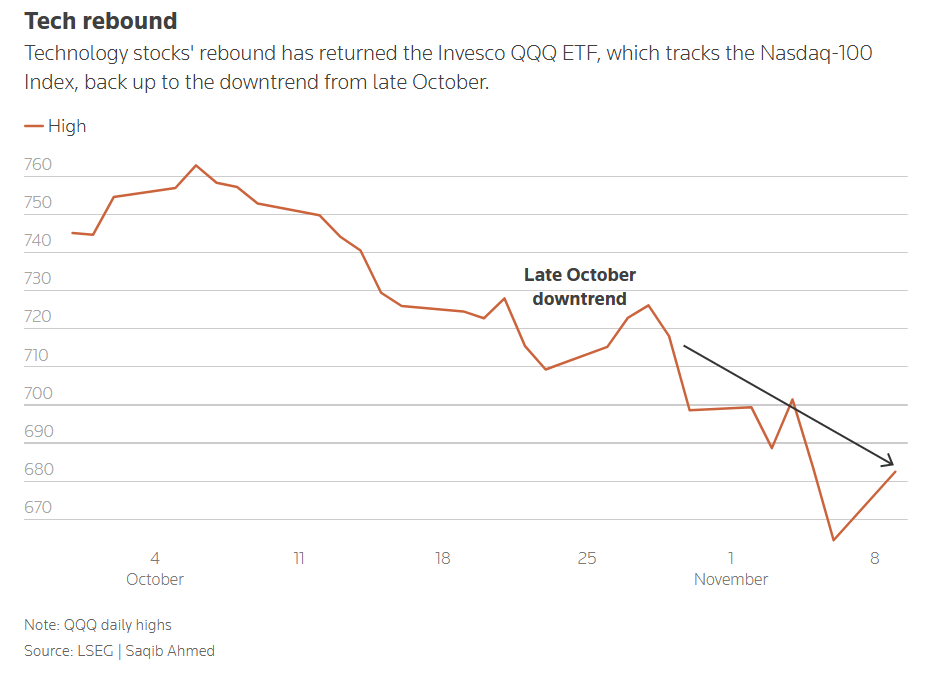
Newton said that given that short-term trends and momentum are still skewed, and there are no signs of Demark trend exhaustion — a technical signal indicating that the trend has reached its end — the US stock market is likely to continue to fluctuate for about two weeks.
“There is confidence now that last week's decline is over; it's still too early.” Newton said.