
Goodwill B (02256): Pimitinib was approved by both China and the US, and the accelerated realization of the global value of the “billion dollar molecule” became the key to allocation
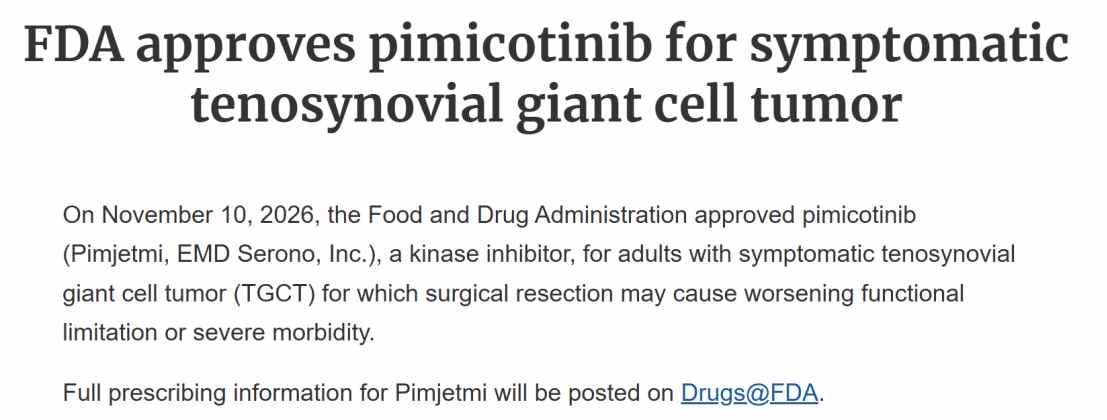
On November 10, the US Food and Drug Administration (FDA) officially announced that it has approved Pimicotinib (trade name: Pimjetmi), a kinase inhibitor independently developed by Wayu-B (02256), to be marketed in the US to treat symptomatic tendon sheath giant cell tumors (TGCT) in adults.
As a major “billion-dollar molecule” with BIC potential under Heyu, the world's first new drug marketing application for pimitinib (Betamec®) was officially approved in China in December last year.
Today, pimitinib is being marketed in many countries, including China and the US, which means that this “billion-dollar molecule” is actually being commercialized globally, and it has also brought definitive value delivery to the reputation.
At the end of 2023, Hoyo reached a “high down payment, high milestone, and high share” BD deal for pimitinib and Merck. The total potential payment amount was as high as US$606 million, plus a double-digit net sales share. In March of this year, Beijemer® issued its first prescription in China, and Wealth immediately began confirming sales share revenue. In the first half of this year, the company received a payment of 92 million yuan from Merck's first prescription tablet in China, and confirmed a sales share of 1.1 million yuan. As a result, the cumulative down payments and milestone payments collected by Kazuyo from this transaction are close to US$170 million.
The Zhitong Finance App learned that when pimitinib is commercialized for the first time in the US, it will once again trigger a milestone payment from partner Merck, which will bring Hewin a definitive revenue of 20 million US dollars at that time. This also means that pimitinib has steadily entered the stage of global hematopoiesis, and future large-scale distribution of the drug on a global scale is expected to bring clear profit fulfillment to Hewin and contribute to stable recurring cash flow.
The world's first and only model approved for listing in China and the US, further highlighting BIC's strength
For a long time, surgery was almost the main treatment for TGCT, but for diffuse TGCT, the lesion is often difficult to completely remove. Some patients require multiple surgeries, and repeated surgeries may also cause patients problems such as scarring, joint stiffness, neurovascular damage, and joint degeneration.
In recent years, with the development of targeted therapy on the CSF1/CSF1R pathway, TGCT is gradually moving from “surgery as the main focus” to an individualized treatment model combining surgery, systematic treatment, imaging evaluation, rehabilitation, and patient-reported outcomes. Several studies have shown that CSF1/CSF1R pathway inhibitors can not only shrink tumors, but also improve pain, joint mobility, physical function, and quality of life.
According to Zhitong Finance, the FIC product of Daiichi Sankyo, Pexidartinib (pesidatinib), is the first CSF1/CSF1R pathway target drug approved for specific TGCT patients in the US. It was approved for marketing in the US in 2019 as a systematic treatment for severe TGCT that cannot be improved through surgery, but the drug has serious liver toxicity and was “black box warned” by the FDA. In 2020, the EMA gave a disapproval opinion on Pexidartinib's marketing application; in April of this year, the drug's application in China was also not approved.
As the original research company for vimseltinib, the world's second CSF1/CSF1R pathway-targeting drug, Deciphera previously reported that in recent years, Pexidartinib's share of the US TGCT treatment market was only about 15%, while the market share of imatinib, which is an ultra-indicated drug, was once as high as 70%. But even so, Pexidartinib's 2023 revenue reached 5.3 billion yen, showing huge unmet treatment demand.
In contrast, pimitinib has been continuously proven to show significant BIC strength in terms of efficacy, safety, and compliance for giant cell tumors of the tendon sheath.
The approval of pimitinib in the US is mainly based on the key global phase III clinical study PROVIDER (NCT05804045). Research results showed that in terms of efficacy, when pimicotinib treated patients with unresectable TGCT for 25 weeks, the objective response rate (ORR) reached 56%, which was significantly higher than 3.2% in the placebo group. At 14.3 months of follow-up, ORR increased further to 76.2%. For rare chronic diseases such as TGCT, the curative effect was particularly outstanding; in terms of safety, most of the adverse effects were mild to moderate, concentrated on skin, edema, and abnormal laboratory enzymology indicators, and there was no serious unexpected toxicity.
Looking at the non-head-to-head horizontal data comparison, compared with the marketed drugs pexidartinib and vimseltinib with the same target and imatinib for TGCT superindications, the ALIBER study results not only once again confirmed the remarkable efficacy of pimitinib, but also provided strong evidence that it is safe and reliable for long-term use. Naturally, its BIC strength has also been highly recognized by authoritative regulatory authorities around the world.
According to the Zhitong Finance App, among the three new CSF1/CSF1R pathway-targeting drugs currently approved for TGCT treatment around the world, Pexidartinib and Vimseltinib are only marketed in the US market, while pimitinib is the first and only variety in the world to be marketed in both China and the US.
Furthermore, according to the FDA's official website, the current approval of pimitinib was approved through Project Orbis international collaborative review, which not only shortens the time gap in regulatory decisions in various countries, but also reflects the consensus and wide recognition of the drug's clinical needs worldwide. While further highlighting the strength of pimitinib BIC, it is also expected to promote its registration and marketing process in other markets around the world. Currently, pimitinib has been approved for marketing in Canada and Switzerland based on Project Orbis.
Entering the global commercialization stage, the “billion-dollar molecule” value delivery accelerates
As mentioned above, thanks to the active action of partner Merck, Kazuyo has now collected nearly US$170 million in down payments and milestone payments from this BD transaction, which also shows Merck's “must win” attitude and confidence in future global sales of pimitinib.
In fact, as a “billion-dollar molecule,” pimitinib's accelerated value delivery during the global commercialization phase is a greater driving force for the continued increase in the certainty of Heyuan's subsequent investments.
Taking the US market as an example, TGCT adds 14,000 to 18,000 new patients in the US every year. Of these, 2% of patients are unsuitable for surgical treatment, and there are 2000-2,400 patients who have recurred after surgery. For patients who are unsuitable for surgery or recurrence after surgery and require systemic treatment, the US adds about 1300 to 1,400 new patients every year, while the current number of patients is around 8,000.
Referring to Fabrazyme for Fabry disease, Strensiq for hypophosphatasia, and Takhzyro for preventing hereditary angioedema, these 3 billion dollar varieties all correspond to fewer than 10,000 patients. In other words, the number of 8,000 patients in the US market is enough to support a market size of over 1 billion US dollars.
In the Chinese market, the incidence rate of TGCT in China has also remained relatively stable in recent years, with about 71,300 cases. Due to improved diagnostic capacity and increased disease awareness, the incidence rate is expected to rise slightly to 72,500 cases by 2032. The corresponding market size is expected to rapidly expand from RMB 157 million in 2024 to RMB 1,543 billion in 2032, with a compound annual growth rate of 33.1%.
In the current context of TGCT treatment gradually moving from “surgery-centered” to an individualized treatment model, pimitinib is expected to use its BIC strength and first-mover advantage to occupy an important share in the two major markets of China and the US and the future global TGCT treatment market.
Earlier, China Merchants Securities International published a research report stating that pimitinib developed by Heyu is the CSF-1R small molecule with the best curative effect in the world. The bank believes that Merck has high expectations for this group and is expected to reach a peak of nearly 1.5 billion US dollars in global sales revenue.
Furthermore, as a potential global BIC drug on the CSF-1R inhibitor circuit, pimitinib not only has outstanding TGCT indications, but also has more room for imagination in various indications such as cGVHD. As treatment space for various indications continues to be explored, its global commercial hematopoietic potential as a “billion-dollar molecule” is expected to be realized at an accelerated pace.
epilogue
In the current environment, an important sign that an innovative pharmaceutical company has high investment certainty is to switch the company's cash cycle pillar from financing cash flow to net operating cash flow. This requires pharmaceutical companies to have a “phenomenal” cash cow product to support it. Today, the core product pimitinib has been approved for marketing in countries such as China, the United States, Canada, and Switzerland, providing key conditions for the steady growth of Heyuan's intrinsic value.
Furthermore, Heyu is also one of the few innovative pharmaceutical companies in the Hong Kong Stock Market 18A that gives back to investors through continuous stock buybacks. Since the beginning of the year, the company has repurchased a total of 2.384 million shares 47 times, involving more than HK$20 million.
As Heyu officially enters a new stage of commercial hematopoiesis, in the future, with abundant cash flow support from the company's “billion dollar molecule”, it is expected to accelerate the construction of a closed loop of its own differentiated innovation, and accelerate its transition to the international leader Biopharma in systematic competition in various fields such as global R&D, overseas registration, and international commercialization.
Based on an optimistic judgment on the future growth of Horizon, several institutions have recently updated their research reports on the company, reaffirming the “buy” or “gain” ratings. Among them, China Merchants Securities International released a research report stating that it maintains the target price of HK$32.5 and the “increase in holdings” rating, and indicates that the company is currently significantly undervalued by the market.