
“Standing in the Light” Corning (GLW.US) was first “bought” by Jefferies! AI factories are stealing optical fiber, and the global supply gap may reach 30%
The Zhitong Finance App learned that Wall Street financial giant Jefferies announced that it covered Corning (GLW.US) (GLW.US), the leader in fiber and optical connectivity solutions in AI data centers for the first time, and gave “buy” the most optimistic rating and a bullish target of $134, driving Corning's stock price to surge 7.43% to $120.460 as of Wednesday.
Dushyant Ailani, a senior analyst from Jefferies, first covered Corning's core logic is that the huge gap in the global fiber supply level in 2026 is about 30% of demand, and the shortage is expected to continue for a long time. The shortage can be described as very helpful for Corning to lock in orders for many years and fill new fiber production capacity with products with higher value and higher integration density.
According to the investment agency's latest estimates, Corning's photonics business is expected to expand from 2028 to bring an incremental opportunity of about 10 billion US dollars by 2030. According to its valuation scale, Corning's ratio of corporate value to EBITDA (FY2 EV/EBITDA) for the second fiscal year has dropped from a summer high of about 32 times to 14 times, and is beginning to be cost-effective when buying on dips. Therefore, Jefferies is optimistic about this investment window, based on the fact that the existing optical communication business is already making profits, and there is room for internal optical connectivity to the device to grow as the mass production platform expands.
For Corning, the current increase in profit comes from the expansion of the AI cluster. The more links across cabinets and campuses, and the more customers need to install more fibers in limited piping and cabinet space, the more opportunities Corning has to use high-density optical cable product lines, pre-terminated components, and high-speed optical connection systems to increase the supply value of each link. Years of procurement commitments also made sales volume more predictable after production expansion. This logic was reflected in the third quarter. Optical Communications sales increased 44% year over year, and the division's net profit increased 80%.
In addition, Corning's next round of growth comes from co-packaged optics (CPO) moving optoelectronic conversion closer to the chip, and GPU scale-up networks (scale-up) gradually adopting optical connections. The former allows Corning to cut into a precise optical path inside the device, while the latter increases the optical connectivity required for each GPU. Jefferies anticipates that the photonics business is expected to accelerate in 2028, bringing incremental revenue opportunities of about $10 billion by 2030.
From glass manufacturer to AI optical interconnect infrastructure supplier
Jefferies analyst Dushyant Ailani covered Corning for the first time, giving a “buy” rating and a target price of $134. In his research note to clients, the analyst wrote, “Corning is a materials science company based on glass, ceramics, and optical physics. It changed from a glass manufacturer with diverse businesses and performance closely related to the consumer electronics and display markets to an investment target in the AI optical infrastructure sector, and the market valuation was also significantly re-evaluated.”
“We anticipate that the current shortage of global fiber supply will continue, with a gap equivalent to approximately 30% of 2026 demand. This will benefit Corning, increase demand visibility, strengthen customers' multi-year procurement commitments, and enable the company to use the additional capacity to produce higher-value, more integrated products.” Analyst Ailani wrote.
Regarding Corning's focus on the future long-term growth prospects of the next round of optical product lines, the analyst said: In the long run, the photonics business volume from 2028 will bring additional growth opportunities. We estimate that by 2030, the scale of this opportunity will reach $10 billion, or about 25% of the estimated revenue for 2030. Corning's valuation benchmark once reached about 32 times the EBITDA forecast for the second fiscal year this summer, then fell back to about 14 times, but is still significantly higher than the high single-digit level from 2021 to 2024. Despite the recent recovery in stock prices, they are still close to recent lows. As demand for optical connectivity in AI data centers grows, we believe the stock price of this premium beneficiary still provides an attractive entry opportunity.”
In addition to Jefferies, a number of Wall Street financial giants have recently submitted bullish research reports at a time when Corning's stock price has declined sharply due to concerns about stagnant data center construction brought about by the Democratic Party's overall victory in the US midterm elections, heavy pressure on AI financing costs, and the recent deleveraging storm on the subject of AI transactions. Based on the same closing price, UBS maintained a “buy”. The target price dropped from $201 to $192, implying an increase of 59.4%. At the same time, it revised its earnings forecast per share for the next three years, and is optimistic about the improvement in optical interconnection volume and profit margins within the cluster.
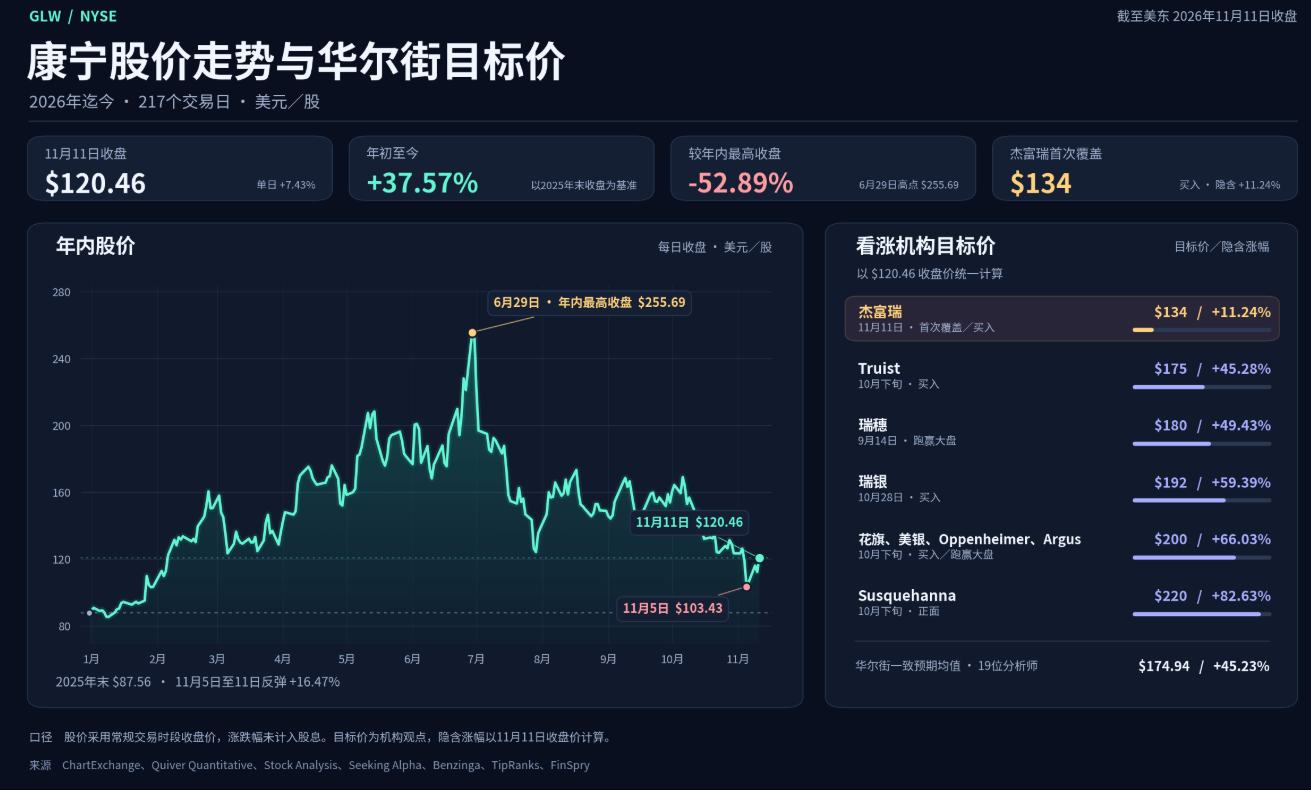
Another Wall Street giant, Citi, maintained a “buy”. The target price dropped from 220 US dollars to 200 US dollars, implying 66.0% potential share price increase; the agency believes that optical communication performance has exceeded expectations, but solar energy is climbing slowly, and peer valuations have also declined somewhat. Truist also maintained a “buy” with a target price of $175, implying a potential upside of 45.3%, and significantly revised the profit forecast due to the growth of optical communications and the new growth contract for the new optical business. The common denominator of these bullish judgments is that profit expectations for the data center construction process linked to Corning's optical communications business are improving, and the target price still depends on the product line launch time and the valuation multiples the market is willing to give.
Two rounds of “optical growth” opportunities belonging to Corning - the optical network expands outward and the optical path extends to the chip
For Corning, the recent increase in profits is mainly due to the expansion of the AI cluster. As optical links across cabinets and campuses increase, customers need to deploy more optical fibers within limited piping and cabinet space, thereby driving demand for high-density optical cables and connectivity systems.
More importantly, as a leader in AI data center fiber and optical connectivity solutions, Corning can be described as benefiting from the expansion of large-scale data center optical networks across cabinets and campuses, and is using co-packaged optics (CPO) to extend the scope of supply to cutting-edge precision optical paths within the device and close to the chip.
Corning's two rounds of landmark growth opportunities came from a wider network and closer optical connectivity to the chip. In the first round, the larger the AI cluster and the more optical links across cabinets and campuses, Corning sold more high-density optical cables, connectors, and wiring systems. In the second round, the photoelectric conversion moved from the front panel of the device to the vicinity of the switching chip, and Corning was able to extend the scope of supply to the precise optical path inside the device. The larger potential increase comes from the GPU's vertical expansion network starting to use up light, increasing the usage of high-speed optical connectivity systems corresponding to each GPU.
As required across cabinets, data must be exchanged frequently from GPUs. Large model training requires synchronizing gradients and transmitting intermediate results between different GPUs, and mixed expert models (MoE) also need to send different tokens to corresponding experts. Communications can't keep up, and expensive GPUs wait for data. As clusters expand from dozens of cabinets to hundreds of cabinets, scale-out networks (scale-out) connect computing nodes via Ethernet or InfiniBand. An increase in nodes will increase the number of access ports and uplinks, and the switching layer may also be added as the cluster expands further. Corning therefore supplies cover cabinet jumpers, pre-terminated components, high-core backbone optical cables, and wiring systems, all connecting links throughout a link.
Cross-park demand comes from restrictions on computing power site selection due to electricity and construction conditions. When it is difficult for a single campus to obtain sufficient grid-connected capacity, land, and computer room space at the same time, operators will distribute the capacity across multiple sites and then use data center interconnect (DCI) connections. Cross-campus transmission increases cable mileage and increases pipeline capacity and deployment speed requirements. That's the value of Corning's high-density products. The same pipeline can accommodate more fiber cores, and customers can use existing routes to expand capacity and reduce the cost of re-excavation and cabling. At the same time, wavelength division multiplexing (WDM) and multi-core fiber can increase the transmission capacity of a single fiber, so Corning's revenue elasticity depends on the number of additional links, wiring density, and the value of components used in each link. Looking at port rates alone, it is easy to overestimate fiber core requirements.
This round of growth has been reflected in financial reports. In the third quarter of 2026, Corning Optical Communications's sales reached US$2,379 million, up 44% year on year, and the division's net profit increased 80% to US$532 million. The division's net profit margin in terms of sales rose from approximately 17.9% to 22.4%. Enterprise network sales increased by 84%, and sales of generative AI products increased by more than 100%. At the same time, management pointed out that additional production capacity, rising actual transaction prices, and high-value products are jointly driving revenue growth. Meta's multi-year supply agreement of up to $6 billion also covers fiber, cable, and connectivity products, indicating that major customers are locking in the full range of cabling supply capabilities.
In the second round, as optoelectronics moved closer to the chip, Corning began supplying precise optical paths within the equipment. Co-packaged optics (CPO) places the optical engine and switching chip in the same package, while near-package optics (NPO) uses a separate package to place the optical engine near the chip. Both shorten the high-speed electrical path. When the cabinet's power and cooling budget is fixed, reducing the energy consumption per bit of interconnect can leave more power and cooling headroom for computing devices. Nvidia is already using this route for the Spectrum-X Ethernet Photonics switches that are in production, spearheading horizontal expansion and cross-campus networks.
Corning's new supply chain accurately sends light from the front panel of the device to the photonic integrated circuit (PIC). The optical engine undertakes electro-optical conversion, and Corning supplies passive devices along the way, including high-density panel connectors, bend-resistant optical fibers suitable for small spaces, pre-installed fiber trays, and fiber array units (FAU) that accurately align multiple fibers to the chip's optical interface.
Taking GlassBridge as an example, Corning integrates a precision waveguide into the glass to form a detachable optical interface. The value here comes from assembly accuracy and mass production capacity: a large number of optical channels must simultaneously meet insertion loss, bending radius, alignment accuracy, and reliability requirements in a small space. By co-designing, pre-installing, and testing these components according to the customer's chassis, Corning has an opportunity to increase the delivery value of a single device.
Greater flexibility in usage comes from scale-up (scale-up), which means that more GPUs work together in the same low latency, high bandwidth domain. NVLink in the Nvidia Vera Rubin NVL72 cabinet still uses about 5,000 copper cables, and the short-range copper connection has a mature engineering foundation. When it comes to the planned Rubin Ultra NVL576, Nvidia will include eight cabinets in the same 576 GPU NVLink domain, and combine copper connections with direct optical links. CPO and NPO decide where to place the photoelectric conversion, and scale-up photochemistry determines how many links originally carried by copper will be varnished. The latter is directly related to how many additional optical connectivity requirements each GPU can bring to Corning.
Corning Investor Day put this difference very intuitively. In its Rubin Ultra schematic architecture, each GPU corresponds to about 16 optical fibers when only the light is scaled horizontally. If the vertical expansion link is completely photonized according to the 200 Gb/s scheme per channel and one optical fiber for each transceiver, an additional 144 will be added, for a total of about 160. This is an all-light scenario under the specified architecture. Corning estimates the usage of optical connections per GPU in 2028 is 1.3 to 1.5 times the current level, and sees about $10 billion in 2030 as a potential revenue opportunity for its photonics business.