
Vericel (VCEL) Raised Guidance, Is The Upside Already Priced In?
Vericel (VCEL) has just posted third quarter results that showed higher revenue and net income compared with a year earlier, raised full year sales guidance, and completed a modest share repurchase program.
Vericel’s latest earnings, higher sales guidance and completed buyback have landed against a powerful run in the shares, with a 7 day share price return of 30.7% and a 30 day share price return of 46.4% pushing the stock to US$59.45. Over a longer stretch, momentum has been building too, with a year to date share price return of 67.0% and a 1 year total shareholder return of 47.0% supported by multi year total shareholder returns of 64.9% over 3 years and 40.4% over 5 years, which helps explain why investors are focusing closely on how the recent operating results reset expectations for future growth and risk.
Compare Vericel’s earnings-fueled surge with other healthcare names showing strong fundamentals by checking our hand picked list of solid balance sheet and fundamentals (23 results) in the same space.
After a run like this and a modest buyback already in the rear view mirror, the key issue now is simple: Does Vericel’s current price still offer a compelling trade off between potential upside and risk when you line it up against its valuation metrics?
Most Popular Narrative: 0% Undervalued
Vericel’s last close at $59.45 sits almost exactly on the analyst consensus Narrative fair value of about $59.71. The analyst consensus Narrative on Simply Wall St bases this on detailed revenue and earnings forecasts and a 7.53% discount rate.
Ongoing operational initiatives including the now approved Burlington manufacturing facility, automation and the approximately 30% MACI sales force expansion effective in 2026 are shifting from a transition year of fixed cost absorption toward the company’s goal of around US$500m revenue and high 30% adjusted EBITDA margins by 2029. If achieved, this would improve net margins.
See why 9 investors see Vericel as 0% undervalued.
Result: Fair Value of $59.71 (ABOUT RIGHT)
Still, Vericel’s reliance on a small product set and the heavier fixed cost base planned for 2026 could pressure the story if procedure volumes underwhelm.
Find out about the key risks to this Vericel narrative.
Another View: Vericel Looks Rich On Earnings Multiples
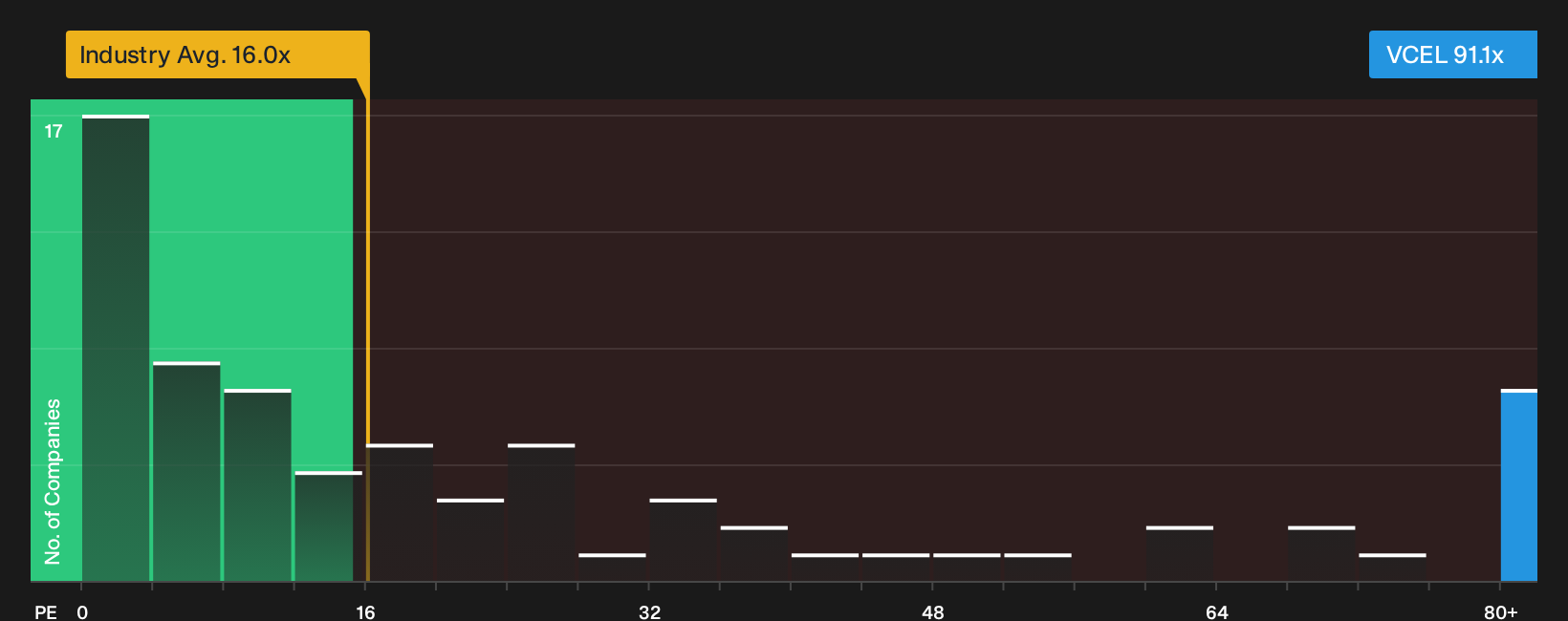
On the flip side of that fair value narrative, Vericel trades on a P/E of 91.1x, which is far higher than the US Biotechs industry on 15.4x and a peer average of 11.9x. It also sits well above a fair ratio of 23.9x. That gulf points to meaningful valuation risk if sentiment cools or growth expectations are revised.
For a closer look at what this gap might mean in practice, including how the current P/E could re-rate toward that fair ratio over time, See what the numbers say about this price — find out in our valuation breakdown.
Next Steps
With sentiment this strong around Vericel, you should pressure test the story against your own risk tolerance and time horizon, then weigh those 2 key rewards using the 2 key rewards.
Looking for more investment ideas beyond Vericel?
If Vericel has sharpened your focus on valuation and risk, do not stop here. Broaden your watchlist now and give yourself more options.
- Target potential mispricing by scanning for companies that combine quality fundamentals with lower valuations using the 32 high quality undervalued stocks.
- Prioritise resilience and sleep better at night by filtering for businesses with robust finances through the 30 resilient stocks with low risk scores.
- Hunt for future leaders before the crowd catches on by reviewing the 19 high quality undiscovered gems.
Have feedback on this article? Concerned about the content? Get in touch with us directly. Alternatively, email editorial-team@simplywallst.com