
How Investors Are Reacting To U.S. Physical Therapy Stock After Earnings Loss
- U.S. Physical Therapy reported third quarter 2026 revenue of US$222.56 million and net income of US$11.05 million, while recording a basic loss per share from continuing operations of US$1.04, compared with basic earnings per share from continuing operations of US$0.48 a year earlier.
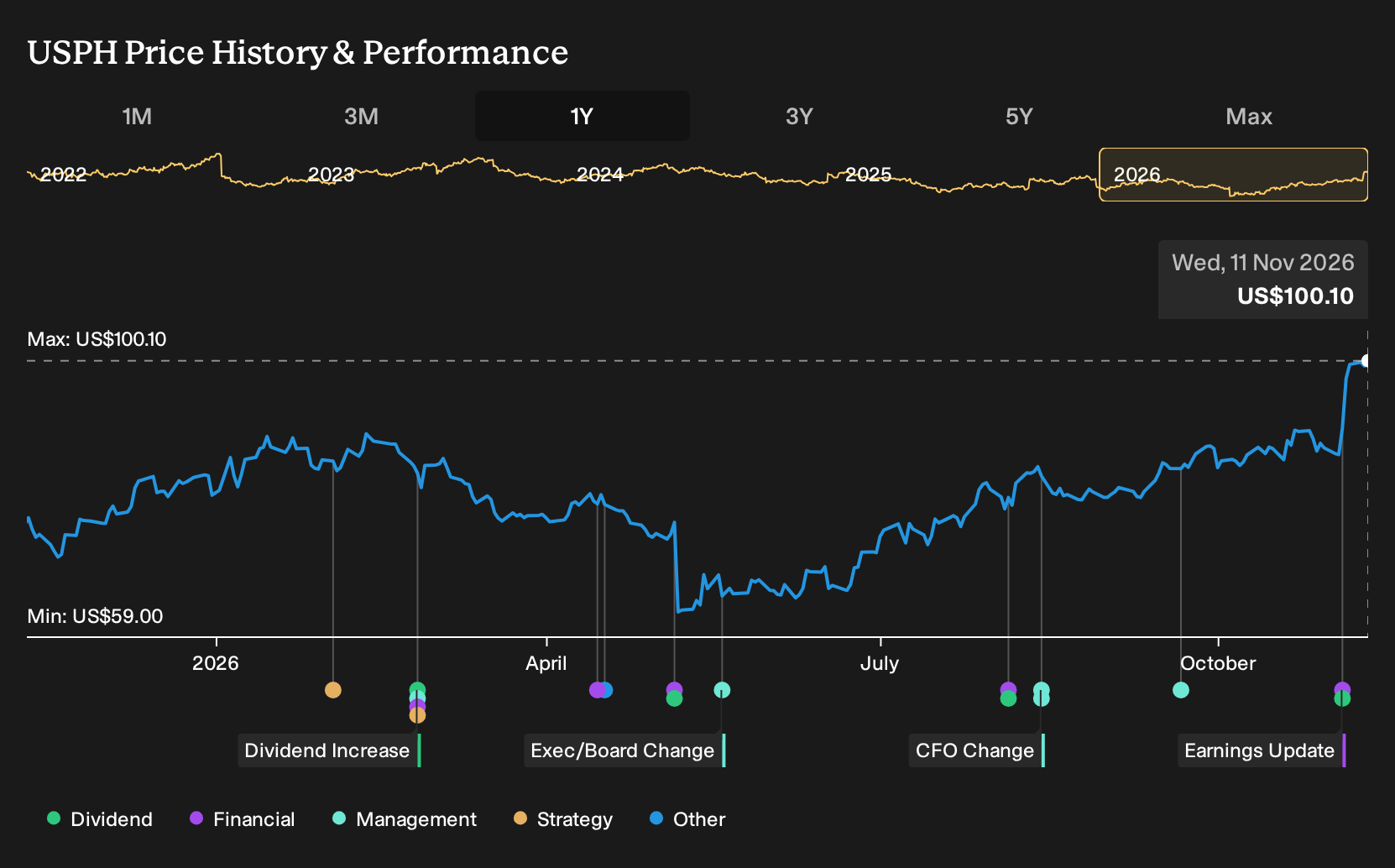
- The firm has kept its US$0.46 quarterly dividend for December 2026 in place, even as nine month net income declined versus the prior year and earnings from continuing operations moved to a basic loss per share, highlighting a tension between shareholder payouts and current profitability.
- We will examine how U.S. Physical Therapy's investment narrative holds up in a period of higher revenue alongside weaker earnings and a reported loss.
Compare U.S. Physical Therapy's mix of higher revenue and weaker earnings with other hand picked businesses by scanning our list of solid balance sheet and fundamentals (23 results), which are keeping their financial footing steadier.
U.S. Physical Therapy Investment Narrative Recap
For U.S. Physical Therapy, the main view is that strong clinic volumes, hospital affiliations and the Industrial Injury Prevention arm could eventually support healthier profitability again. The latest quarter shows that higher revenue is not yet flowing through to the bottom line, with a reported loss per share from continuing operations despite higher sales.
In the near term, the key catalyst highlighted in the analyst consensus Narrative on Simply Wall St is execution on cost control and technology rollouts that target margins. The biggest operational risk is that reimbursement and labor pressures persist, which would limit any earnings recovery and keep returns on capital and dividend cover looking tight.
The decision to keep the US$0.46 quarterly dividend for December 2026 is the most relevant announcement here. That payout sits against nine-month net income of US$25.98 million and a basic loss per share from continuing operations, so income-focused investors are receiving dividends while profitability from core operations remains under strain.
For catalysts, that dividend decision increases the focus on whether hospital affiliation growth, acquisitions and Industrial Injury Prevention can support both reinvestment and shareholder returns. If reimbursement, wage costs or self-insured medical expenses stay elevated, the gap between cash needs for growth and cash paid out could become a more pressing issue to monitor.
U.S. Physical Therapy's analyst narrative points to revenue of US$1.0b and earnings of US$95.0 million by 2029, based on expectations of 8.0% yearly revenue growth and an earnings shift of roughly US$115.1 million from earnings today of a US$20.1 million loss.
Uncover why U.S. Physical Therapy's fair value indicates a 4% potential upside to its current price before that discount to expectations closes.
Exploring Other Perspectives
Fair value inputs from 2 Simply Wall St Community members cluster between about US$104 and US$139 per share, so U.S. Physical Therapy screens as materially over or underpriced depending on whose model you trust. Those views sit beside live questions on reimbursement pressure, labor costs and the dividend, which you can compare by exploring more community perspectives.
Explore another U.S. Physical Therapy fair value estimate, including one that suggests as much as 38% potential upside from the current price.
Decide For Yourself
Disagree with existing narratives? Extraordinary investment returns rarely come from following the herd, so go with your instincts.
- A great starting point for your U.S. Physical Therapy research is our analysis highlighting 2 key rewards and 1 important warning sign that could impact your investment decision.
- See our latest analysis for U.S. Physical Therapy. The report includes a comprehensive fundamental analysis summarized in a single visual, the Snowflake, making it easy to evaluate U.S. Physical Therapy's overall financial health at a glance.
Looking for more investment ideas beyond U.S. Physical Therapy?
If you want to test your view on U.S. Physical Therapy against a wider opportunity set, use the Simply Wall St Screener to scan for other businesses that better fit your income, risk or value preferences.
- If reliable cash generation and lower balance sheet stress matter most to you, start with a curated list of solid balance sheet and fundamentals (23 results) that already filters for stronger financial footing.
- If value is your edge and you prefer paying less for quality, review a focused pool of 32 high quality undervalued stocks that may align more closely with your return expectations.
- If steady income is a priority and you want yields above 5%, scan through a hand picked set of 6 dividend fortresses that combine higher payouts with supporting fundamentals.
Have feedback on this article? Concerned about the content? Get in touch with us directly. Alternatively, email editorial-team@simplywallst.com