
Wolverine Worldwide’s Q3 2026 sales beat estimates

Footwear conglomerate Wolverine Worldwide (NYSE:WWW) reported revenue ahead of Wall Street’s expectations in Q3 2026, with revenue up 7.5% year on year to $505.4 million. The company expects the full year’s revenue to be around $2.01 billion, close to analysts’ consensus estimates. Its non-GAAP profit of $0.79 per share was 72.6% above analysts’ consensus estimates.
For more on Wolverine Worldwide, read the full research report for free.
Wolverine Worldwide Q3 2026 highlights:
- Revenue $505.4 million vs. S&P consensus estimates of $499.7 million (7.5% year-on-year growth, 1.1% beat)
- Adjusted EPS $0.79 vs. S&P consensus estimates of $0.46 (72.6% beat)
- Revenue guidance The company slightly lifted its revenue guidance for the full year to $2.01 billion at the midpoint from $1.99 billion
- Adjusted EPS guidance Management raised its full-year adjusted EPS guidance to $1.97 at the midpoint, a 23.1% increase
- Operating margin 17.7%, up from 8.4% in the same quarter last year
- Free cash flow margin 13.2%, up from 6.4% in the same quarter last year
- Market capitalization $1.8 billion
"We delivered a strong third quarter performance, led by our two largest brands and disciplined execution across the business," said Chris Hufnagel, President and Chief Executive Officer of Wolverine Worldwide. "This quarter, now our eighth consecutive quarter of growth, is further evidence that our transformation story is also a growth story – with continued earnings improvement and a healthier balance sheet providing us greater capacity to invest behind our brands and the opportunities we see ahead. While we continue to navigate a dynamic environment – based on our year-to-date results and our expectations for the final quarter of the year – we're raising our outlook for 2026."
Revenue growth
Reviewing a company’s long-term revenue performance reveals insights into its quality. Any business can post a good quarter or two, but the best consistently grow over the long term. Wolverine Worldwide’s demand was weak over the last five years as its revenue fell at a 2.8% annual rate. That underwhelming result is a sign of poor business quality.
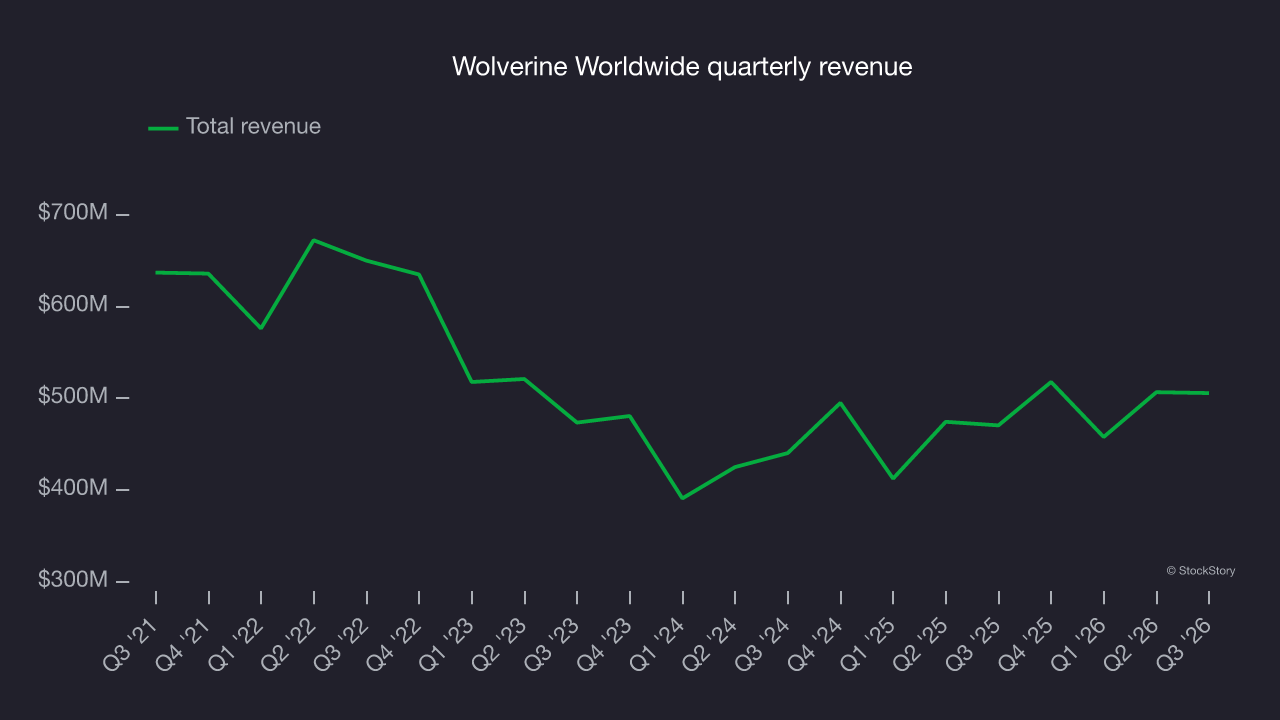
Long-term growth matters most, but within consumer discretionary, a stretched historical view may miss a company riding a successful new product or trend. Wolverine Worldwide’s annualized revenue growth of 7% over the last two years is above its five-year trend, a positive sign.
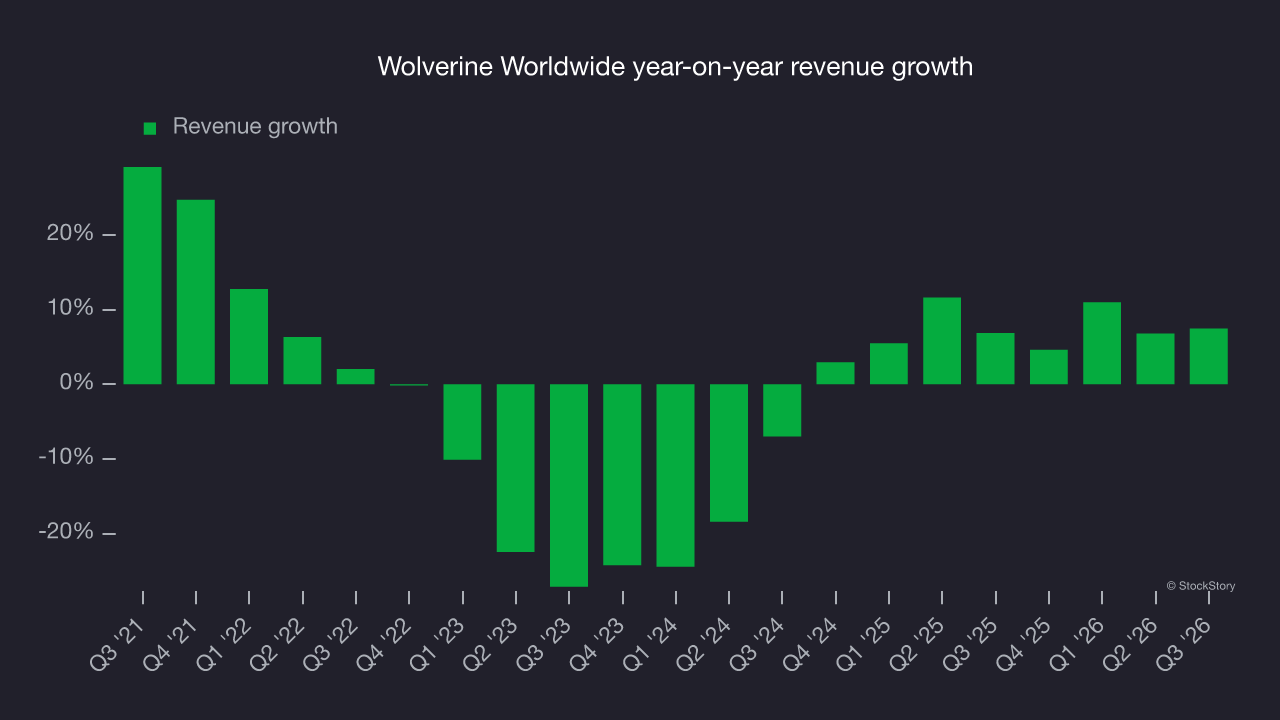
This quarter, Wolverine Worldwide reported year-on-year revenue growth of 7.5%, and its $505.4 million of revenue exceeded Wall Street’s consensus estimates by 1.1%.
Looking ahead, sell-side analysts expect revenue to grow 5.1% over the next 12 months, according to S&P, a slight deceleration versus the last two years. This underwhelming projection indicates its products and services will see some demand headwinds.
Operating margin
Operating margin is a key measure of profitability. Think of it as net income, the bottom line, excluding the impact of taxes and interest on debt, which are less connected to business fundamentals.
Wolverine Worldwide’s operating margin has risen over the last 12 months and averaged 9.4% over the last two years. The company’s improved efficiency is a positive, but its suboptimal cost structure still leaves it with thin profitability for a consumer discretionary business.
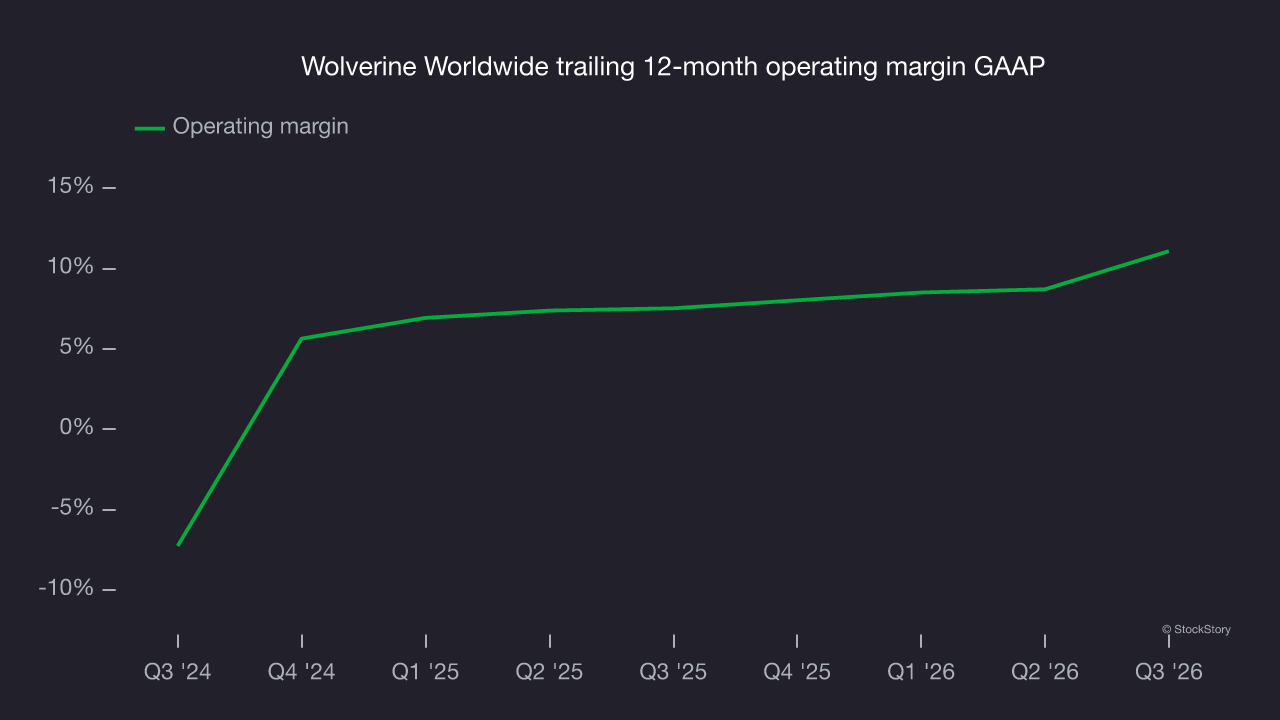
In Q3, Wolverine Worldwide generated an operating profit margin of 17.7%, up 9.3 percentage points year on year. This was a positive development, reflecting improved efficiency.
Earnings per share
We track the long-term change in earnings per share, or EPS, for the same reason as long-term revenue growth. Compared to revenue, however, EPS highlights whether a company’s growth is profitable.
Wolverine Worldwide’s flat EPS over the last five years was weak but better than its 2.8% annualized revenue declines. This tells us management adapted its cost structure.
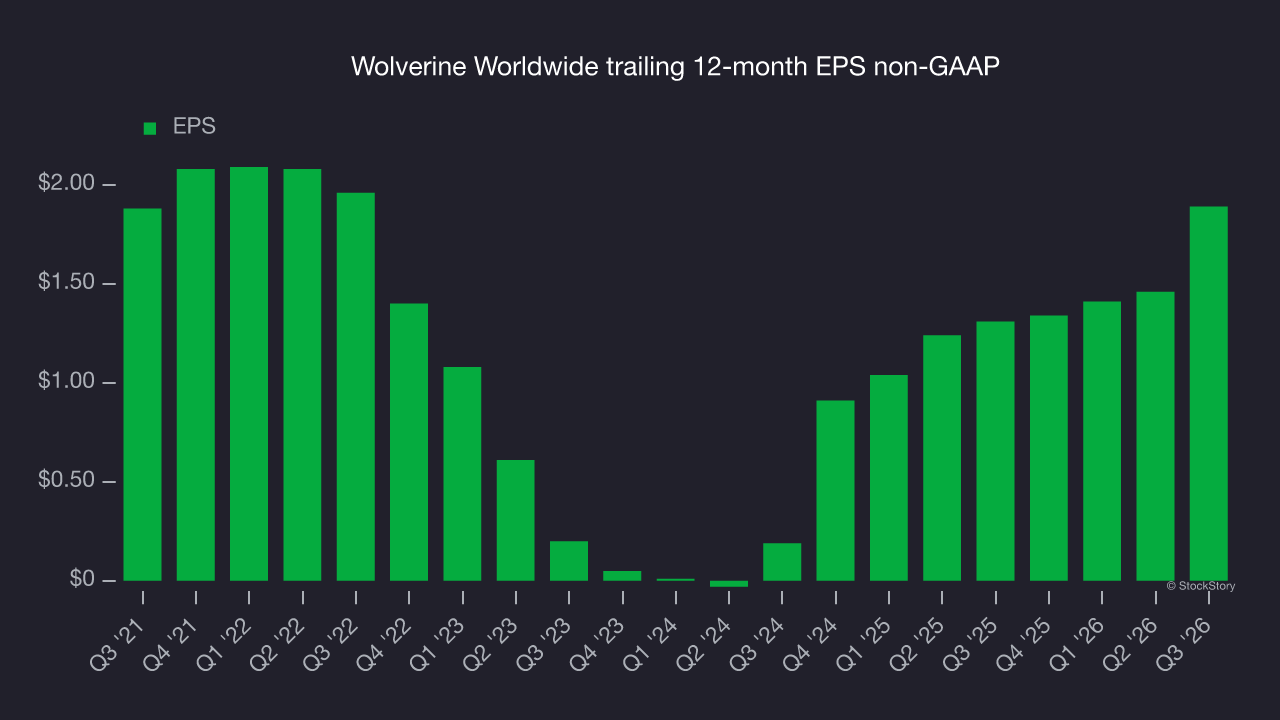
In Q3, Wolverine Worldwide reported adjusted EPS of $0.79, up from $0.36 in the same quarter last year. The result came in well above analysts’ consensus estimates. Over the next 12 months, Wall Street expects Wolverine Worldwide’s full-year EPS to shrink by 4.6% from $1.89 to $1.80, according to S&P.
Key takeaways from Wolverine Worldwide’s Q3 results
An EPS beat and full-year EPS guidance above Wall Street’s consensus estimates after being raised gave Wolverine Worldwide’s quarter some key positives. Shares rose 2.6% to $22.49 immediately after the results.
Wolverine Worldwide reported solid earnings, but one quarter doesn’t necessarily make the stock a buy. Assessing whether it is a good investment depends more on longer-term business quality and valuation than on the latest quarter. For more on Wolverine Worldwide, read the full research report here (it’s free).