
Is DoorDash (DASH) Undervalued On Lyft Go And Its DoorDash Tie Up?
Lyft’s new Lyft Go membership, which lets riders earn credits redeemable for Lyft trips or DoorDash (DASH) orders and bundles DashPass into a single subscription, has pushed DoorDash into the center of rideshare loyalty economics.
For investors watching DoorDash, the picture is mixed. The share price has drifted lower this year, with a year to date share price return down 18.9%. However, the three year total shareholder return of 87.5% still points to a strong longer term payoff profile.
See how Lyft’s partnership with DoorDash fits alongside other platform players by checking a curated set of 19 high quality undiscovered gems that may be flying under most investors’ radar.
DoorDash has delivered strong multi year shareholder returns, yet the stock has retreated this year and now trades at a sizable discount to some published value estimates. Is most of the payoff already cashed in, or is there still clear upside ahead?
Most Popular Narrative: 28% Undervalued
On the analyst consensus Narrative on Simply Wall St, DoorDash screens as undervalued, with a fair value of about $249 against a last close of $178.26. That view leans heavily on how newer growth engines reshape earnings over time.
The main thing that has to go right is that DoorDash turns fast-growing grocery, retail, and international operations into consistently gross profit positive businesses while keeping delivery affordable and managing rising regulatory and competitive pressures.
The current valuation implies that the market is not fully pricing in this narrative’s bullish view that DoorDash is undervalued relative to the long-term earnings power suggested by expansion into new verticals, international scale up, and higher margin subscription and advertising revenue.
See why 82 investors see DoorDash as 28% undervalued.
Result: Fair Value of $249 (UNDERVALUED)
Still, two pressure points could upset that 28% undervalued storyline for DoorDash: tighter regulation on worker pay and heavier spending to stay competitive in grocery delivery.
Find out about the key risks to this DoorDash narrative.
Another View on DoorDash’s Valuation
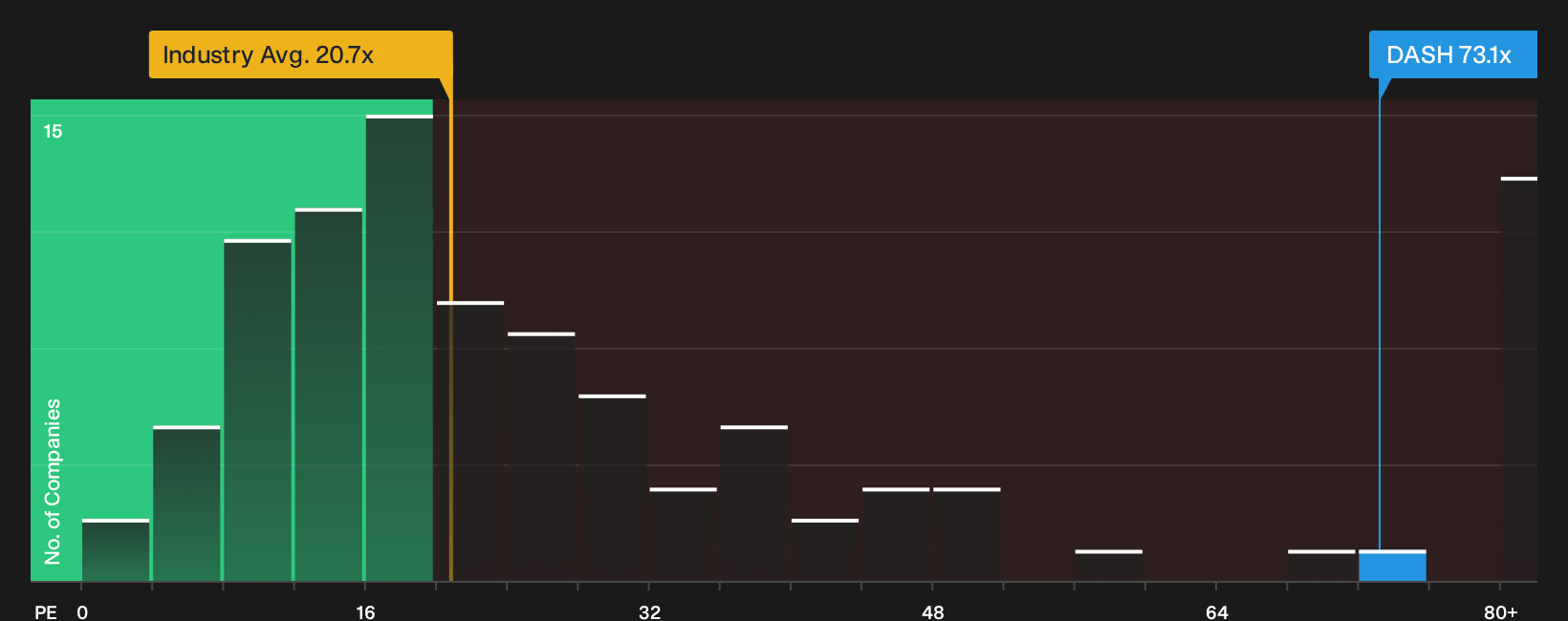
That 28% upside story rests on future earnings power, yet today DoorDash trades on a P/E of 73.1x, which is rich compared with a fair ratio of 50.7x, the US Hospitality industry at 20.7x, and peers at 28.1x. Does that premium signal confidence, or does it leave less room for error?
Investors who want to pressure test that higher multiple against the earnings outlook can review a detailed breakdown of how current pricing stacks up to these benchmarks and the fair ratio in our valuation summary, then decide which assumptions feel realistic for their own thesis. See what the numbers say about this price — find out in our valuation breakdown.
Next Steps
Mixed signals on DoorDash can create hesitation, yet the real edge comes from seeing the evidence firsthand and forming your own view quickly. To weigh both the concerns and the potential upside, start with the 4 key rewards and 1 important warning sign.
Looking for more investment ideas beyond DoorDash?
DoorDash is only one piece of your portfolio puzzle, and widening the opportunity set now can matter more than debating a single ticker’s next move.
- Target potential mispricings by scanning a focused set of high quality opportunities through the 32 high quality undervalued stocks.
- Strengthen your downside protection by zeroing in on companies with cleaner finances using the list of solid balance sheet and fundamentals (23 results).
- Lock in reliable income ideas by hunting for resilient payers through the 6 dividend fortresses.
Have feedback on this article? Concerned about the content? Get in touch with us directly. Alternatively, email editorial-team@simplywallst.com