
Jensen Huang Just Resigned From Nvidia. Your Investment Could Still Lose Another 22%.
Nvidia (NVDA) investors have had a rough week, and the news just got worse. CEO Jensen Huang has resigned from the artificial intelligence chip giant following revelations about his personal relationships and allegations involving Chinese intelligence. Chief Financial Officer Colette Kress has been named interim CEO.
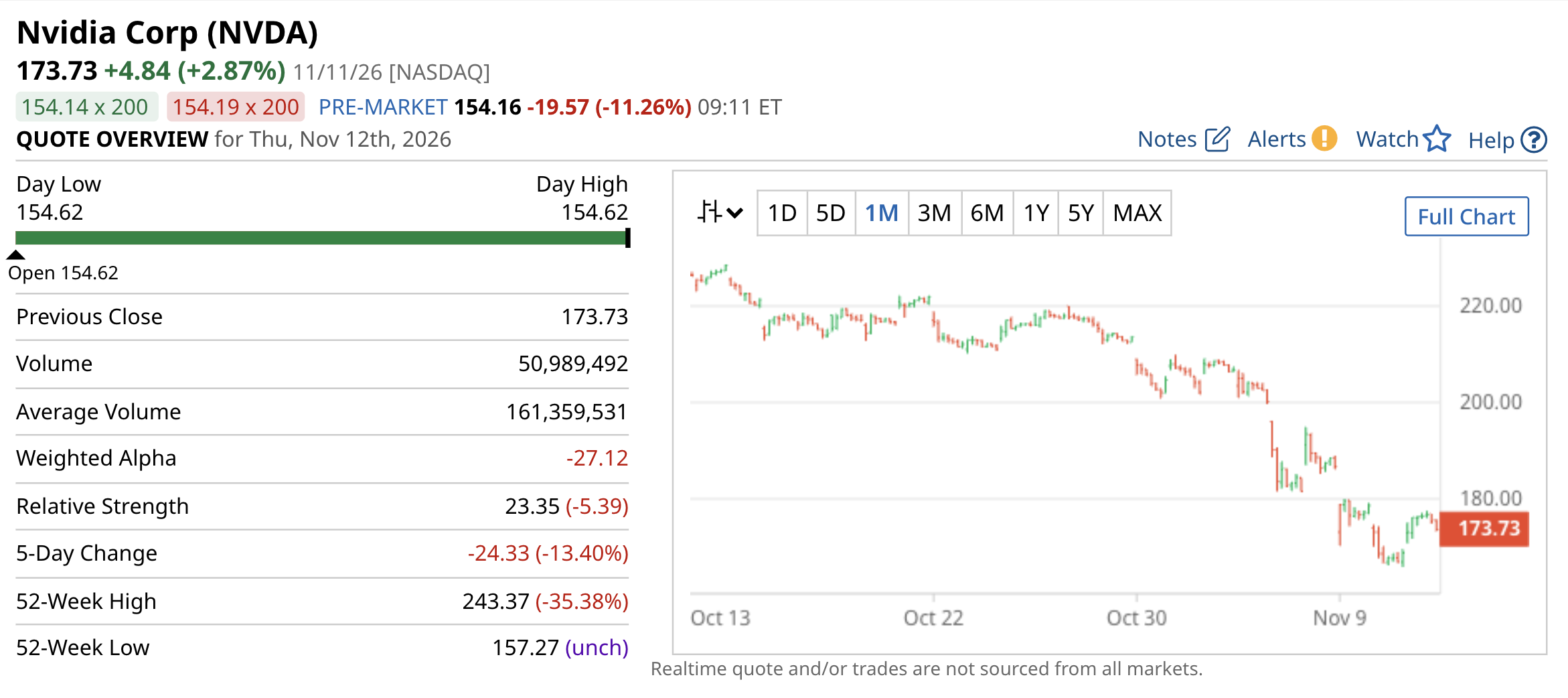
The uncertainty has already taken a substantial bite out of shareholders' portfolios. A $10,000 investment at last Friday's closing price was worth approximately $8,585 in Thursday's premarket trading.
But one prominent Wall Street analyst warned that losing Huang could erase considerably more of Nvidia's value. Now that his departure is a reality, investors must consider just how much further the stock could fall.
Wall Street's Worst Fears Come True
Huang's resignation follows days of mounting controversy surrounding his personal relationships. On Wednesday, The New York Times reported a second alleged affair, this time involving a senior Nvidia executive who reported to him. The disclosure followed earlier reports about his relationship with a woman suspected by U.S. intelligence officials of ties to Chinese espionage.
The allegations raised questions about corporate governance and potential security vulnerabilities. They also sparked growing speculation that Nvidia's board would remove the executive who transformed the company into an AI powerhouse.
On Thursday morning, prediction platform Polymarket put the probability of Huang's ouster being announced by Nov. 30 at 72%. Traders were betting heavily on his departure, but the announcement came much sooner than the deadline.
For investors, however, the more important question is how much of Nvidia's value depended on Huang remaining in charge.
Dan Ives, the widely followed technology analyst at Yorkville Ives, believes the answer could be as much as 30%.
Before Huang's resignation, Ives warned that Nvidia could be worth 25% to 30% less without its longtime leader. He argued that Huang was central to Nvidia's AI strategy and that the company lacked an executive who could seamlessly replace him.
At the time, Ives estimated only a 15% chance of Huang losing his job. That scenario has now become reality.
What a 30% NVDA Stock Decline Means for Your Portfolio
Consider someone who invested $10,000 in NVDA stock at its Nov. 6 closing price of $186.64, before the controversy erupted.
By Thursday morning, shares were trading around $160.23 in premarket trading, leaving that investment worth approximately $8,585. That's already a $1,415 loss in less than a week.
Using Nvidia's Nov. 9 closing price of $178.67 as a benchmark, before allegations of a second affair broke, a 30% decline would put the shares near $125.07.
If Nvidia eventually reached that level, the investor's remaining $8,585 position would shrink to approximately $6,700.
That's another $1,885 lost, representing 22% of the investment's remaining value. Combined with the decline already suffered, the original $10,000 investment would have lost approximately $3,300, or one-third of its value. Interestingly, Ives has maintained his $300 price target and “Outperform” rating on NVDA stock, reflecting his continued optimism about the company's long-term prospects.
The concern is that the market may assign Nvidia a lower valuation as investors reassess its future without Huang.
Nvidia's Biggest Strength Has Become a Risk
For years, Huang's leadership was one of Nvidia's greatest competitive advantages. He helped transform a graphics-chip manufacturer into the dominant supplier of processors powering the AI revolution.
Yet, that extraordinary influence also created what investors call key-person risk.
When a company's strategy, customer relationships, and reputation become closely identified with one executive, losing that person can undermine confidence even if the underlying business remains strong.
Nvidia's technology leadership, software ecosystem, and relationships with major cloud providers haven't disappeared with Huang's resignation. Demand for AI computing could remain substantial.
But Kress now faces the difficult task of reassuring investors that Nvidia can maintain its extraordinary growth without the executive who built its AI empire.
And until a permanent successor establishes credibility, the market could continue demanding a discount on Nvidia shares.
The Bottom Line
Huang's resignation removes one uncertainty surrounding Nvidia but introduces another: whether the company can sustain its leadership in AI without him.
Ives' warning doesn't guarantee another 30% decline, and Nvidia's underlying business remains formidable. But shareholders now face a leadership transition at a time when confidence in the company is already under pressure.
For someone who started last week with $10,000 invested in Nvidia, the potential cost of that uncertainty could run into thousands of dollars.
On the date of publication, Rich Duprey did not directly have a position in any of the securities mentioned in this article. All information and data in this article is solely for informational purposes. For more information please view the Barchart Disclosure Policy here.