
Black Hills (BKH) Posts Stronger Q3 Results, Is The Valuation Already Full?
Why Black Hills Stock Is Back in Focus After Q3 Results
Black Hills (BKH) moved back onto investor watchlists after reporting third quarter and nine month results that showed higher sales, stronger net income and improved earnings per share from continuing operations versus a year earlier.
That earnings beat lands on a stock that has already been building momentum. Black Hills now trades at US$86.96, with a 30 day share price return of 13.94%, a 1 year total shareholder return of 25.19%, and a 3 year total shareholder return of 89.40%, which underlines how long term holders have been rewarded even before this latest quarterly update.
Scan for other utilities showing similar momentum and earnings strength to Black Hills using our curated list of 30 resilient stocks with low risk scores.
Black Hills now trades close to analyst targets, even as intrinsic estimates sit well below the market price after this sharp rebound. Is this a cautious market mispricing, or a fair warning signal on valuation risk?
Price-to-Earnings of 21.1x: Is it justified?
Valuation on Black Hills now leans on a P/E of 21.1x at a share price of $86.96, which places the utility at a premium to the wider integrated utilities group while still below some peer and fair value markers.
The P/E ratio compares what investors pay for each dollar of current earnings. For a regulated utility like Black Hills, this measure often reflects how much confidence the market has in earnings durability and any forecast growth in future profits rather than short term trading sentiment.
On one side, the stock is described as good value when stacked against an estimated fair P/E of 27.7x and a peer average of 23.5x. On the other side, the same 21.1x multiple is described as expensive relative to the global integrated utilities industry average of 17.7x, which points to the market assigning Black Hills a higher earnings tag than many sector peers and a valuation level that could tighten if sentiment cools.
Explore the SWS fair ratio for Black Hills.
Result: Price-to-Earnings of 21.1x (ABOUT RIGHT)
Still, Black Hills faces valuation risk if sector sentiment weakens or if analyst price targets, which sit only slightly higher, start to drift lower.
Find out about the key risks to this Black Hills narrative.
Another View: What Our DCF Model Says About Black Hills
P/E suggests Black Hills is roughly in the right zone, yet the SWS DCF model paints a cooler picture. On that framework, an estimated future cash flow value of $66.74 sits well below the current $86.96 share price. This points to a stock that appears overvalued rather than a bargain.
If earnings forecasts are right, is the market simply paying up early for that growth? Or does this gap hint at limited upside from here for new buyers? Look into how the SWS DCF model arrives at its fair value.
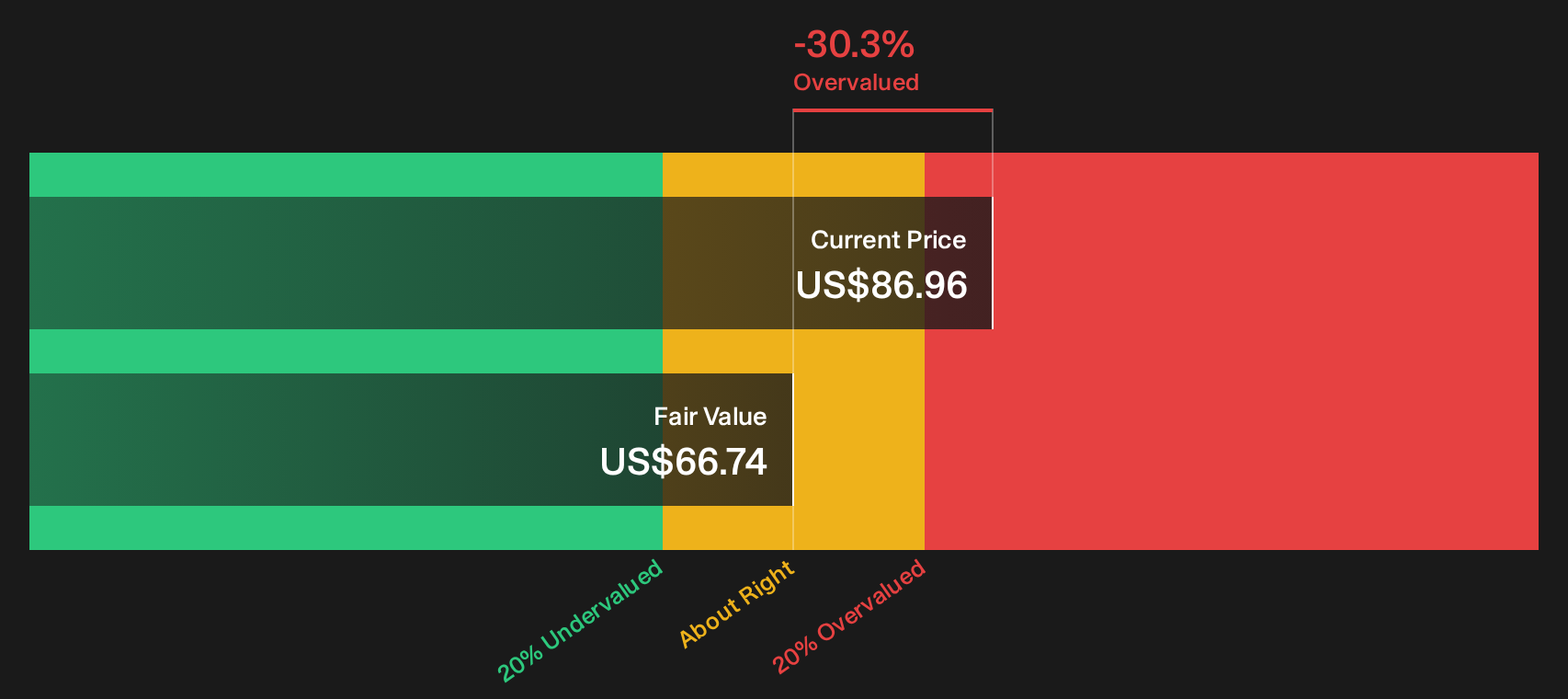
Simply Wall St performs a discounted cash flow (DCF) on every stock in the world every day (check out Black Hills for example). We show the entire calculation in full. You can track the result in your watchlist or portfolio and be alerted when this changes, or use our stock screener to discover 32 high quality undervalued stocks. If you save a screener we even alert you when new companies match - so you never miss a potential opportunity.
Next Steps
On balance, the mood around Black Hills feels cautiously optimistic, with clear upside factors as well as real issues that investors are debating. Act promptly, review the data, and weigh both sides by checking the 2 key rewards and 2 important warning signs.
Looking for more Black Hills style investment ideas?
If you only stop at Black Hills, you might miss stronger balance sheets, higher yields, or better value elsewhere. Use the screeners below to give yourself more options.
- Target steadier portfolios by focusing on companies with stronger fundamentals using our list of solid balance sheet and fundamentals (23 results).
- Hunt for mispriced opportunities by scanning the market for 32 high quality undervalued stocks.
- Turn income into a core part of your approach by tracking higher yielding 6 dividend fortresses.
Have feedback on this article? Concerned about the content? Get in touch with us directly. Alternatively, email editorial-team@simplywallst.com