
Nvidia Stock Falls Another 11% as Jensen Huang Resigns. Michael Burry’s ‘Heck of a Trade’ Comments Could Set Up a Rebound.
Nvidia (NVDA), the $4.18 trillion chipmaker whose GPUs, networking hardware, and software power AI, data centers, gaming, visualization, and autonomous driving, lost its founder-CEO this morning. Jensen Huang resigned as president, CEO, and board member, effective immediately. CFO Colette Kress is now interim CEO.
NVDA stock fell another 11% and hit a new 52-week low of $148.80 in Thursday morning's session, down $18.73 from Wednesday's $173.73 close, on volume of about 64.8 million shares. While it has bounced back some, the steep drop follows a decline of nearly 10% over the two previous sessions, which wiped out roughly $470 billion in market value. After these five sessions, Nvidia trades roughly 8% below where the selloff began, but today's heavy volatility can change that figure at a moment's notice.
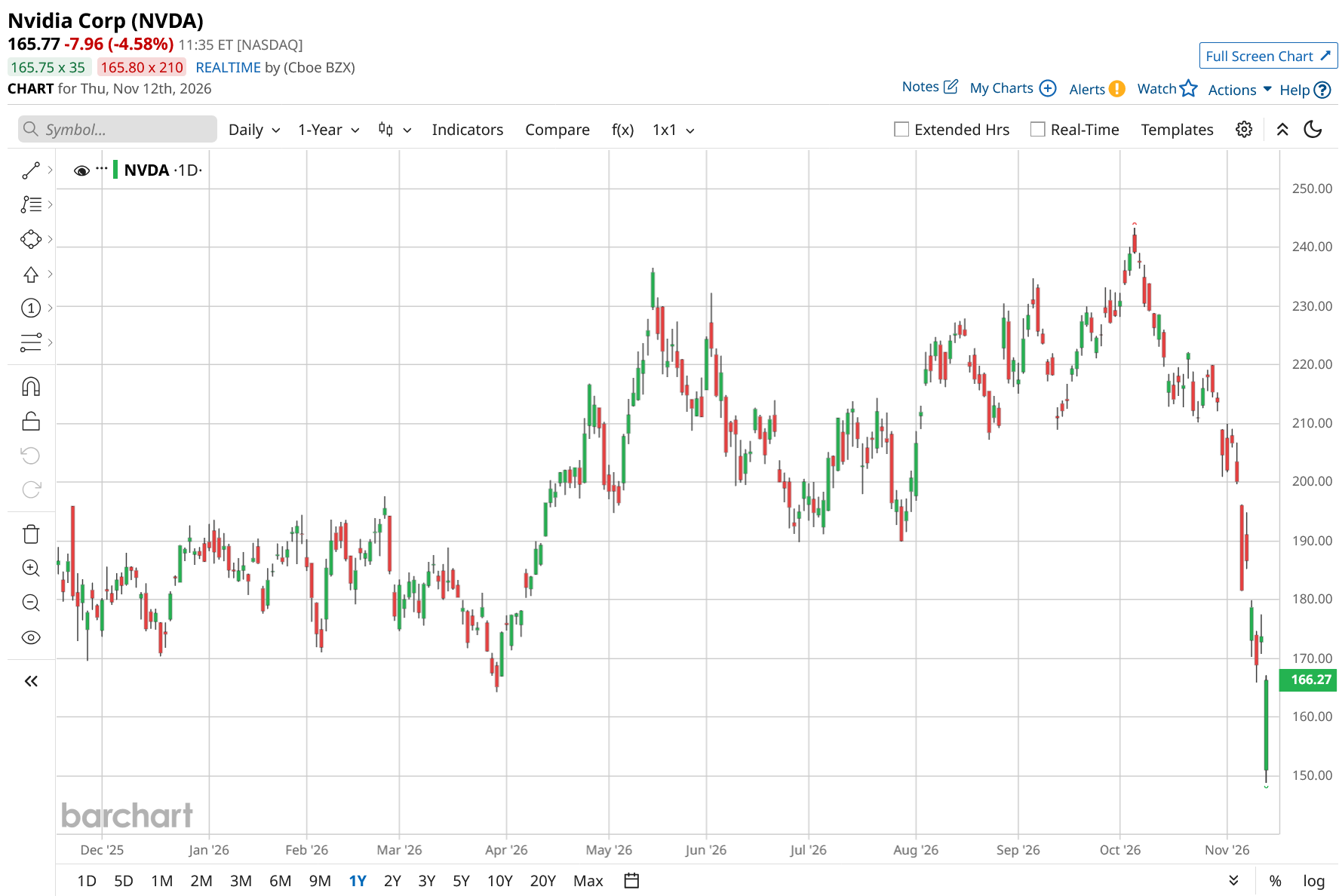
Before Huang's exit, Michael Burry, the “Big Short” investor, told his Substack readers on Nov. 10 that Nvidia could become “a heck of a trade” and that he could “imagine the whole market is going to think this is a heck of a trade fairly soon.” The share price is now far lower than when he wrote that, which makes the entry cheaper. But the thing Burry was weighing, a controversy around the CEO, has turned into a leadership vacuum.
With fiscal third-quarter earnings due Nov. 17, the first report under new leadership, investors face a harder question. Is this a deeper discount on a business still growing at triple digits, or a warning that Nvidia's next chapter is less certain than its numbers suggest?
What Burry's “Heck of a Trade” Means After Huang's Exit
Burry sees room for a rebound while remaining skeptical about owning Nvidia for years. In his Nov. 10 Substack post, he said he could “imagine the whole market is going to think this is a heck of a trade fairly soon.” He did not disclose buying Nvidia shares in that post.
Burry doubted that the controversy surrounding Huang’s relationship with a Chinese businesswoman allegedly connected to Chinese intelligence would materially hurt Nvidia’s business economics.
However, subsequent reporting complicates that argument. On Nov. 11, allegations of another extramarital relationship surfaced, this time involving Kimberly Powell, Nvidia’s vice president of healthcare, who reports to Huang. Nvidia declined to comment, and Powell did not immediately respond. The allegation added workplace-conflict concerns to the security investigation.
The situation changed materially on Nov. 12. Huang resigned as president, CEO, and board member, effective immediately, ending his 33-year tenure leading the company. Nvidia appointed Colette Kress, its finance chief since September 2013, as interim CEO while she retains her CFO responsibilities. The board also named Harvey C. Jones as its first-ever chair and began a permanent CEO search that will consider internal and external candidates. Jones said the board expects operations, customer commitments, and the product roadmap to continue without interruption. That provides a measure of continuity, but it is the board’s expectation. It is not proof that replacing the company’s founder will leave execution unaffected.
The stock is cheaper, but investors now face a risk that Burry’s original comment did not fully address: Nvidia must now navigate an immediate leadership transition. His Nov. 10 remarks, therefore, cannot be read as an endorsement of buying after Huang’s resignation. For Nvidia, the near-term test is whether Kress and the existing leadership team can preserve customer confidence and execute the roadmap while the board finds a permanent successor.
What Nvidia’s Numbers Say
Nvidia’s Aug. 26 earnings report shows how rapidly its business has expanded despite the pressure on it. Its revenue for the second quarter of fiscal 2027, which ended July 26, 2026, reached $96.2 billion, up 18% sequentially and 106% annually. The data center business drove that expansion, generating $89.0 billion, up 18% sequentially and 117% annually.
The growth came with GAAP and adjusted gross margins of 75%, while diluted earnings per share reached $2.46 and $2.22, respectively. Nvidia returned approximately $26 billion through dividends and repurchases, leaving $99 billion in repurchase authorization.
Now former CEO Jensen Huang attributed accelerating demand to expanding adoption across leading AI laboratories, startups, openly available models, and physical AI.
Nvidia is meanwhile extending its technology into robotics. The company unveiled GR00T 2 and Isaac Lab 3.0 on Nov. 9 at the Conference on Robot Learning.
The nearer revenue benchmark remains management’s third-quarter forecast of $108 billion, plus or minus 2%, excluding China data center compute revenue. Its GAAP and adjusted gross margin forecasts were 74%, plus or minus 50 basis points, with operating expenses of $9.2 billion and $9.0 billion, respectively. These remain management projections, rather than guaranteed results.
Wall Street’s Expectations for NVDA Stock
Nvidia’s next earnings report is due on Nov. 17, 2026, after markets close. Wall Street expects October quarter earnings of $2.49 per share, up 100.81% from $1.24 a year earlier.
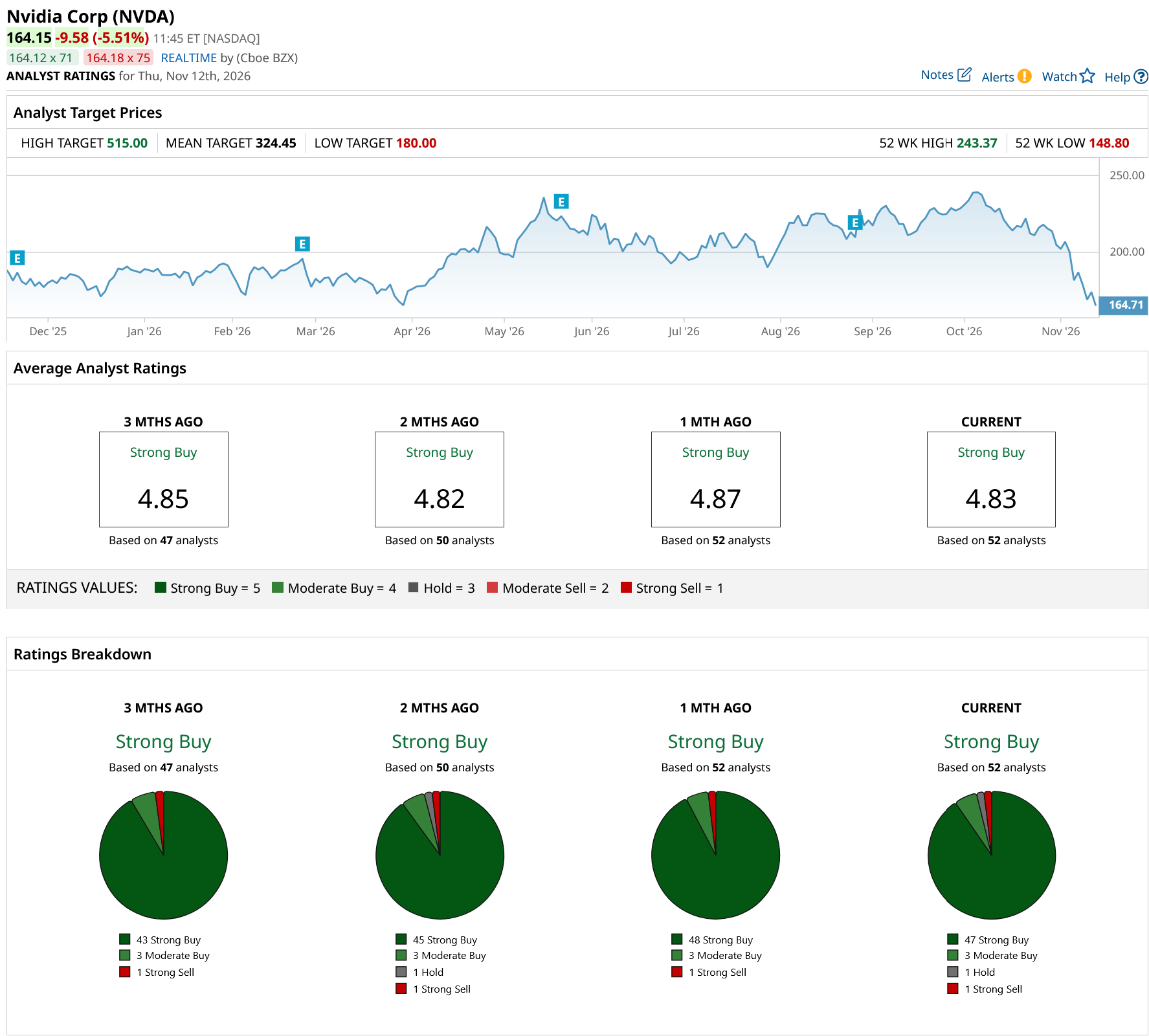
Analysts were already becoming more cautious before the resignation. Baird downgraded NVDA stock to “Neutral” and cut its price target 60%, from $500 to $200. Meanwhile, Morgan Stanley removed the stock from its “Top Picks” list while keeping its $300 target, 50% above Baird’s revised figure.
Citi’s Atif Malik remains more confident, maintaining “Buy” despite lowering his target to $285. He expects another earnings beat, although rising high-bandwidth memory costs could offset some benefits of stronger sales by reducing gross margins.
Wells Fargo’s Joe Quatrochi also remains positive, even after trimming his target to $300. He expects results above fiscal third-quarter estimates. More importantly, he wants evidence that spending on AI infrastructure can hold up.
Despite these target cuts, the consensus across 52 analysts remains “Strong Buy.” Their average target of $324.45 implies approximately 111% upside from Nvidia’s current price.
Conclusion
Investors should treat Burry’s comment as a possible rebound trade, not a green light to buy and hold. Nvidia is cheaper, but Huang’s exit adds a leadership risk that was not part of his original call. The company expects operations and its product roadmap to continue uninterrupted, though investors still need to see that confidence backed up by execution. Until then, buying requires more than confidence in Burry’s timing. The real question is whether Nvidia’s business and leadership can justify holding through the next rough patch.
On the date of publication, Ebube Jones did not directly have a position in any of the securities mentioned in this article. All information and data in this article is solely for informational purposes. For more information please view the Barchart Disclosure Policy here.