
How Investors Are Reacting To RLI (RLI) Special Dividend Declaration
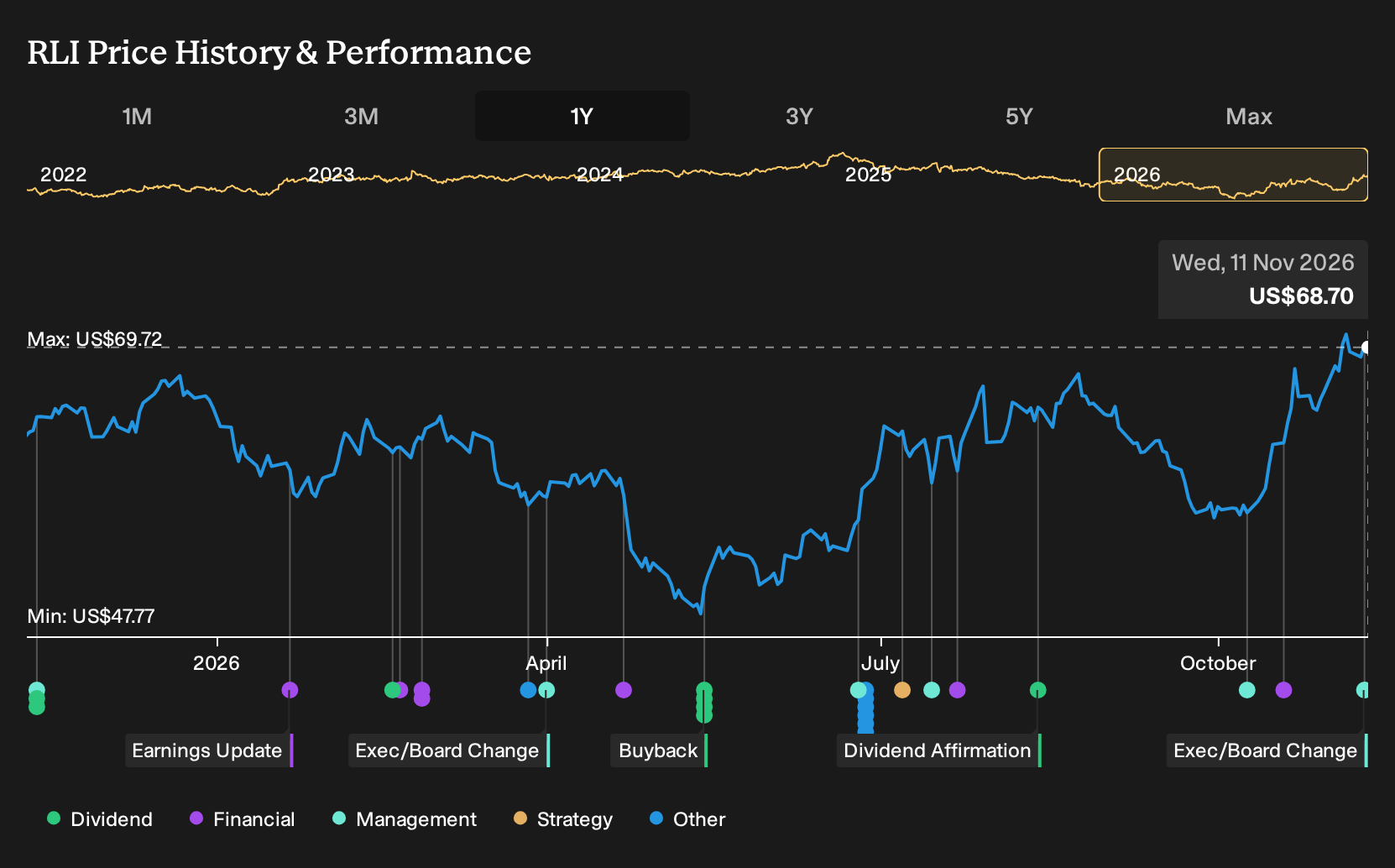
- RLI Corp. reported that its Board approved a regular quarterly cash dividend of US$0.18 per share and a special cash dividend of US$3.00 per share, both paid on 7 December 2026 to shareholders on record as of 30 November 2026.
- The roughly US$275 million special payout signals that RLI’s capital position supported a large one time return of cash without disclosing any change to its underwriting focus or operating plans.
- We will now explore how RLI's sizeable special cash dividend could reshape the existing investment narrative around underwriting discipline and capital returns.
Scan how RLI's special cash return compares with other insurers returning capital and start a watchlist of income ideas with 6 dividend fortresses
RLI Investment Narrative Recap
RLI investors need to believe the insurer can keep underwriting discipline intact while expense pressure and softer commercial and E&S property markets test profitability. The analyst consensus narrative on Simply Wall St leans on RLI sustaining solid combined ratio habits and using technology and service to keep risk selection tight, even as growth expectations remain muted.
The special US$3.00 per share dividend and ongoing US$0.18 quarterly payout do not materially change the near term operating catalyst or main risk. The flashpoint still sits in higher expenses, a 40.1% expense ratio and more catastrophe risk retained, which could strain earnings if pricing competition persists or severe events hit.
The special cash dividend of US$3.00 per share is the announcement most tied to the current news. It points to RLI having capital available for shareholders while still absorbing a lower ceded premium ratio and a smaller catastrophe tower for 2026. The business is effectively choosing to hold more catastrophe exposure on its balance sheet.
For you as a shareholder, that combination keeps the key catalyst squarely on underwriting execution in casualty, property and surety while managing a higher cost base. It also leaves the main risk unchanged. Earnings volatility could rise in severe catastrophe years, which would test both the dividend profile and how investors view RLI’s P/E premium to insurance peers.
RLI's narrative projects US$2.0b revenue and US$223.2 million earnings by 2029. That reflects 1.2% yearly revenue growth and an earnings decrease of about US$171.9 million from US$395.1 million today.
Uncover why RLI's fair value indicates a 15% potential downside to its current price, which leaves little room for error.
Exploring Other Perspectives
Some of the most optimistic analysts frame RLI’s lower catastrophe reinsurance spend as a catalyst, since it leaves more premium on its own balance sheet. Before this dividend news, that group was modeling about US$2.0b of revenue and US$273.6 million of earnings by 2029. You can treat this special payout as a fresh reason to compare those upbeat views with more cautious scenarios and decide which narrative you find more convincing.
Explore 3 other RLI fair value estimates, including one that suggests up to 8% upside from the current price.
Reach Your Own Conclusion
Disagree with existing narratives? Extraordinary investment returns rarely come from following the herd, so rely on your own research and judgment.
- A great starting point for your RLI research is our analysis highlighting 2 key rewards and 2 important warning signs that could impact your investment decision.
- See our latest analysis for RLI. The report includes a comprehensive fundamental analysis summarized in a single visual, the Snowflake, making it easy to evaluate RLI's overall financial health at a glance.
Looking for more investment ideas beyond RLI?
RLI may already be on your radar, but building a resilient portfolio usually means lining it up against a wider watchlist. Use the Simply Wall St Screener to spot other opportunities that fit your income, quality or risk profile and see how they compare.
- For investors who care most about getting paid to wait, start with a focused set of income candidates through 6 dividend fortresses.
- If capital preservation and steadier business profiles rank higher for you, filter for companies with stronger financial footing using the 30 resilient stocks with low risk scores.
- When you want quality businesses that the market may be overlooking, broaden your research with a 20 high quality undiscovered gems.
Have feedback on this article? Concerned about the content? Get in touch with us directly. Alternatively, email editorial-team@simplywallst.com