
AMD Stock Stands to Gain as Jensen Huang Scandal Is Expected to Trouble Nvidia’s Prospects
On Nov. 8, Nvidia (NVDA) CEO Jensen Huang admitted in an email to employees that he had an affair. "I was unfaithful to my wife," he wrote in the message. Reports identified the woman he had an affair with as Alice Huang, a former executive at Megaspeed, a Singapore-based company that buys Nvidia chips. I previously wrote about Nvidia, Huang, and Megaspeed when the investigation into this situation was first reported; CEO Jensen Huang initially claimed that Nvidia's dealings with the company were normal. Now, the story has become more personal.
U.S. intelligence officials believe Alice Huang may have been working for Chinese intelligence and trying to get information from the Nvidia CEO. In response, Nvidia's board opened an independent investigation. “Regarding the national security concerns raised in news reports, Nvidia’s Board of Directors has initiated an independent investigation,” Huang wrote to employees. “I support the investigation and will cooperate fully.” Today, Jensen Huang stepped down as CEO.
NVDA stock is down another 5% so far today, after dropping 4% and 5% earlier this week on Nov. 9 and Nov. 10. Meanwhile, Advanced Micro Devices (AMD) stock jumped about 13% on Nov. 9 alone and has been in the green this week. Let's take a closer look.
Why AMD Could Be the Biggest Winner
Some investors who want to own artificial intelligence (AI) chip stocks but don't want the uncertainty around Nvidia are moving their money into AMD, the next-largest AI chipmaker. AMD also stands to benefit from how Nvidia's customers deal with this news. Tech giants like Microsoft (MSFT), Meta Platforms (META), and Alphabet (GOOGL) are spending billions on AI chips. These companies care about their reputation, especially when it comes to national security issues.
While the investigation itself is ongoing, some may want to avoid relying heavily on Nvidia and buy more from AMD. In fact, even before this scandal, companies were already moving away from relying on Nvidia alone. OpenAI and Meta each committed to buying 6 gigawatts of AMD chips earlier this year, while Anthropic (ANT) agreed to deploy up to 2 GW. As I covered after AMD launched Helios in late July, the company can also now sell customers an entire AI server rack, not just chips, which makes switching from Nvidia much easier.
Nvidia’s Lead Is Still Hard to Catch
Still, given how big Nvidia's lead is, dethroning it won't be easy. In the latest quarter, Nvidia's data-center business brought in $89 billion of revenue, up 117% year-over-year (YOY). That's more than 10 times AMD's data-center revenue of $8.5 billion reported in Q3 2026.
What's more, although I've mentioned switching to AMD being easier with Helios, there are still reasons for customers to stick with Nvidia. For example, its CUDA software has been the industry standard for nearly two decades. Many AI programs are built on this software, and rewriting them takes time and money. Meanwhile, AMD is nearly sold out of its high-end server chips, so it can't just take on a flood of new demand unless it increases capacity.
All told, I don’t think the scandal breaks Nvidia's business. But there is a very real possibility that it helps AMD's growth accelerate further.
About AMD Stock
Advanced Micro Devices designs chips for PCs, gaming consoles, and data centers. Its biggest growth now comes from AI chips and full server racks that compete directly with Nvidia. That puts the company in a good position to gain if some of Nvidia's customers start looking elsewhere. Founded in 1969, AMD is headquartered in Santa Clara, California, and led by CEO Lisa Su.
AMD stock has surged about 173% so far this year, well ahead of the VanEck Semiconductor ETF’s (SMH) 40% gain during the same period. Strong demand for its server chips from AI labs helped pushed the stock to an all-time high of $658.52 in October 2026. Since then, though, a series of chip selloffs and Intel's (INTC) weak outlook have weighed on AMD stock. The stock is now roughly 12% below its peak despite gaining this week.
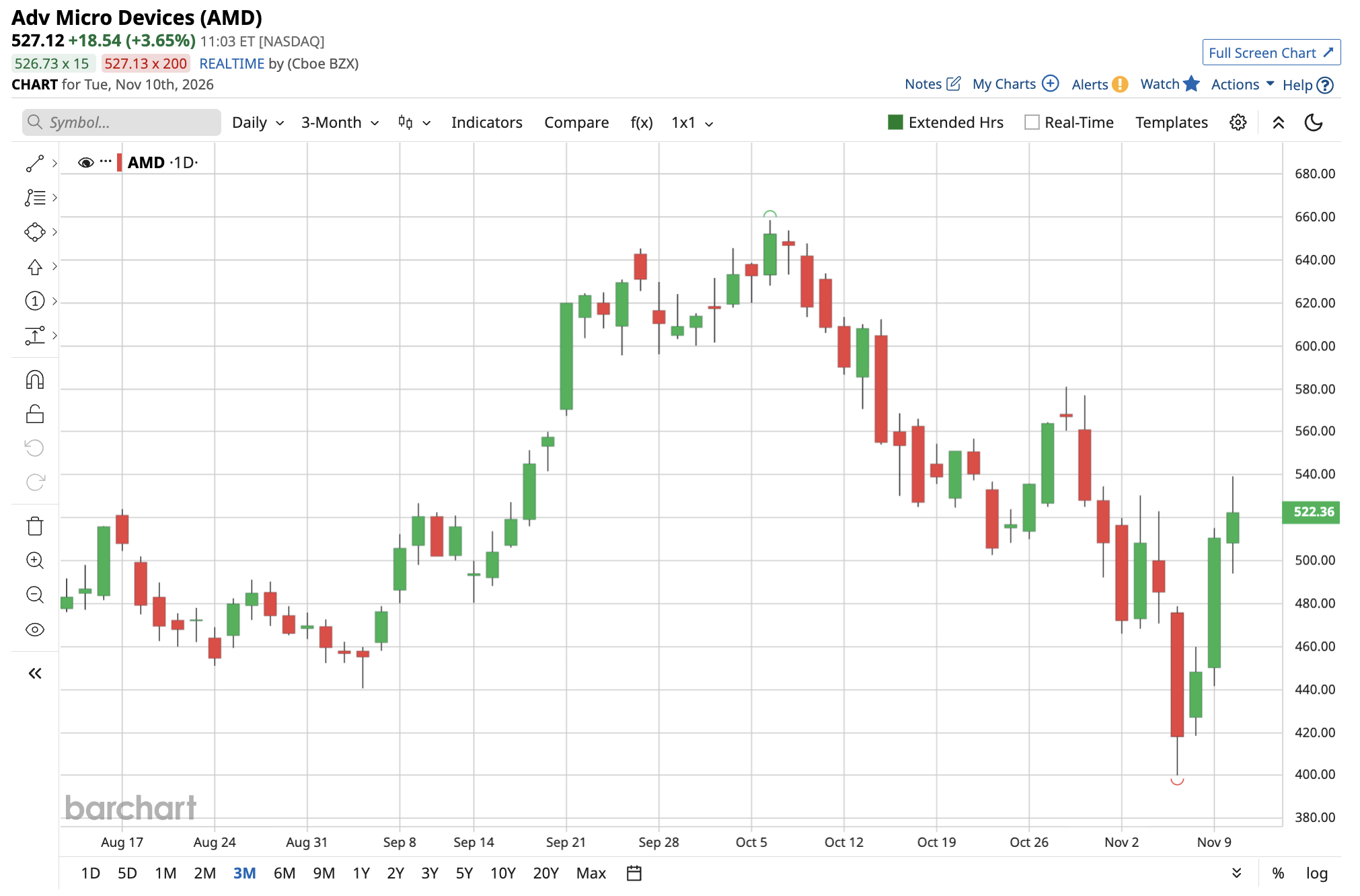
AMD stock trades above its historical norms, but I think the premium makes sense. Its forward price-to-earnings (P/E) ratio of 74.3 times sits well above its five-year average, while its price-to-sales (P/S) ratio of 24.3 times is even higher compared to its average.
The EPS outlook helps explain why investors are willing to pay up. Analysts expect earnings to more than double in fiscal 2026 to $6.93 per share, then more than double again in fiscal 2027 to $16.04 per share. That is exceptional for a company worth more than $900 billion by market capitalization. The balance sheet is solid, too; AMD holds about $15.8 billion in cash against roughly $7 billion in debt. If the Nvidia scandal pushes even a few big customers toward AMD, its growth numbers that are already so strong may look even better.
What Do Analysts Expect for AMD Stock?
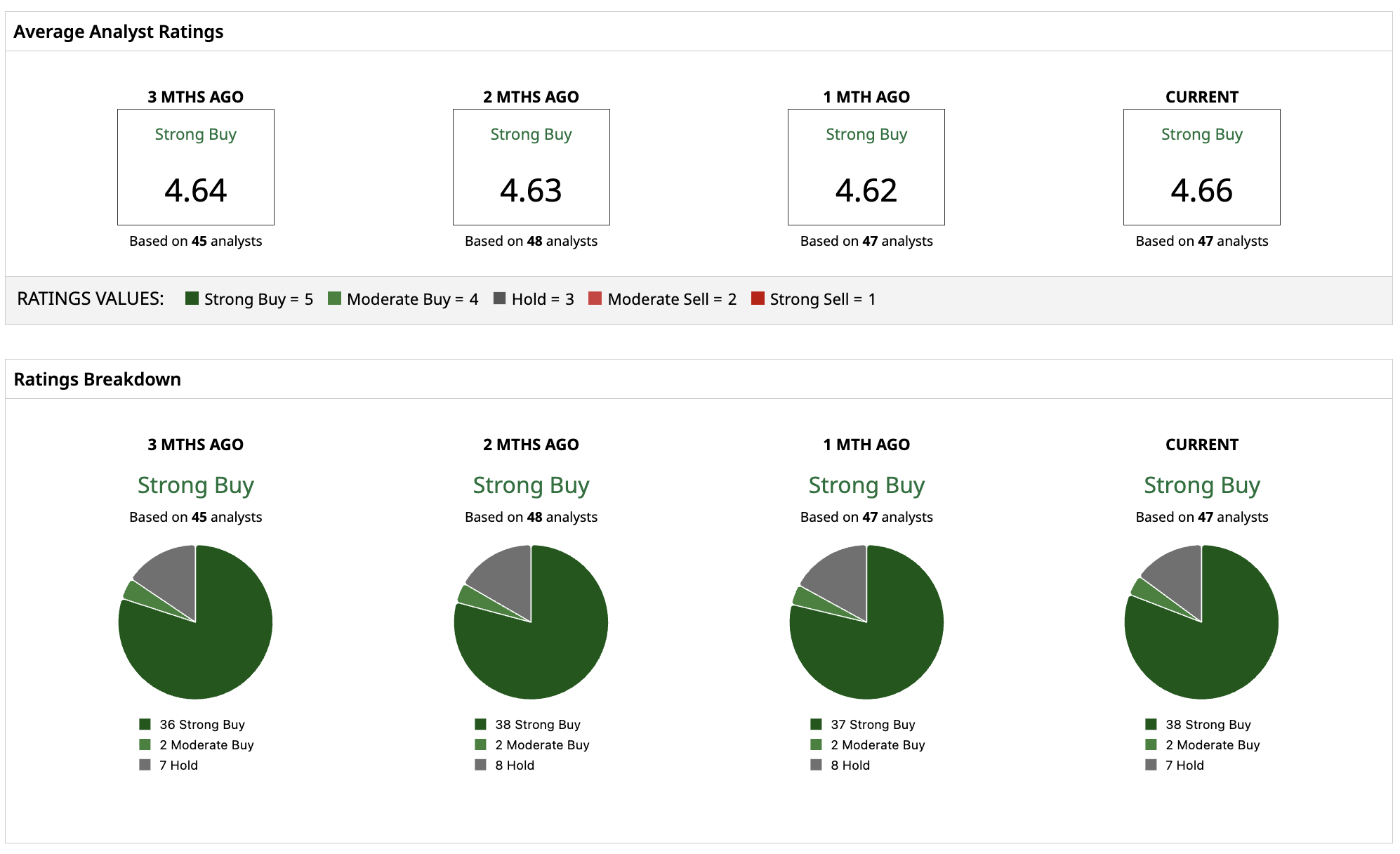
Based on 47 Wall Street analysts with coverage, AMD stock holds a consensus “Strong Buy” rating. The mean price target of $660.37 indicates potential upside of 14% from current levels. None of the analysts covering AMD suggest selling the stock, while the mean target is even higher than its all-time high, showing that analysts remain largely bullish.
On the date of publication, Jabran Kundi did not directly have a position in any of the securities mentioned in this article. All information and data in this article is solely for informational purposes. For more information please view the Barchart Disclosure Policy here.