
Suzuki Motor (TSE:7269) Looks Cheap Following Its Profit Outlook Cut
Suzuki Motor (TSE:7269) cut its full year pretax profit outlook after flagging that higher raw material costs are expected to offset gains from growing vehicle sales, particularly in India, putting fresh attention on margins.
At a share price of ¥2,201.0, Suzuki Motor has seen a 30 day share price return of 6.87% and a 90 day share price return of 5.49%, even though the year to date share price return is down 7.97%. The 3 year total shareholder return of 48.52% and 5 year total shareholder return of 84.92% point to a much stronger longer term record, so the recent pullback around the outlook cut appears more like momentum cooling than a full reset of the longer trend.
Scan Suzuki Motor alongside a hand-picked 18 high quality undervalued stocks that may offer similar cash flow support but with different exposure to input costs and regional demand.
Suzuki Motor now trades at a discount to analyst targets, even as its own cash flow model points to fair value. Is the market being sensibly cautious about margins, or too harsh on the outlook cut?
Preferred P/E of 8.5x for Suzuki Motor: Is it justified?
Suzuki Motor trades on a P/E of 8.5x at a last close of ¥2,201, which screens as cheap relative to both peers and the broader JP market on earnings-based measures.
The P/E ratio compares the current share price to net profit per share. For a mature automaker like Suzuki Motor, it gives a quick sense of how much investors are paying for each unit of current earnings, in a sector where demand, input costs and capital intensity all matter.
On several checks, that 8.5x earnings multiple looks low. It sits below the JP market P/E of 13.2x and below the Asian auto industry average of 13.2x, which points to a clear discount. It is also beneath the peer group average of 11.3x and an estimated fair P/E of 12.4x, a level the valuation work suggests could be more in line with the firm’s history and quality of earnings.
Explore the SWS fair ratio for Suzuki Motor.
Result: Price-to-earnings of 8.5x (UNDERVALUED)
Still, rising raw material costs and pressure on Suzuki Motor margins, along with any slowdown in key markets like India, could quickly challenge that valuation story.
Find out about the key risks to this Suzuki Motor narrative.
Another view on Suzuki Motor valuation
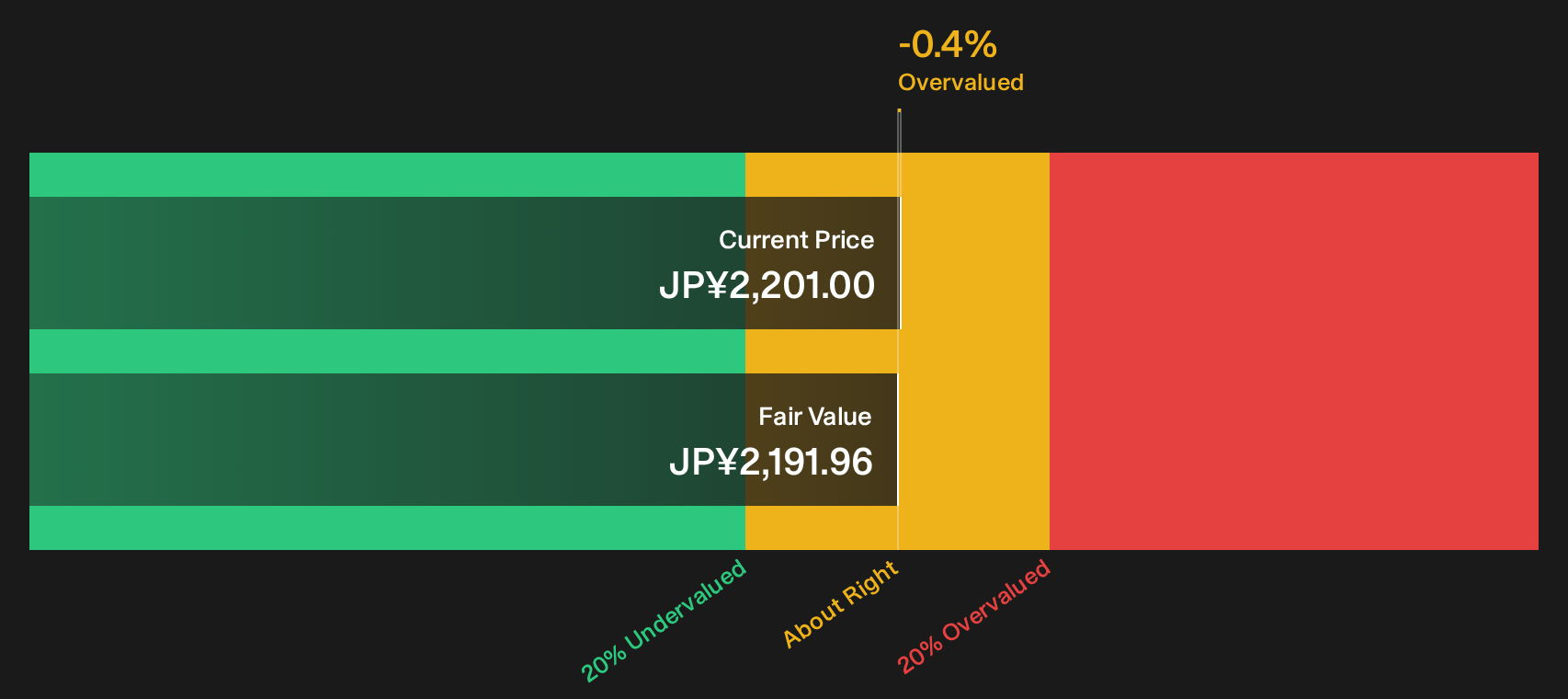
The earnings multiple presents Suzuki Motor as inexpensive, but the SWS DCF model is less generous. At a share price of ¥2,201, the stock is trading slightly above an estimated future cash flow value of about ¥2,192, which points to a modestly overvalued reading rather than a clear bargain.
This kind of small gap can still matter. It suggests less of a clear value cushion and more of a market that already reflects a significant portion of the expected cash generation. That raises the question of how much room remains for a stronger upside case if margins stay under pressure.
Look into how the SWS DCF model arrives at its fair value.
Simply Wall St performs a discounted cash flow (DCF) on every stock in the world every day (check out Suzuki Motor for example). We show the entire calculation in full. You can track the result in your watchlist or portfolio and be alerted when this changes, or use our stock screener to discover 18 high quality undervalued stocks. If you save a screener we even alert you when new companies match - so you never miss a potential opportunity.
Next Steps
If sentiment around Suzuki Motor feels mixed, that is the point. Use the data on margins, valuation and demand to pressure-test your own stance, and then complete that picture by reviewing the 5 key rewards
Looking for more investment ideas beyond Suzuki Motor?
If you stop with Suzuki Motor, you only see one angle. Use the Simply Wall Street Screener to widen your opportunity set with targeted, data driven filters.
- Zero in on potentially resilient businesses by scanning a 20 resilient stocks with low risk scores that focuses on stability and risk profile, not just headlines.
- Spot potential mispricings early by reviewing a 74 high quality undiscovered gems that highlights strong fundamentals the market may be overlooking.
- Strengthen your capital base by filtering for a list of solid balance sheet and fundamentals (25 results) that prioritises robust finances before growth stories.
Have feedback on this article? Concerned about the content? Get in touch with us directly. Alternatively, email editorial-team@simplywallst.com