
Flowers Foods’s Q3 2026 earnings results: Revenue in line with expectations but stock drops 10.2%
Packaged bakery food company Flowers Foods (NYSE:FLO) met Wall Street’s revenue expectations in Q3 2026, but revenue fell by 4.7% year on year to $1.17 billion. The company’s full-year revenue guidance of $5.04 billion at the midpoint also came in 0.7% below analysts’ consensus estimates. Its non-GAAP profit of $0.10 per share was 34.1% below analysts’ consensus estimates.
For more on Flowers Foods, read our free full research report.
Flowers Foods Q3 2026 highlights:
- Revenue $1.17 billion vs S&P analyst consensus of $1.17 billion (4.7% year-on-year decline, in line)
- Adjusted EPS $0.10 vs S&P analyst consensus of $0.15 (34.1% miss)
- Adjusted EBITDA $78.93 million vs analysts’ consensus estimates of $97.31 million (6.8% margin, 18.9% miss)
- Revenue guidance The company dropped its revenue guidance for the full year to $5.04 billion at the midpoint from $5.11 billion, a 1.3% decrease
- Adjusted EPS guidance Management lowered its full-year adjusted EPS guidance to $0.66 at the midpoint, an 18.1% decrease
- EBITDA guidance $422.5 million at the midpoint for the full year, below analysts’ consensus estimates of $457.5 million
- Operating margin 2.8%, down from 6.4% in the same quarter last year
- Free cash flow margin 5%, up from 2.5% in the same quarter last year
- Sales volumes fell 7% year on year (-0.6% in the same quarter last year)
- Market capitalization $1.33 billion
"Our third-quarter results reflect a continued challenging operating environment, driven by pressure on household budgets, evolving consumer behavior and heightened promotional activity, as well as areas where we need to move faster with focused execution," said Ryals McMullian, chairman and CEO of Flowers Foods. "Following the second quarter, we expected our earlier pricing actions and the relaunch of Nature's Own with fewer, simpler ingredients to help stabilize performance as we worked to introduce new innovation to market. We are seeing encouraging signs for Nature's Own, including improving sequential trends and growing awareness of the relaunch, although the pace of improvement has been slower than anticipated, primarily in loaf, where category trends remain challenging. We are accelerating actions already underway to strengthen customer execution, close innovation gaps, and better align our portfolio with evolving consumer preferences."
Revenue growth
Reviewing a company’s long-term revenue performance reveals insights into its quality. Even a poor business can perform well for one or two quarters, but a high-quality one grows for years.
With $5.17 billion in revenue over the past 12 months, Flowers Foods carries some recognizable products but is a mid-sized consumer staples company. Its size could bring disadvantages compared to larger competitors benefiting from better brand awareness and economies of scale.
Flowers Foods struggled to increase demand, as its $5.17 billion in revenue for the trailing 12 months was close to its revenue three years ago. This is mainly because consumers bought less of its products. We’ll explore what this means in the “Volume Growth” section.
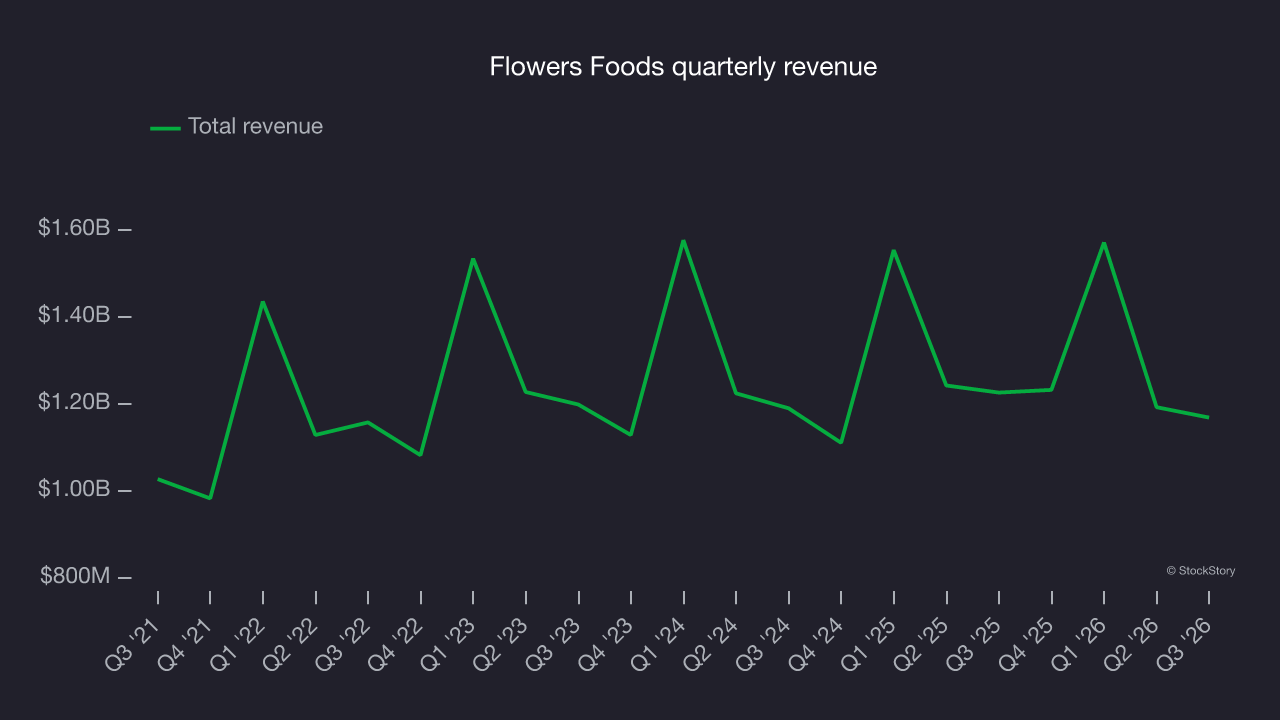
This quarter, Flowers Foods reported an uninspiring 4.7% year-on-year revenue decline to $1.17 billion, in line with Wall Street’s consensus estimates.
Looking ahead, sell-side analysts expect revenue to decline by 2.3% over the next 12 months, according to S&P, a deceleration versus the last three years. This projection is underwhelming and implies its products will face some demand challenges.
Volume growth
Revenue growth can be broken down into changes in price and volume (the number of units sold). While both are important, volume is central to a successful staples business as there’s a ceiling to what consumers will pay for everyday goods; they can always trade down to non-branded products if the branded versions are too expensive.
Flowers Foods’s average quarterly sales volumes have shrunk by 3.3% over the last two years. This decrease isn’t ideal because the quantity demanded for consumer staples products is typically stable. 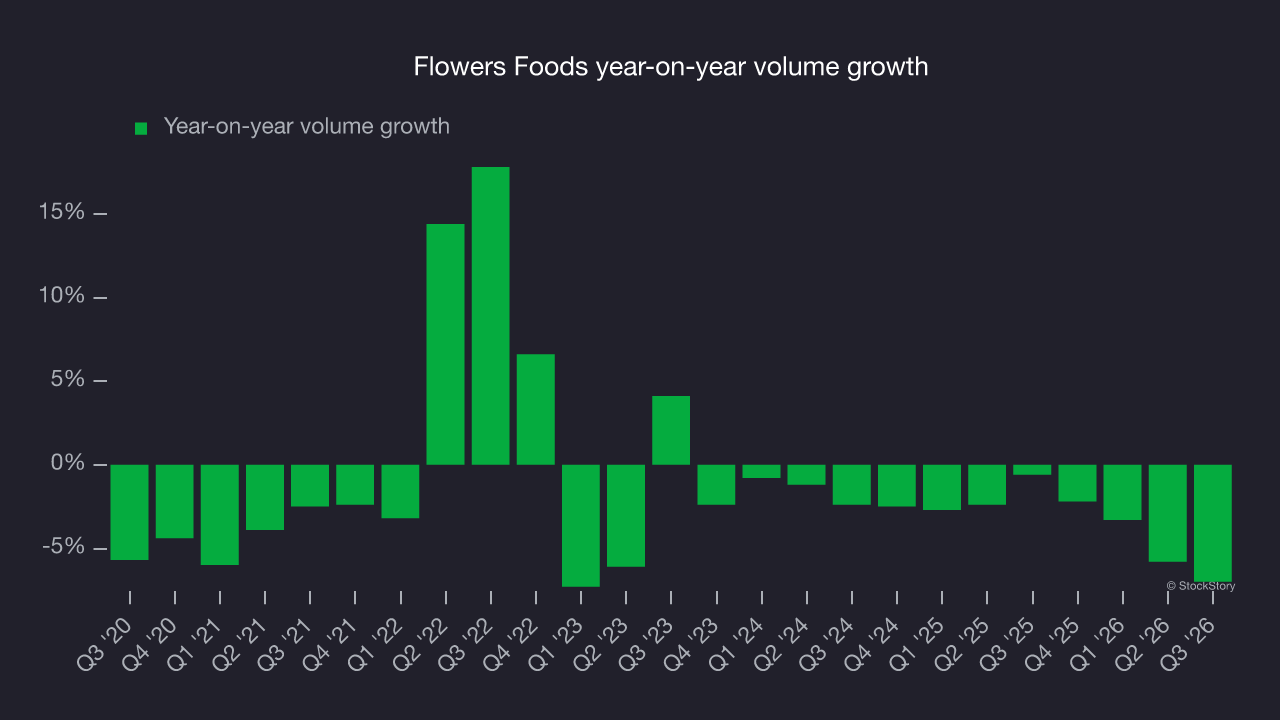
In Flowers Foods’s Q3 2026, sales volumes dropped 7% year on year. This result represents a further deceleration from its historical levels, showing the business is struggling to move its products.
Key takeaways from Flowers Foods’s Q3 results
Flowers Foods delivered a weaker quarter with few positives: Both EBITDA and EPS fell short of Wall Street’s consensus estimates. Shares plunged 10.2% to $5.39 immediately after the results.
Flowers Foods may have had a tough quarter, but the latest quarter is only one part of assessing its longer-term business quality. Quality, when combined with valuation, can help determine whether the stock is a buy. For more on Flowers Foods, read our full research report here (it’s free).