
The explosion in the Strait of Hormuz sounded again! An LNG tanker hit by lightning boosts supply risks, European gas prices rose slightly
The Zhitong Finance App learned that according to Iran's official media reports, the Islamic Revolutionary Guard Corps Navy said that an oil tanker carrying liquefied natural gas (LNG) hit a naval mine and exploded while sailing in the Strait of Hormuz on Friday. The report said that the tanker was operating on what Iran called “an unauthorized and dangerous route” at the time.
Despite a rebound in shipping traffic in the Strait of Hormuz and market expectations that the war between the US and Israel against Iran will escalate — an expectation that is reflected in falling oil prices — oil tankers continue to be attacked in the strait. According to the Washington Institute for Near East Policy Research, at least 10 ships were attacked in the first 10 days of November; while there were 37 attacks in October, the highest number of attacks since the conflict broke out in late February.
Iranian media reported on Thursday that four oil tankers were bombed in the Strait of Hormuz, a waterway critical to global shipping. The report said that these ships ignored the warning and sailed into the waters identified by Iran as a restricted area of this strategic waterway.
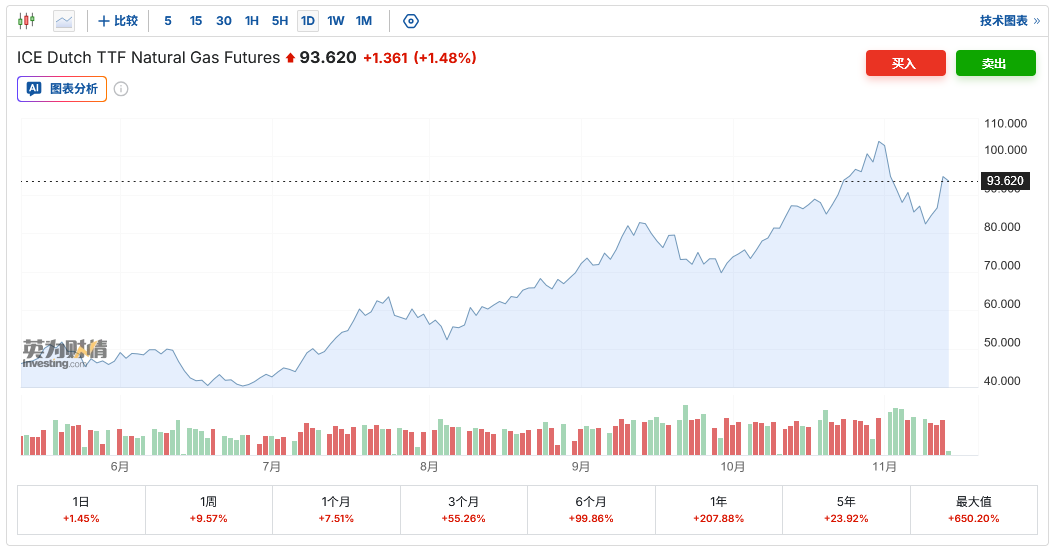
Affected by this news, the European benchmark Dutch TTF natural gas futures price rose 1.48% in recent months to 93.62 euros/megawatt-hour as of press release.
The current state of affairs in the Middle East is still confusing. Earlier, it was reported that US Vice President Vance is considering holding face-to-face talks with Iran's Supreme National Security Council Secretary Rezai to push for an end to the war in Iran. US President Trump is open to this. However, on November 12, local time, Trump said that the US did not need to reach an agreement with Iran. Trump said those days are long over. He claims that the US already has hundreds of billions of dollars in Iran's capital and the Strait of Hormuz.
Iran's Revolutionary Guard Corps issued a statement on November 13 saying that it attacked and destroyed the US military's early warning radar in Bahrain that day. This is Iran's first known attack on US military facilities in the Middle East in two months. Islamic Parliament Speaker Kalibaf said in an interview with Al Jazeera TV on November 11 that Iran and the US should not maintain the current state of “no war, no peace,” nor does Iran necessarily have to go through negotiations to achieve this goal; Iran must establish a sustainable deterrent. Kalibaf reiterated that the Strait of Hormuz will never return to the way it was before. The US side must implement the seven conditions proposed by Iran before negotiations can continue, and the Strait of Hormuz will be reopened.
The ongoing attacks on ships in the Strait of Hormuz may delay the resumption of oil and gas transportation in the region. This isn't good news for Europe. Europe's winter gas stocks are at an abnormally low level. The average gas storage level in the EU has fallen to 72%, which is lower than the average of 89% over the same period in the past five years. Germany's gas storage level is only 59%. Some parts of Europe have recently experienced cold waves and the simultaneous weakening of wind power (leading to a decline in wind power generation), further increasing the pressure on gas stocks in the region.
Low inventory levels in Germany, Europe's largest economy, have prompted the German gas storage industry organization INES to issue a warning. The organization said that if extreme cold weather occurs this winter, Germany's gas supply will not be fully guaranteed. Currently, the market expects temperatures in Germany to be mild to average this winter, but some meteorologists warn that there is still a risk of cold waves in the late heating season.
Europe's dependence on global liquefied natural gas (LNG) supply will increase further in the coming months due to low inventory levels, so it is particularly vulnerable to price fluctuations. And unless exports from the Middle East recover — the Middle East accounts for about one-fifth of global liquefied natural gas (LNG) flows before the war — the market still expects gas prices to remain high.
The amount of LNG loaded into tankers in Qatar has rebounded over the past few weeks, indicating that despite ongoing disruptions to shipping in the Strait of Hormuz, this major exporter is seeking to supply more LNG cargo to the global market. However, the increase in shipping volume has yet to translate into a similar increase in the estimated eastbound shipping volume of the Strait of Hormuz. As winter weather turns colder in the northern hemisphere, competition between Europe and Asia over the limited supply of available natural gas is likely to intensify further. If the direction of the situation in the Middle East remains unclear, and even if the conflict between the US and Iran escalates again, it will increase supply pressure on the global LNG market and may further push up European gas prices.