
Nvidia Just Lost Its Most Important Asset. Don’t Count the AI Giant Out Yet.
Nvidia (NVDA) has been the center of attention this past week. On Nov. 12, Jensen Huang’s exit as CEO sent shockwaves through Nvidia and the entire AI sector. This was far more than just another CEO stepping down. Nvidia has lost the visionary who transformed it into the beating heart of the global AI chip industry, leaving investors to wonder if the company’s meteoric rise can continue without Jensen Huang at the helm. Under Huang’s leadership, Nvidia became a $5 trillion giant.
However, while a founder can depart in a single day, the legacy of systems and loyal customers built over three decades remains.
A Sudden End to a Founder-Led Era
Nvidia's leadership crisis followed reports about Jensen Huang's personal relationships, including an alleged affair with an Nividia executive and another with a Chinese businesswoman suspected by U.S. authorities of intelligence links to Beijing. The board swiftly ordered an independent investigation into the latter and ultimately assured shareholders that no sensitive information or national security interests were at risk.
Subsequently, Huang resigned, and CFO Colette Kress took the helm as interim CEO. Huang, who co-founded Nvidia in 1993 and led it for 33 years, leaves behind a company now vulnerable to key-person risk when a company's strategy, relationships, and growth depend heavily on one individual.
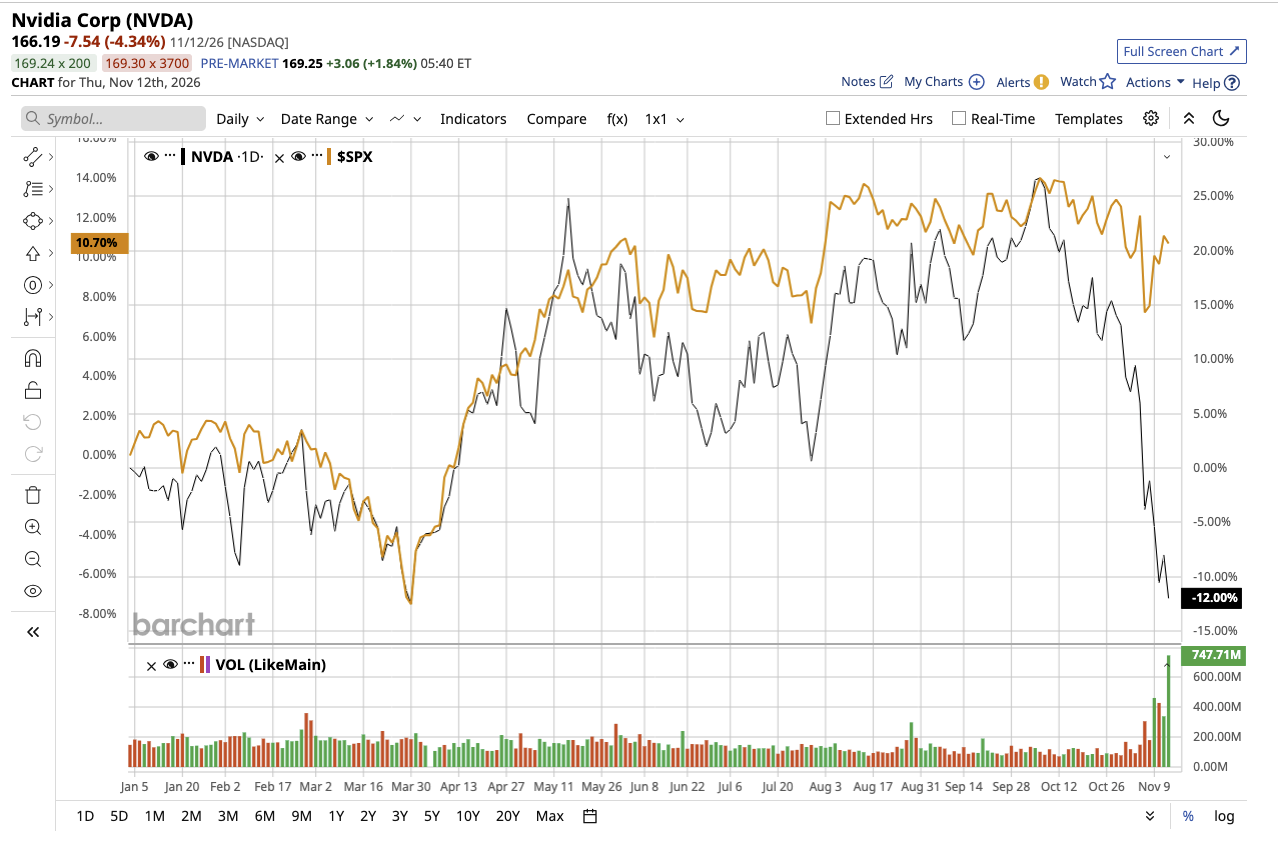
The market reacted sharply as investors now question whether Nvidia can keep its remarkable momentum alive without its visionary founder. Shares closed 4.3% lower on Nov. 12 at $166.19, clawing back from an intraday decline of as much as 14%. However, the stock had already fallen roughly 13% over the past five days as the controversy intensified, putting hundreds of billions of dollars in market value at risk.
Can Colette Kress Actually Replace Jensen Huang?
Kress has steered Nvidia’s finances since 2013, guiding its finances through an extraordinary period of growth. Previously, she held senior finance positions at Microsoft (MSFT) and Cisco (CSCO), giving her considerable operational experience. However, managing Nvidia's finances is different from replacing Huang's technological vision and industry influence.
Reuters reported that Kress had at times pushed back against his bold investment plans, hinting at a more disciplined approach to capital allocation.
While her leadership could bring stability for now, the permanent successor must preserve Nvidia's innovation strategy and customer relationships. Until the choice is made, this leadership uncertainty might remain an overhang on the stock.
Nvidia’s Technology Ecosystem Is Much Bigger Than Its CEO
Even amid a leadership crisis, Nvidia’s financial strength stays unshaken. In fact, the company’s business appears more formidable than ever, despite Huang's departure. In the second quarter of fiscal 2027, revenue reached $96.2 billion, up 106% year-over-year (YoY), while Data Center revenue soared 117% to $89 billion. GAAP earnings per share increased to $2.46 from $1.08 a year earlier. These numbers highlight the strength of AI infrastructure demand before the leadership transition.
Nvidia's advantage stretches beyond GPUs. The company combines fast processors, advanced networking, integrated systems, and its powerful CUDA software to create an ecosystem competitors can’t easily match. Developers and businesses have spent years on this platform, so switching would be costly and difficult. These competitive advantages remain intact even without Huang.
The bigger concern is who will guide Nvidia's next phase of expansion. Huang shaped its technology roadmap, strategic investments, and deep relationships across the AI industry.
There is also a political risk. Huang played a key role in representing Nvidia’s interests in Washington, especially on U.S. chip export restrictions to China. His departure could complicate the company's efforts to handle regulatory scrutiny and China-related business relationships.
What Investors Should Watch Next While Wall Street Stays Divided
Wall Street is unsure how Nvidia will move forward without its founder. Some analysts wonder if the company can keep its strategic focus and strong customer ties during this transition. Gil Luria from D.A. Davidson said Kress is respected by investors and capable of leading the company but also acknowledged that it is difficult to replace a founder who made most of the big decisions. The debate is less about Nvidia's existing technology and more about who will direct its next phase of growth.
Nvidia’s upcoming Nov. 17 fiscal Q3 earnings announcement will be particularly important. Nvidia previously guided for Q3 revenue of $108 billion, plus or minus 2%. Investors will want to see if AI demand remains strong, shipments are progressing as expected, and management remains confident in its outlook. Investors should also examine Nvidia's investment commitments. Supporting AI infrastructure partners can accelerate adoption of its technology, but too much financial risk could be a problem if customers can’t generate returns or cut back on spending.
Kress's commentary will offer early insight into how she intends to manage the transition. Her approach to investment commitments will reveal whether the company charges ahead with Huang's bold expansion approach or shifts gears toward financial discipline.
The permanent CEO search is another development investors should watch closely. Nvidia must find a forward-thinking leader with both deep technical know-how and powerful industry connections to safeguard its lead. If this uncertainty drags on, it could cast a cloud over the stock even if earnings remain strong.
Don't Count the AI Giant Out
Huang's departure is a major challenge, and investors should realize that finding his replacement will not be easy. Yet, Nvidia's business is thriving, and its powerful technology ecosystem proves the company stands on solid ground despite concerns about leadership change. The company's future will depend on whether Kress and the board can preserve these strengths while building strong long-term leadership.
No doubt, a founder and CEO like Huang was instrumental in making Nvidia the king of AI infrastructure, but his departure does not mean the company has lost the technology, ecosystem, and competitive advantages that made it an AI giant.
In my opinion, now is not the moment to part ways with Nvidia's stock. For those confident in the company’s future, this could be a golden chance to scoop up more shares.
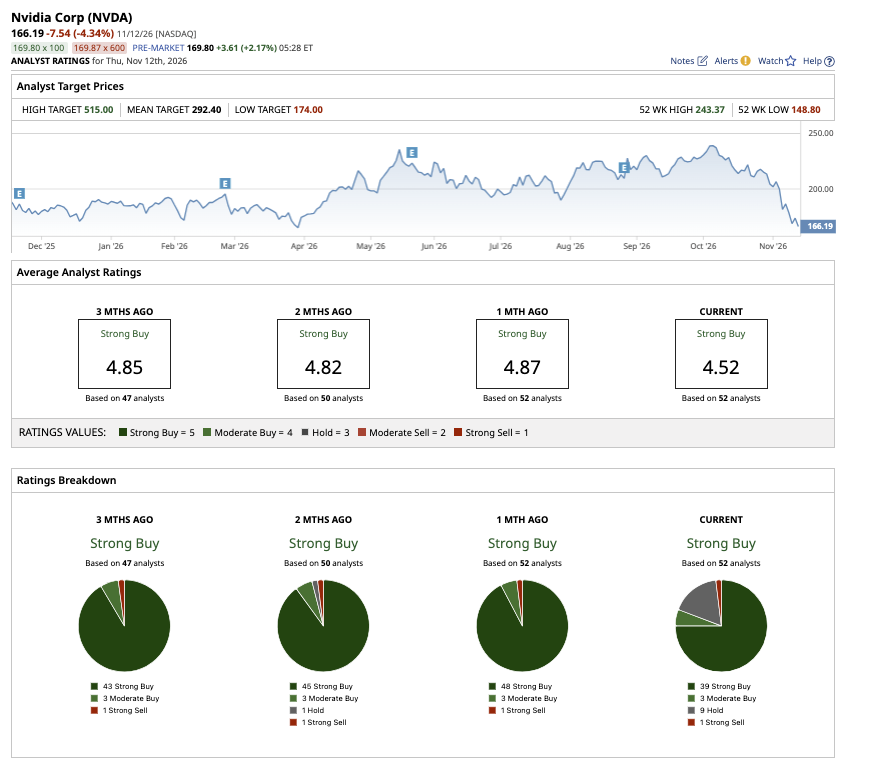
On Wall Street, NVDA stock is still a “Strong Buy.” Of the 52 analysts following the stock, 39 recommend a “Strong Buy,” three suggest a “Moderate Buy,” nine say it is a “Hold,” and one rates it a “Strong Sell.” The average target price is $292.40, suggesting a possible 76% gain from current prices. The highest estimate, $515, points to a potential 209% increase over the next year.
On the date of publication, Sushree Mohanty did not directly have a position in any of the securities mentioned in this article. All information and data in this article is solely for informational purposes. For more information please view the Barchart Disclosure Policy here.