
Weis Markets (WMK) Posts Stronger Third Quarter Results, Is The Stock Overvalued?
Weis Markets (WMK) just paired a fresh third quarter earnings report with a new revolving credit agreement, giving investors two concrete updates on how the supermarket operator is running and funding its business.
The share price has pulled back 2.83% over the past day to US$78.57. However, a 6.05% 1 month share price return and 10.77% 3 month share price return suggest momentum has been building ahead of this earnings and credit update. Over a longer horizon, total shareholder return of 21.07% over one year and 35.49% over three years reflects investors steadily rewarding Weis Markets as recent financial results and funding flexibility reshape perceptions of both growth potential and balance sheet risk.
See how other food and retail operators are priced relative to their recent earnings momentum by checking our curated list of 32 high quality undervalued stocks alongside Weis Markets.
Recent gains hint at investors rewarding Weis Markets for steadier earnings and added funding capacity, while the latest pullback points to mood swings. Which of those is really driving the current valuation setup?
Preferred P/E of 18.5x: Is it justified for Weis Markets?
Weis Markets now trades on a P/E of 18.5x, while our SWS DCF model suggests a future cash flow value of $42.13 compared with the $78.57 last close. That mix of a premium earnings multiple and a DCF value well below the market price raises a clear question about how much optimism is already in the Weis Markets share price.
The P/E ratio compares the current share price to earnings per share, so it reflects how much investors are willing to pay today for each dollar of profit. For a supermarket operator like Weis Markets, where growth is often steady rather than explosive, the P/E tends to capture expectations around margin resilience, competitive position, and how durable recent earnings progress might be.
At 18.5x earnings against a peer average of 11.6x, the stock trades on a meaningfully richer multiple than similar consumer retailing businesses. The earnings picture is mixed as well, with 13.3% earnings growth over the past year and an improvement in net profit margin to 2.1%, but a 3.9% per year earnings decline over five years and a low 7.5% return on equity. The combination suggests the market is paying up for the recent acceleration in results and high quality earnings, while looking past the weaker longer term record.
The wider Consumer Retailing industry runs at a P/E of 18.4x. This puts Weis Markets almost exactly in line with the broader group despite the company underperforming the sector on a 1 year return basis. That alignment signals investors are valuing the supermarket roughly in step with its industry even though it has lagged on share price performance and carries a DCF estimate well under the current quote. Together these factors point to a full valuation rather than a clear bargain.
See what the numbers say about this price — find out in our valuation breakdown.
Result: Price-to-Earnings of 18.5x (OVERVALUED)
Still, that richer P/E at Weis Markets could look fragile if earnings momentum cools or if tighter consumer budgets start to pressure supermarket pricing power.
Find out about the key risks to this Weis Markets narrative.
Another View: What The SWS DCF Model Says About Weis Markets
The story looks different when you switch from the headline P/E to the SWS DCF model. On that framework, Weis Markets screens as overvalued, with a future cash flow value of $42.13 versus the current $78.57 share price. That gap raises a simple question for you: Is the earnings multiple or the cash flow math closer to how you think about value?
Look into how the SWS DCF model arrives at its fair value.
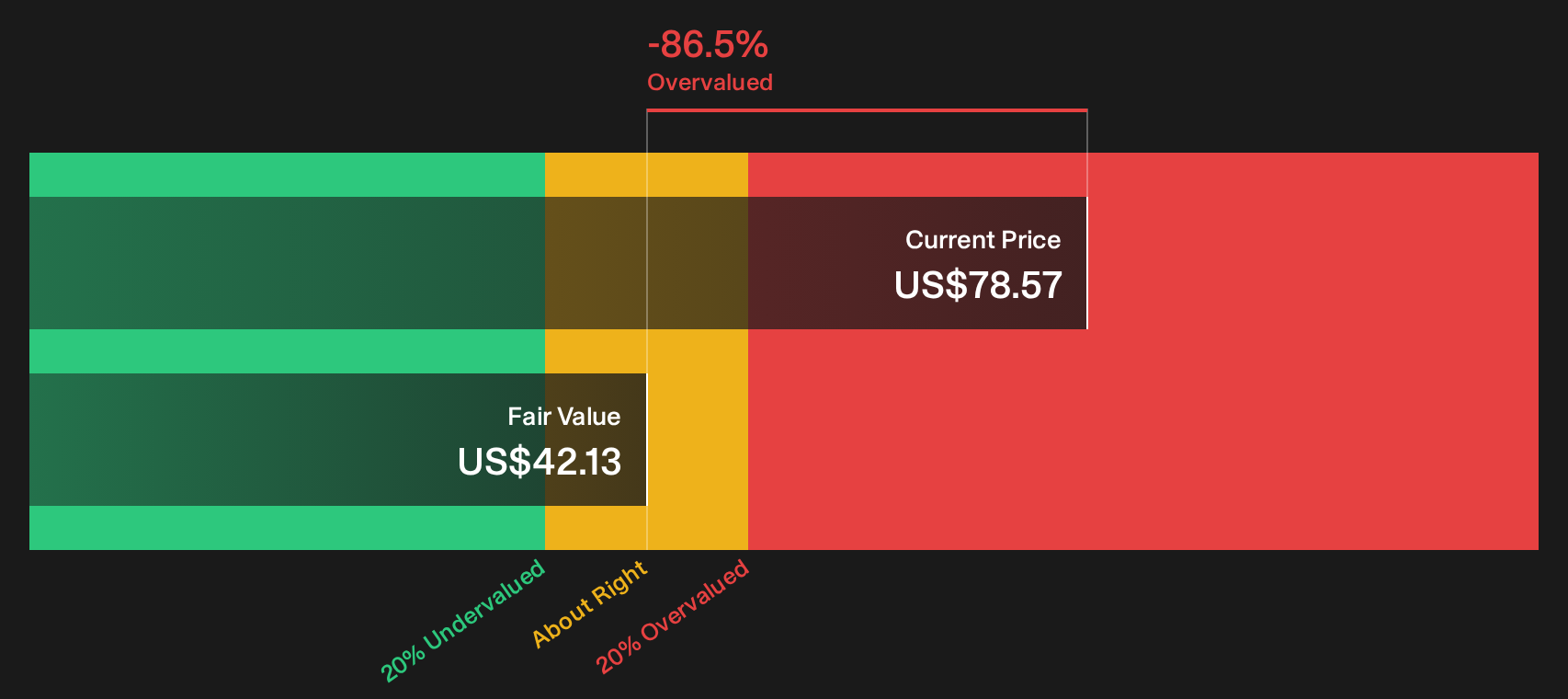
Simply Wall St performs a discounted cash flow (DCF) on every stock in the world every day (check out Weis Markets for example). We show the entire calculation in full. You can track the result in your watchlist or portfolio and be alerted when this changes, or use our stock screener to discover 32 high quality undervalued stocks. If you save a screener we even alert you when new companies match - so you never miss a potential opportunity.
Next Steps
Mixed signals on Weis Markets so far. If you want to move before the crowd, stress test the thesis yourself by weighing 2 key rewards and 1 important warning sign
Looking for more Weis Markets sized investment ideas?
If you stop with Weis Markets, you miss a broader field of potential opportunities that match different risk levels, income needs, and balance sheet comfort zones.
- Target potential mispricings by scanning for quality companies trading below what their fundamentals suggest through the 32 high quality undervalued stocks.
- Stack your portfolio with income by focusing on businesses that offer higher yields and robust payout profiles using the 6 dividend fortresses.
- Dial down risk and protect capital by filtering for resilient businesses with stronger financial footing through the 29 resilient stocks with low risk scores.
Have feedback on this article? Concerned about the content? Get in touch with us directly. Alternatively, email editorial-team@simplywallst.com