
What Bayer Holders Bought Into Before An 89% Run
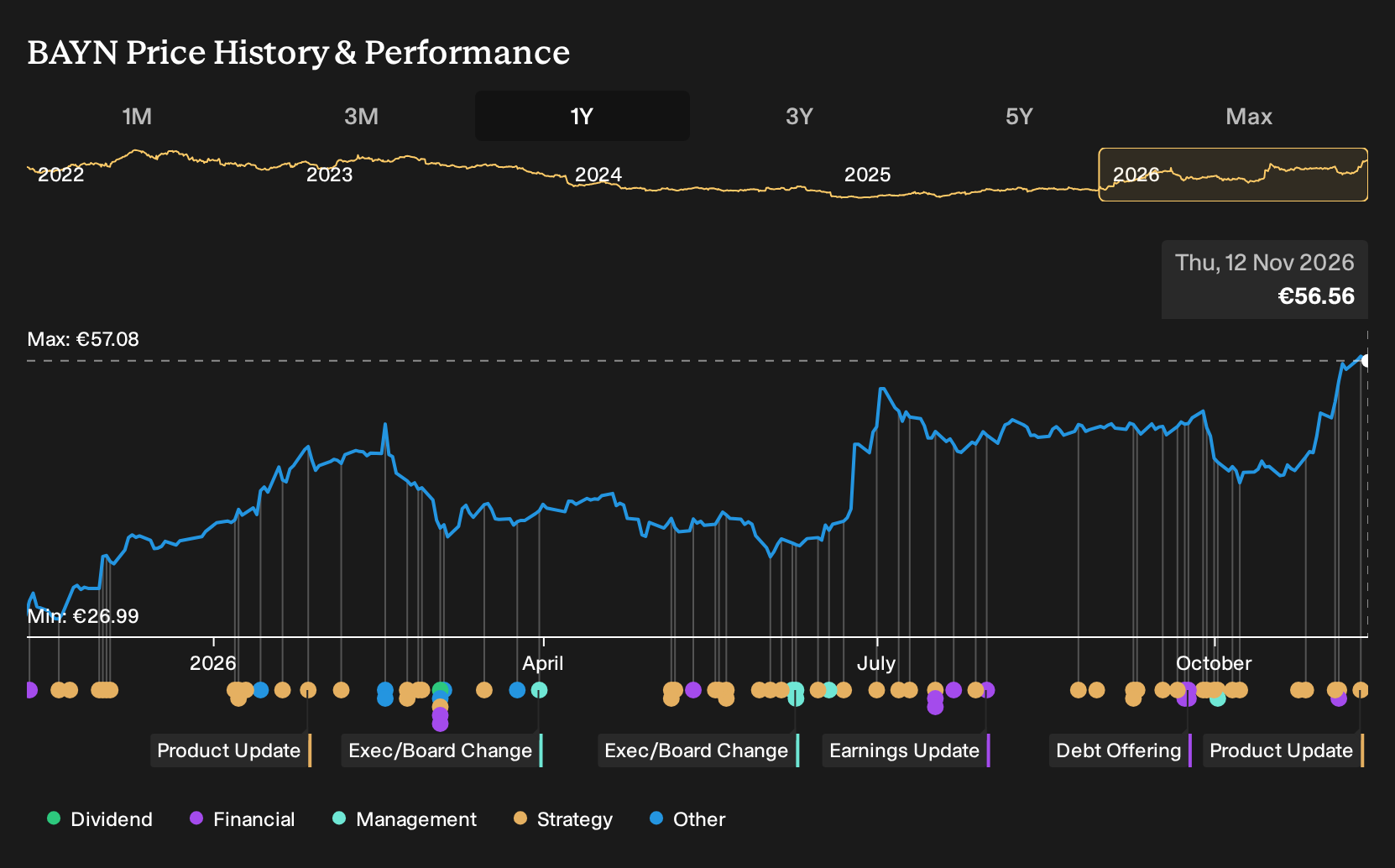
If Bayer was on your watchlist rather than in your portfolio, the outcome over the last twelve months may feel like a missed shot. For Bayer shareholders, the return over the past year was 89.5%, including dividends. That kind of payoff invites a simple question. If you had believed that legal liabilities would be capped and that new drugs such as Nubeqa and Kerendia could support revenue and margin recovery, would you have treated the stock differently at the time?
Bayer is not the only name tied to this theme. Zero in on 123 healthcare AI stocks and compare how each one is priced.
What Bayer Investors Were Really Arguing About
The shares cost €29.06 at the start of the period, and Bayer sat between two sharply different stories about where the business could head next.
On the bullish side, one narrative argued that sustainable farming and rising healthcare demand could support a Fair Value of €39, a notional price implied by its assumptions. That view leaned on stronger uptake for drugs like Nubeqa and Kerendia and earlier progress on cost and productivity gains.
The bearish narrative pointed to a Fair Value of €23, again purely as the price its outlook would justify. It focused on mounting glyphosate and PCB liabilities and over €33b of debt as long-running constraints on cash flow and flexibility.
What The Results Changed For The Bayer Debate
The pivotal development for Bayer was the US Supreme Court ruling that federal law preempts Roundup cancer warning lawsuits, which sharply reduced legal uncertainty and leaned toward the bullish case on capped liabilities. At the same time, Q3 2026 revenue of €10,053m and a smaller net loss than Q3 2025 gave the optimistic side some support, although profitability remained unproven with a net margin still negative at -6.7%. Overall, the evidence cut both ways.
The lesson for any stock is clear. When the argument hinges on legal risk and a promised margin recovery, investors can track concrete litigation outcomes and the net margin line in quarterly reports to see whether the risk is actually shrinking and losses are closing.
What Today's Bayer Price Already Assumes
Bayer now trades at €56.56, and the bearish analyst Narrative on Simply Wall St sees its Fair Value sitting below that market level based on its own assumptions. The focus of that view is not fresh legal shock, but whether execution matches the promises already baked in.
A buyer today effectively has to assume Bayer converts its cost program, working capital plans and newer therapies into steady cash that comfortably carries debt and litigation outflows. The key question is how the execution risks highlighted in the bearish analyst Narrative on Simply Wall St line up with that expectation.
"The main thing that has to go right is that Bayer executes its Crop Science 5-year framework and its pipeline shift in Pharmaceuticals. This would involve turning targeted margin improvements, working capital release and new cardio renal and oncology products into durable cash generation that outlasts legacy patent losses."
Not everyone reads the same price the same way. → See the lower figure this Narrative lands on, and how it gets there
Another Way To Play Bayer?
Bayer leans heavily on chronic disease drugs. You could also consider rivals targeting the same long running conditions.
One large pharmaceutical group is building a broad cardiometabolic and obesity franchise using several therapy types.
At the same time, it is expanding in cancer, neuroscience, immunology and vaccines, so sales are not tied to a single obesity brand.
Business development deals and acquisitions focused on new drug platforms keep refreshing its late stage pipeline.
The open question is how that evolving mix might reshape its future earnings base and competitive position.
The case is on the record, with the assumptions it rests on. → See the Narrative that values this company 16% above its price
Have feedback on this article? Concerned about the content? Get in touch with us directly. Alternatively, email editorial-team@simplywallst.com