
How Investors Are Reacting To Vistra (VST) Earnings And 2027 Outlook
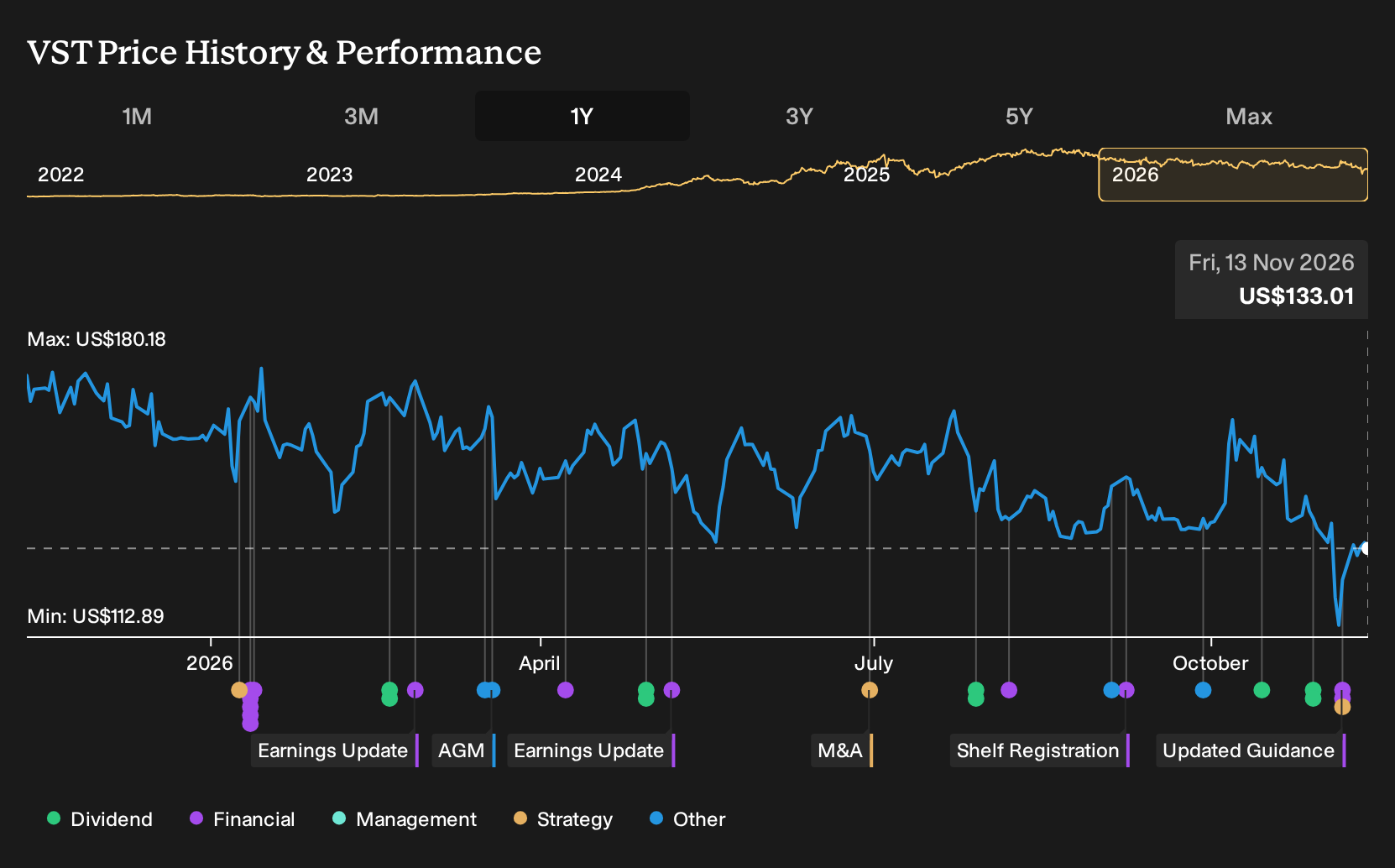
- Vistra Corp. reported third quarter 2026 sales of US$6,347 million and net income of US$1,140 million, with nine month net income of US$2,474 million and a US$269 million impairment of long lived assets.
- The board released 2026 and 2027 net income guidance that brackets multi billion dollar earnings, giving investors a clearer view of Vistra's medium term profit expectations in the context of higher impairments and softer Texas fundamentals.
- Investors can now observe how Vistra's investment narrative is influenced by the combination of strong reported earnings and its newly issued multi year profit guidance.
Compare Vistra's setup with a curated group of utilities and power producers by scanning the 44 power grid technology and infrastructure stocks that may also be pricing in regulation risk and earnings guidance shifts.
Vistra Investment Narrative Recap
To own Vistra, you need to be comfortable with a power producer that leans on large contracted volumes, heavy hedging and a meaningful debt load. According to John_Eric, an investor in the Simply Wall St Community who wrote the narrative, the real bet is that long term earning power from nuclear, gas and data center demand more than offsets Texas price pressure.
The short term swing factor is how quickly markets look past softer Texas fundamentals and higher impairments toward those contracted earnings. The biggest current risk is that high leverage and policy uncertainty in Texas combine with weaker power prices, which could keep sentiment fragile even as reported net income remains high.
Vistra’s new 2026 and 2027 net income guidance sits at the center of this story. Management now pegs 2026 net income at US$3.97b to US$4.29b and 2027 at US$3.36b to US$3.99b. That range frames what the business itself thinks is achievable while Texas power prices remain under pressure and data center policy is in flux.
Those numbers also matter because, as John_Eric argued, Vistra’s hedge book and long dated contracts can make GAAP results swing from quarter to quarter. The guidance bands give you a reference point to judge future quarters, assess whether impairments stay manageable and see how well the company converts its data center, nuclear and gas exposure into steady earnings.
On John_Eric’s numbers, that US$163.00 fair value for Vistra comes from pairing 9.3% annual revenue growth with a future profit margin of 10.6%. The narrative treats that mix of top line expansion and profitability as a reasonable earnings power anchor for the business over time.
Uncover how Vistra's fair value indicates a 23% potential upside to its current price before the market closes the gap.
Exploring Other Perspectives
One bullish twist on Vistra focuses on the capital plan rather than Texas headwinds. The most optimistic analysts, writing before this latest guidance, were assuming revenue could reach about US$32.5b by 2029 with earnings near US$4.5b. That is a far more upbeat storyline and it shows how widely opinions can differ. Use this contrast as a prompt to explore several viewpoints before deciding how the new numbers might reshape your own thesis.
Explore 10 other Vistra fair value estimates, including one that suggests potential upside of as much as 224% from the current price.
The Verdict Is Yours
Disagree with existing narratives? Extraordinary investment returns rarely come from following the herd, so go with your instincts.
- A great starting point for your Vistra research is our analysis highlighting 3 key rewards and 2 important warning signs that could impact your investment decision.
- See our latest analysis for Vistra. The report includes a comprehensive fundamental analysis summarized in a single visual, the Snowflake, making it easy to evaluate Vistra's overall financial health at a glance.
Looking for more investment ideas beyond Vistra?
If Vistra has sharpened your thinking about earnings quality, guidance, and risk, use that same lens to scan a broader field of potential opportunities using the Simply Wall St Screener.
- If capital preservation is top of mind, filter for companies that historically pair steadier fundamentals with lower overall risk using the 31 resilient stocks with low risk scores.
- For investors who want growth without stretching on quality, narrow the field to businesses that combine solid cash flows with attractive pricing through the 32 high quality undervalued stocks.
- If you prefer sturdier balance sheets and cleaner fundamentals, focus your research on companies highlighted in our list of solid balance sheet and fundamentals (24 results).
Have feedback on this article? Concerned about the content? Get in touch with us directly. Alternatively, email editorial-team@simplywallst.com