
Does Tighter Revenue Guidance Change The Bull Case For Tidewater Stock (TDW)?
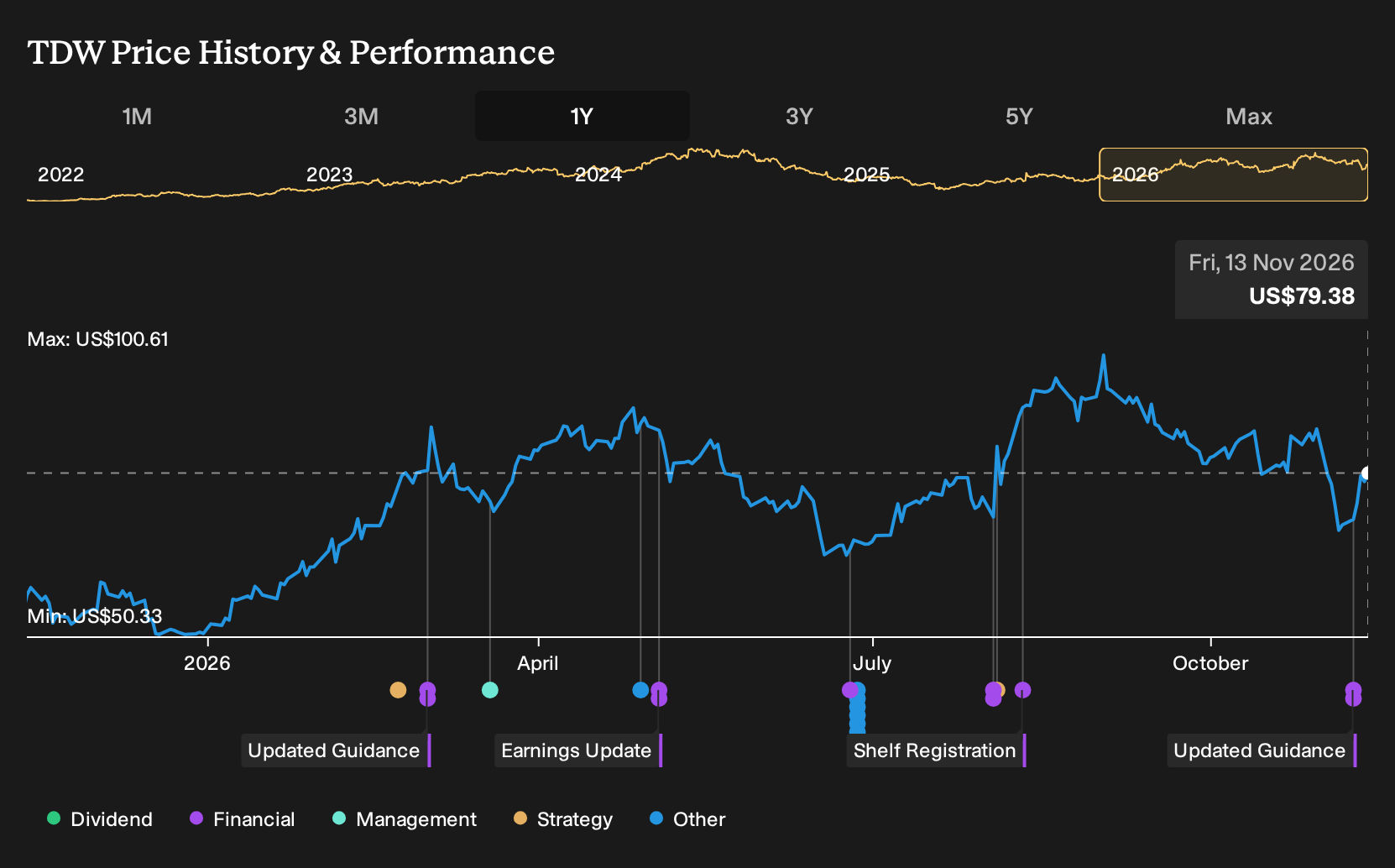
- Tidewater updated full year 2026 revenue guidance to a range of US$1.43b to US$1.44b and issued 2027 guidance of US$1.70b to US$1.75b, alongside Q3 2026 results that showed US$360.42 million in revenue and a shift from a loss to net income of US$17.51 million.
- The combination of tighter earnings guidance and a return to profitability in the latest quarter gives investors fresh data on how Tidewater is balancing vessel demand, operating costs and capital allocation plans across a still consolidating offshore fleet.
- We will look at how Tidewater's investment narrative is affected by the tighter 2026 and new 2027 revenue guidance ranges.
Compare how Tidewater's tighter guidance stacks up against other offshore and energy service plays by exploring our hand picked list of solid balance sheet and fundamentals (24 results) that could handle similar earnings swings.
Tidewater Investment Narrative Recap
To own Tidewater, you need to be comfortable with a story built on tight offshore vessel supply, disciplined consolidation and the company’s ability to price its fleet sensibly as projects progress. The updated 2026 and new 2027 revenue guidance sharpen that picture but do not radically change it. The key near term catalyst is still how quickly vessels are placed on work at solid day rates as offshore activity moves from tender to firm contracts.
The biggest risk remains that conflict related operating costs and project delays, including items tied to Operation Epic Fury and acquisition timing, eat into margins while vessels sit underutilized. The latest quarter shows Tidewater can produce net income in this context, although nine month earnings are lower than the prior period, which keeps the cost and utilization mix firmly in focus for the next few quarters.
The updated earnings guidance on 9 November 2026 is most relevant for thinking about those catalysts. Management now expects 2026 revenue of US$1.43b to US$1.44b and has put a 2027 range of US$1.70b to US$1.75b on the table. That tighter band interacts directly with the analyst consensus Narrative on Simply Wall St, which leans on tight vessel supply and broad offshore activity through multiple regions.
For you as an investor, the guidance frames how Tidewater might absorb elevated crew, fuel and insurance costs tied to conflict pressures while integrating the Wilson Sons Ultratug fleet and other acquired vessels. Execution on utilization, pricing and rebilling conflict related expenses will likely drive how close results land to those ranges, and how quickly free cash flow can be recycled into more M&A, buybacks or balance sheet optionality.
Tidewater's narrative projects US$1.9b revenue and US$416.5 million earnings by 2029, based on analysts' assumption of 12.6% yearly revenue growth and an earnings increase of about US$169.6 million from US$246.9 million today.
Uncover how Tidewater's fair value indicates a 20% potential upside to its current price that could narrow quickly.
Exploring Other Perspectives
Some of the most optimistic analysts focus on Tidewater’s potential to reprice contracts as conflict related costs build, rather than just worrying about those expenses. Before this guidance update, the bullish camp was modeling about US$2.0b of revenue and US$584.6 million of earnings by 2029, far above consensus. That gap shows how strongly views can differ, and why it can help to compare several forecast paths that may shift after this latest guidance.
Explore 3 other Tidewater fair value estimates, including one that suggests as much as 37% potential upside from the current price.
Form Your Own Verdict
Disagree with existing narratives? Extraordinary investment returns rarely come from following the herd, so go with your instincts.
- A great starting point for your Tidewater research is our analysis highlighting 4 key rewards and 1 important warning sign that could impact your investment decision.
- See our latest analysis for Tidewater. The report includes a comprehensive fundamental analysis summarized in a single visual, the Snowflake, making it easy to evaluate Tidewater's overall financial health at a glance.
Looking for more Tidewater investment ideas?
If Tidewater has your attention but you want a broader watchlist, the Simply Wall St Screener can help you quickly zero in on other companies that match the kind of balance sheet strength, income focus or valuation profile you care about most.
- If you want potential value opportunities with quality fundamentals, start by scanning our hand picked 32 high quality undervalued stocks that combine stronger balance sheets with more appealing pricing.
- For investors who care most about steady income, filter for companies offering higher yields with the help of our focused 6 dividend fortresses built around dividend strength.
- If capital preservation matters more than anything else, concentrate on resilience first and build a shortlist using our curated 31 resilient stocks with low risk scores that screens for lower overall risk scores.
Have feedback on this article? Concerned about the content? Get in touch with us directly. Alternatively, email editorial-team@simplywallst.com