
3 US Defensive Dividend Stocks For Higher Rates and Steady Cash Flow
With the Federal Reserve signalling that interest rates could stay higher for longer if inflation refuses to cool, cash flows and dividends suddenly matter a lot more than stories and hype. That shift creates a window where steady, resilient payers can quietly reshape a portfolio’s risk profile while others chase the next headline. This article explains how that backdrop relates to our US Large-Cap Defensive Dividend Stocks screener and highlights three stocks that appear well positioned under Jefferson’s inflation focused message.
The three stocks that follow are just a sample from this idea, while the full screen surfaced 12 more large-cap defensive dividend companies with equally compelling stories that are not covered below. To weigh those side by side and identify which fit your goals best, head straight into the US Large-Cap Defensive Dividend Stocks screener to filter, analyze, and focus on your highest conviction options.
Elevance Health (ELV)
Overview: Elevance Health is a large U.S. health benefits group that earns recurring premiums and fees by providing medical coverage, pharmacy services, and care management solutions across commercial and government programs. This aligns naturally with a defensive healthcare dividend profile.
Operations: Elevance Health generates about US$170.4b from Health Benefits, US$45.1b from CarelonRx, and US$30.1b from Carelon Services, with around US$201.8b of total revenue sourced in the United States.
Market Cap: US$92.9b
Elevance Health matters in this US Large-Cap Defensive Dividend Stocks screener because recurring premiums, healthcare exposure, and a consistent dividend help tie Jefferson’s higher for longer rate message to a business anchored in essential services. The bearish analyst Narrative on Simply Wall St uses this to test how durable that profile really is.
"Although Elevance Health reports that CareBridge and other Carelon programs are producing double digit medical cost savings in targeted groups, persistent elevated utilization in behavioral health, specialty pharmacy and emergency departments suggests these savings may not scale fast enough across the wider book."
What happens to Elevance Health’s defensive appeal if one unseen pressure on future medical margins proves tougher to contain than expected?
If that margin pressure is what keeps you cautious, read the full narrative for Elevance Health to see how Elevance Health could still compound through disciplined pricing and cost control.

Becton Dickinson (BDX)
Overview: Becton Dickinson develops and sells essential medical supplies, devices, diagnostics and lab equipment that hospitals, researchers and drugmakers rely on worldwide.
Operations: Becton Dickinson generates about US$6.7b from Medical Essentials, US$4.7b from Connected Care, US$5.6b from Interventional and US$2.4b from Biopharma Systems, with US$12.1b from the United States and US$7.4b internationally.
Market Cap: US$58.8b
Becton Dickinson fits the US Large-Cap Defensive Dividend Stocks screener as a healthcare supplier whose recurring consumables and equipment sales support dividend payments when policy stays tight. The analyst consensus Narrative on Simply Wall St points to one key operating system as the engine behind that resilience story.
"The BD Excellence operating system continues to drive roughly 8% plant productivity and is being extended into commercial, R&D and AI enabled supply chain. This is intended to sustain margin expansion, support the roughly 25% adjusted operating margin and contribute to free cash flow and earnings over time."
The real test is how this efficiency playbook holds up if one unresolved cost and pricing pressure turns out to be more stubborn than expected.
If that friction is what interests you, read the full narrative for Becton Dickinson to see how Becton Dickinson’s efficiency engine could still accelerate value creation.

Cigna Group (CI)
Overview: Cigna Group is a large U.S. health insurer and pharmacy benefits provider whose recurring premiums and fees fit the defensive dividend theme.
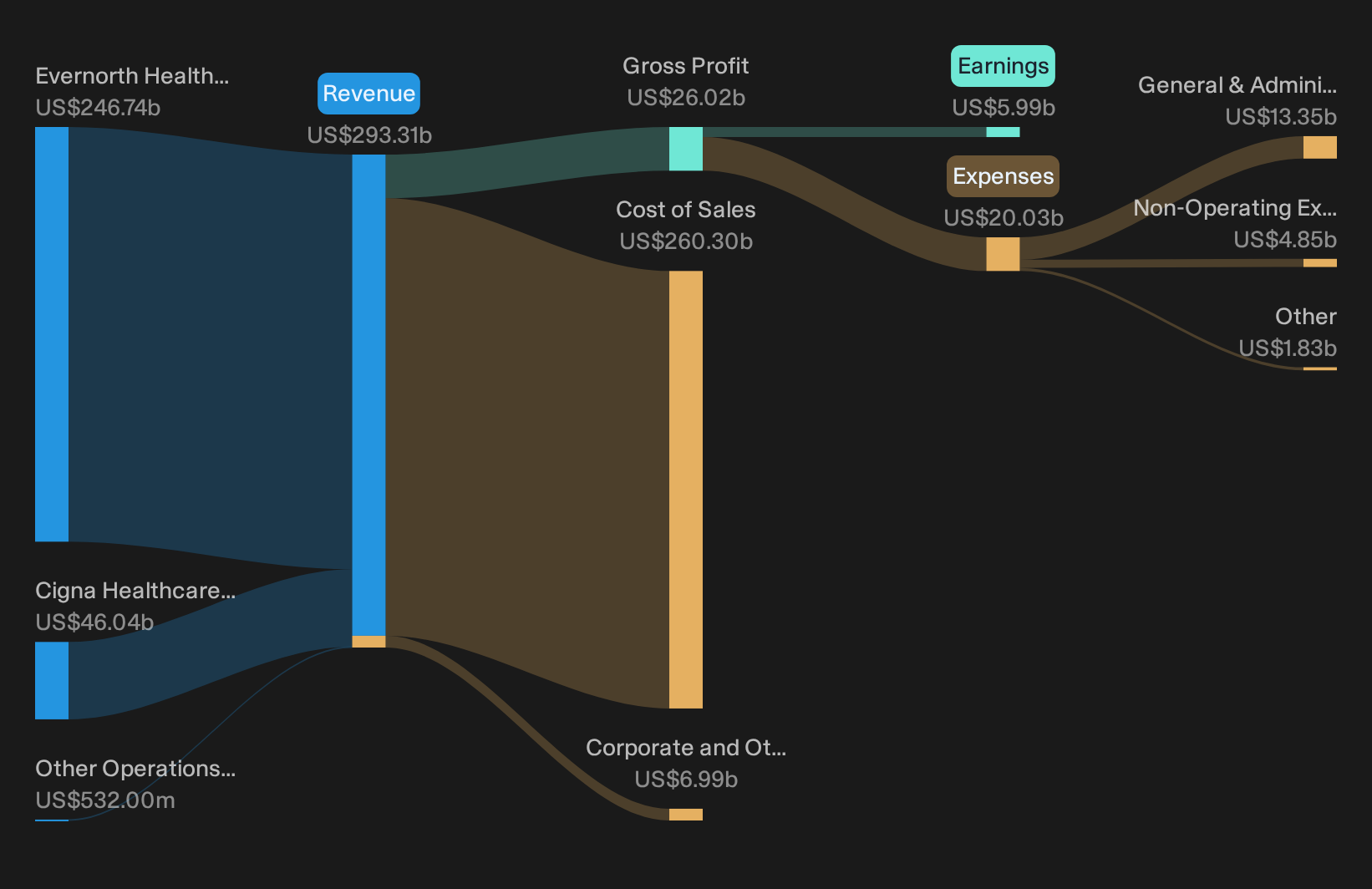
Operations: Cigna Group generates about US$246.7b from Evernorth Health Services, US$46.0b from Cigna Healthcare and US$0.5b from Other Operations, partly offset by US$7.0b in Corporate and Other Operations.
Market Cap: US$78.1b
Cigna Group matters for a higher-for-longer rate backdrop because its health insurance and pharmacy services can keep cash flows steadier. At the same time, the analyst consensus Narrative on Simply Wall St shifts the focus to where earnings quality is improving most.
"Cigna Group is capitalizing on the growing demand for specialty pharmacy and care services, with recent 22% pretax earnings growth in Specialty & Care Services and a larger contribution from this segment, which points to further scaling potential that could support revenue growth and higher consolidated earnings."
The real swing factor is what happens if one pressure point around pricing and cost trends hits those projected earnings harder than expected.
That pressure point could be the catalyst. Read the full narrative for Cigna Group to see how Cigna Group’s earnings mix might be quietly decoupling from the usual insurance cycle.
Seeking Fresh Alternatives Before They Fly
Fresh dividend ideas and under the radar themes can move from quiet to crowded fast. Use that window before momentum gets fully caught by the crowd and aim to get in early.
- Target income resilience by reviewing a curated watchlist of higher-yielding companies in the 6 dividend fortresses while it still feels early, not crowded.
- Hunt for potential compounders by scanning the 20 high quality undiscovered gems that remain largely overlooked for now and consider them before attention increases.
- Explore the next productivity trend by checking the hand-picked 86 robotics and automation stocks that may attract interest as automation demand changes, rather than waiting for headlines.
Have feedback on this article? Concerned about the content? Get in touch with us directly. Alternatively, email editorial-team@simplywallst.com