
3 US Financial Stocks Built For Higher Interest Rates
When inflation heats up and the Federal Reserve hints at more rate hikes, the spotlight quickly shifts to which US large-cap financials might feel the tailwind and which could be left exposed. That mix of risk and potential reward can move money fast and leave slower investors watching from the sidelines. This article highlights three stocks from our US Large-Cap Financials as Rate Beneficiaries screener that appear particularly affected by the latest inflation and rate signals.
The three stocks in focus below are just a starting sample, and the full screen surfaced 19 more large bank and insurance companies with equally compelling narratives that are not covered in this article.
To identify and analyze your own higher conviction rate beneficiaries, head straight into the US Large-Cap Financials (Banks & Insurance) as Rate Beneficiaries screener.
Prosperity Bancshares (PB)
Overview: Prosperity Bancshares is a Houston based regional bank holding company that provides a broad mix of deposits, loans, and digital financial services to households and businesses.
Operations: Prosperity Bancshares generates about US$1.6b of banking revenue entirely in the United States, reflecting a single segment regional banking model.
Market Cap: US$8.7b
Prosperity Bancshares sits near the center of this rate beneficiary screen. The analyst consensus Narrative on Simply Wall St explains how its regional footprint, deposit mix, and acquisition program give it meaningful leverage to a higher for longer Fed path.
"Completion of the American Bank, Texas Partners and Stellar transactions positions Prosperity Bancshares to consolidate a larger Texas and Oklahoma footprint, with management pointing to about US$100 to US$110 million of annual pretax cost savings that would directly support a lower efficiency ratio and higher net earnings power once integration is complete."
The real swing factor is whether one quiet shift in funding costs lets Prosperity Bancshares keep more of that rate fuel as sustained margin.
If that margin shift is what you are watching, the full narrative for Prosperity Bancshares explains how Prosperity Bancshares’ funding mix, acquisitions and rate exposure could be quietly accelerating or limiting earnings power.

WaFd (WAFD)
Overview: WaFd is a Seattle headquartered bank holding company offering loans, deposit accounts, insurance brokerage and wealth services across the Western United States.
Operations: WaFd generates about US$776 million of revenue from thrift and savings style banking activities, all sourced within the United States.
Market Cap: US$2.2b
WaFd fits this rate beneficiary screen because its core business is plain vanilla lending and deposit taking. In an environment of higher for longer interest rates, lending spreads can widen, and the analyst consensus Narrative on Simply Wall St points to a specific balance sheet shift that could matter for earnings.
"Ongoing runoff of low yielding single family mortgage loans and redeployment into higher yielding agency mortgage backed securities with no credit risk should structurally lift asset yields and net interest margin over time, improving net income."
The key issue is how one quiet change in funding costs interacts with that portfolio reshuffle to shape future profitability.
That funding shift is where things get interesting, and the full narrative for WaFd shows how WaFd’s margin story could be accelerating even as headline numbers still look ordinary.

Kemper (KMPR)
Overview: Kemper is a Chicago based insurance holding company offering specialty auto, commercial auto, life, accident, supplemental health and property coverage across the United States.
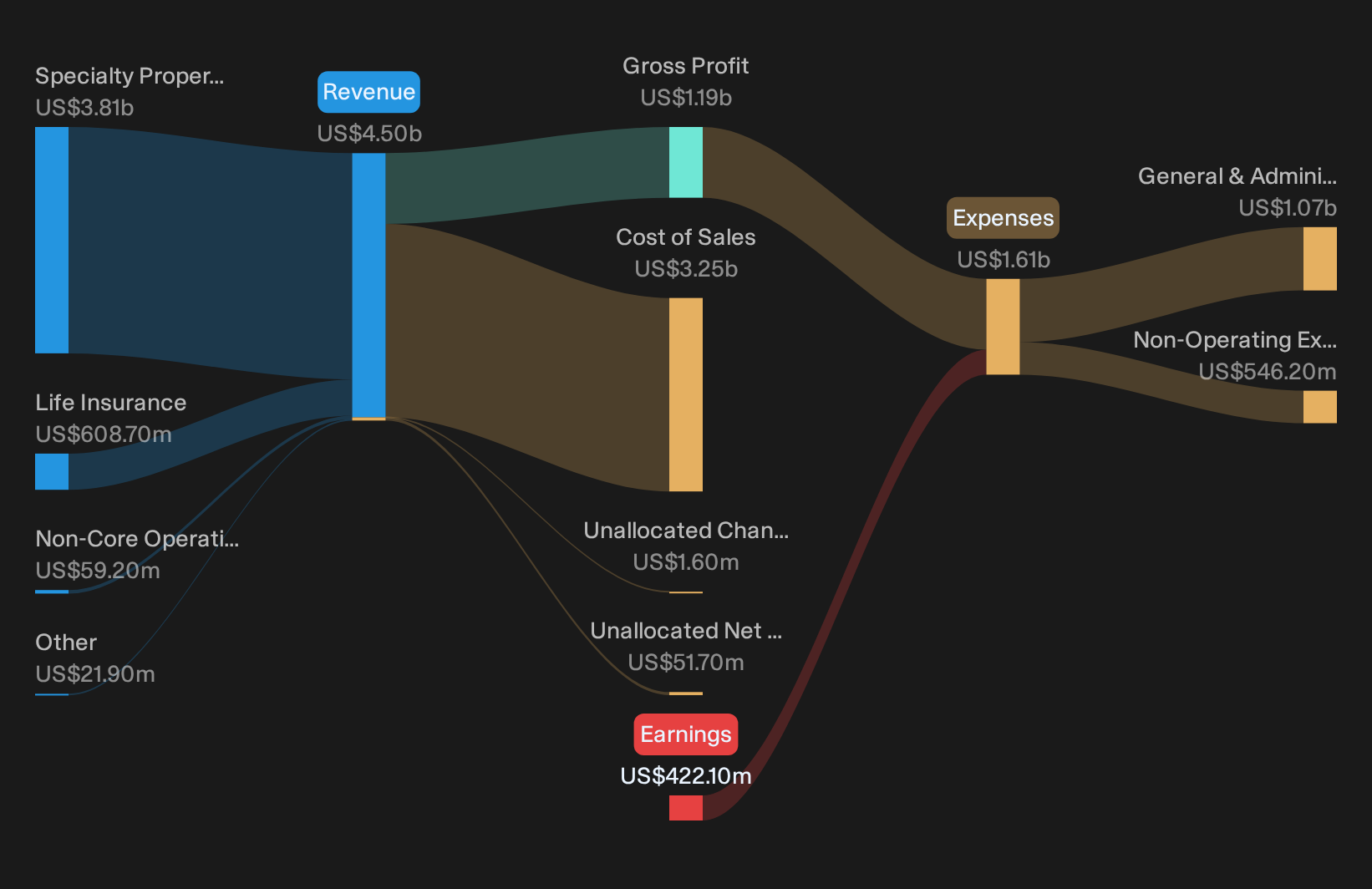
Operations: Kemper generates about US$3.8b from Specialty Property & Casualty insurance and roughly US$609 million from Life Insurance, almost entirely in the United States.
Market Cap: US$2.0b
For Kemper, the rate beneficiary angle is not about classic bank style spreads but about what higher yields on its investment portfolio can do for profit recovery, which is why the bearish analyst Narrative on Simply Wall St focuses so much on how inflation, regulation and pricing power intersect in its core auto lines.
"Ongoing legal and regulatory changes in California and Florida require continued rate filings, non-rate actions and statutory refunds that can lag behind shifting loss costs."
What happens to Kemper’s margins now rests heavily on how quickly one still stubborn cost line bends back toward its pricing assumptions.
If that cost curve is what you are tracking, the full narrative for Kemper explains how Kemper’s pricing resets and investment yields could be quietly separating headline risk from earnings potential.
Seeking Fresh Alternatives Beyond Banks?
Fresh opportunities can move from quiet to breakout before most investors even notice. Use that first mover edge while it matters and before momentum gets fully caught. Act now.
- Target reliable income streams by reviewing 6 dividend fortresses that aim to keep payouts flying while many investors are still focused on short term rate headlines.
- Track where AI momentum might be building next by scanning 42 profitable AI stocks that aren't just burning cash before these cash generative tech stories stop trading under the radar for now.
- Position for potential commodity supply squeezes by checking 17 top copper producer stocks while pricing dislocations remain fresh and not fully priced by the broader market.
Have feedback on this article? Concerned about the content? Get in touch with us directly. Alternatively, email editorial-team@simplywallst.com