
Why Did Aviva (LSE:AV.) Move Today?
Aviva (LSE:AV.) moved after its Q3 2026 update, as the insurer reported 19% growth in general insurance premiums, reaffirmed its 11% operating EPS target, and highlighted stronger UK personal lines following the Direct Line deal.
The Q3 update helped extend a solid run for Aviva, with the share price now at £7.648 and a 30-day share price return of 9.89% contributing to an 11.91% gain year to date. The 5-year total shareholder return of 176.94% points to momentum that has built steadily rather than faded.
Scan how Aviva's latest move compares with other insurers showing confident premium growth and capital strength by reviewing the curated list of 5 resilient stocks with low risk scores in the market.
Aviva now looks like a stronger insurer on the back of Direct Line and premium growth. The harder question is whether that strength is already fully reflected in a share price of £7.648.
Most Popular Narrative: 2% Overvalued
Aviva's last close at £7.648 sits slightly above the analyst consensus Narrative fair value of £7.48, which frames the current Q3 strength against a modest implied premium using a 7.56% discount rate from the analyst consensus Narrative on Simply Wall St.
Accelerating the shift to 'capital light' businesses (now over 66% of earnings and targeting 70%+ after the Direct Line integration) is driving improved group profit margins, lower capital requirements, and better return on equity, creating a strong forward-looking outlook for net earnings and cash generation.
Ongoing digital transformation including advanced use of AI in customer engagement, underwriting, and claims management, plus a unified data and digital strategy is expected to deliver both significant cost efficiencies and improved customer retention, which should boost net margins and long-term profitability.
See why 197 investors see Aviva as 2% overvalued.
Result: Fair Value of £7.48 (OVERVALUED)
Still, heavy reliance on the mature UK market and the execution risk around integrating Direct Line could quickly challenge the current Aviva narrative.
Find out about the key risks to this Aviva narrative.
Another View: Cash Flows Paint A Different Picture
Analysts using earnings multiples see Aviva as slightly overvalued around £7.65, while the SWS DCF model points to a future cash flow value of £12.54. That is a 39% gap. For an investor, this could be interpreted as either a potential warning about the P/E ratio or a signal that cash flows are being underpriced.
Look into how the SWS DCF model arrives at its fair value.
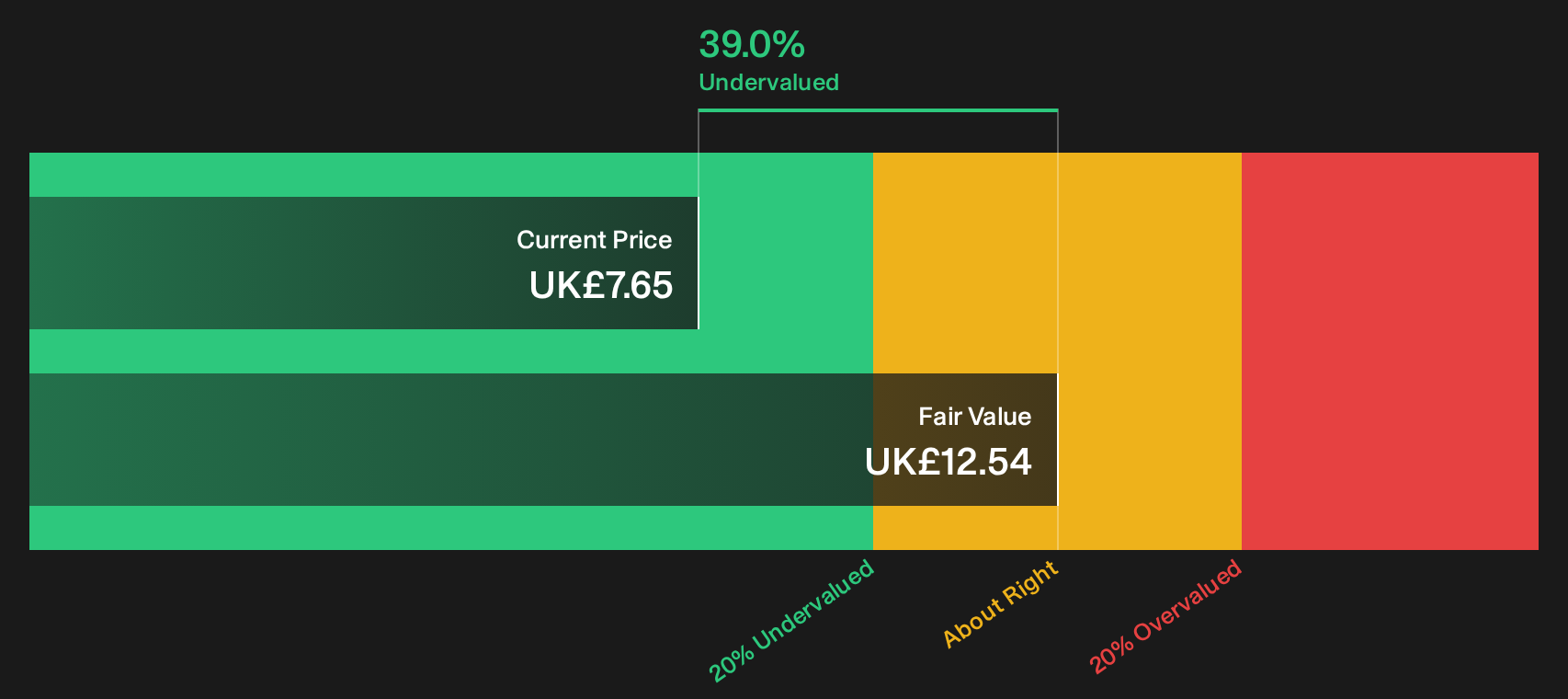
Simply Wall St performs a discounted cash flow (DCF) on every stock in the world every day (check out Aviva for example). We show the entire calculation in full. You can track the result in your watchlist or portfolio and be alerted when this changes, or use our stock screener to discover 15 high quality undervalued stocks. If you save a screener we even alert you when new companies match - so you never miss a potential opportunity.
Next Steps
Mixed signals on Aviva's value, or just a healthy debate? Act while the data is fresh, weigh the upside and the concerns, then ground your own view with 2 key rewards and 1 important warning sign.
Looking for more investment ideas beyond Aviva?
Do not stop your research at Aviva. Fresh ideas often come from comparing strong insurers with very different businesses that share similar financial traits and resilience profiles.
- Target higher quality potential by scanning the 15 high quality undervalued stocks that combine robust fundamentals with prices that may not fully reflect their underlying strength.
- Build a dependable income stream by reviewing 4 dividend fortresses that aim to pair meaningful yields with resilient business models.
- Strengthen your watchlist by filtering for a list of solid balance sheet and fundamentals (9 results) so you focus on companies that prioritise financial resilience when conditions turn challenging.
Have feedback on this article? Concerned about the content? Get in touch with us directly. Alternatively, email editorial-team@simplywallst.com