
Coca-Cola Has Paid a Growing Dividend for 64 Years. Here's the Income $5,000 Can Start You With.
Key Points
The company also benefits from a tight business focus: It sells only drinks.
Its flagship product is familiar in almost every market on Earth.
Among the general public, Coca-Cola (NYSE:KO) is renowned for its classic, sweet, fizzy drink. Among investors, it's known as one of the steadiest and most reliable dividend payers in business history. Not only that, it regularly declares dividend raises, to the point where it's a Dividend King (one of the rare stocks that has lifted its payout at least once annually for a minimum of 50 years in a row).
There's nothing like getting paid regularly by a company for the simple act of owning its stock. Here's how much someone will earn with a relatively modest $5,000 "starter investment" in Coca-Cola.
Missed Nvidia in 2009? This Rare Signal Is Flashing Again. In 2009, a "Double Down" signal flashed for a little-known chipmaker called Nvidia. For the first time in years, that same "Total Conviction" signal is flashing for a company 1/100th the size of Nvidia. Continue »

Image source: Coca-Cola.
The first 50
At Coca-Cola's most recent closing price, $5,000 would buy 50 common shares of the company, with a bit of change left over (which no clever investor should spend on penny stocks, but that's a topic for another time). The current quarterly dividend is $0.53 per share, so that holding would earn $26.50 every payment cycle, annualizing to $106 in total.
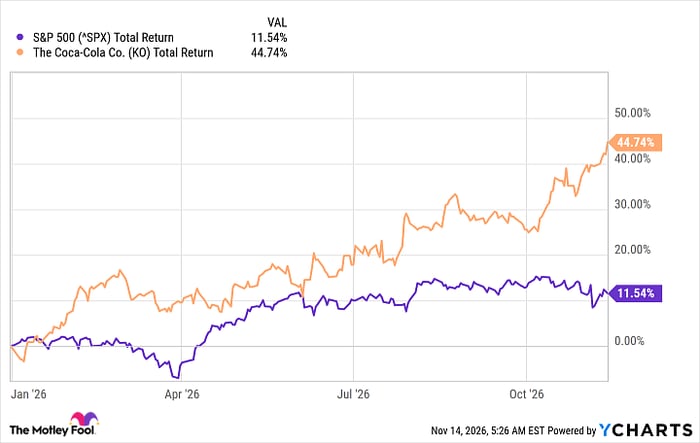
In and of itself, that $106 isn't going to put any investor on the fast road to riches. What he or she is purchasing, however, is one of the best buy-and-hold stocks available. Again, the dividend has steadily risen for over six decades. And in its many periods of outperformance, Coca-Cola's share price has marched higher, too. We can consider most of this year to be one of those times, and the comparison of total return -- share price appreciation plus dividend payments -- shows the stock trouncing the bellwether S&P 500 index. Witness:
How to become a global beverage titan
Coca-Cola likes to hype the lore that the formula for its signature drink is a tightly guarded trade secret known only to a select few. Whether or not that's 100% true, we can say for certain that its formula for commercial success isn't hush-hush at all.
Despite its size, sprawl, and global reach, the company is tightly focused on one key business -- selling a portfolio of beverages anchored by that flagship brown soda. Many Coke-quaffers might not realize that the business behind it owns a bulging portfolio of over 200 drinks, some of which are not, in the public mind, connected to Coca-Cola. Minute Maid orange juice is a company brand, as are Costa Coffee, Gold Peak iced tea, and the implicitly brain-enhancing smartwater.
Not long ago, Coca-Cola returned to its original, asset-light roots. It abandoned the idea of being a vertically integrated drinks company that handled all aspects of manufacturing, marketing, and selling its products. These days, it runs on a lean operational model it modestly named after itself. The Coca-Cola System is the division of labor between the company and its partners. Within this, Coca-Cola sells the concentrates and syrups your local restaurant or bottler can mix to concoct the chosen beverages. It also controls the powerful marketing machine that makes Coke a familiar name from Paducah to Prague, and conducts research and development to create potential additions to that 200-plus product lineup.
What's very advantageous about this model is that it leaves the independently owned bottlers with the heavy capital costs of building and maintaining the factories, machinery, and vehicle fleets that get the job done. It's hardly any wonder that the company is so profitable.
Asset-light and revenue-heavy
This approach, married with enduringly popular and relentlessly marketed anchor products, generates mountains of revenue and high profitability. In its third quarter, Coca-Cola managed to boost its revenue by 7% year over year -- no small feat for a massive global company -- to $13.4 billion. Non-GAAP (adjusted) net income's gain crept into the double digits, with an 11% rise to $3.9 billion. That shakes out into quite a lofty net margin of 29%.
Management believes continued growth is in the bottle, as it raised its full-year guidance for revenue growth (forecast to be at least 5% over the 2025 figure) and adjusted EPS, which is anticipated to clock in at the third-quarter rate of 11%. Those projections are roughly in line with analyst estimates.
I've been a longtime Coca-Cola bull, and I've never wavered, even through the occasionally uninspiring quarter. The company isn't perfect, of course, and it has its challenges. The global trend toward healthy food and drink consumption is a major one, hence the growing presence of zero-sugar versions of beloved drinks and other relatively healthy products in the portfolio. Regardless, the company always finds a way to grow its business and compound its dividend for those who hold on to their shares. To my mind, this makes it one of the best "forever" blue chip stock investments in the world.
Eric Volkman has no position in any of the stocks mentioned. The Motley Fool has no position in any of the stocks mentioned. The Motley Fool has a disclosure policy.