
PG&E (PCG) Faces Fresh Safety Scrutiny, Is It Still 25% Below Fair Value?
PG&E (PCG) is back in focus after a regulatory filing detailed a contractor injury at its Haas Kings River hydroelectric project and outlined corrective safety steps and compliance reporting to federal regulators.
For investors watching PG&E, the regulatory filing and recent legal headlines come after a choppy stretch. The 90 day share price return is down 25.73% and the 1 year total shareholder return has declined 18.60%, signaling that momentum has faded following a more modest 5 year total shareholder return gain of 9.34%.
Spot opportunities beyond PG&E by scanning a hand picked 31 resilient stocks with low risk scores that may offer steadier profiles while regulatory and legal headlines play out.Bulls point to PG&E’s rising annual revenue and net income, while bears focus on regulatory risk, weak recent returns and ETF outflows. Which story does the current valuation actually support?
Most Popular Narrative: 24.5% Undervalued
PG&E last closed at $13.25, while the analyst consensus Narrative on Simply Wall St calculates a fair value of $17.56 using a 7.24% discount rate. This suggests a material valuation gap that depends on wildfire policy and long term capital execution.
Strong alignment of capital strategy and balance sheet flexibility is reinforced by PG&E maintaining FFO to debt around 13%, reaffirming 2026 core EPS guidance and initiating 2027 guidance while planning to avoid additional equity for its US$73b plan. Together with the pursuit of investment-grade ratings and lower financing spreads, this points to future support for earnings and potential dividend capacity.
See why 31 investors see PG&E as 25% undervalued.
Result: Fair Value of $17.56 (UNDERVALUED)
Still, the PG&E story leans heavily on wildfire liability reforms and bill affordability debates, where adverse policy shifts could quickly challenge today’s undervalued narrative.
Find out about the key risks to this PG&E narrative.
Another View: PG&E Through A Cash Flow Lens
The first narrative leans on analyst fair value of $17.56, but the SWS DCF model tells a different story. On that cash flow view, PG&E at $13.25 screens as expensive versus an estimated future cash flow value of $9.38, which points to overvaluation rather than a discount.
The gap between these two approaches is wide. One focuses on earnings and relative value, and the other focuses on long term cash generation. For anyone tracking PG&E, the real question is which set of assumptions feels closer to how the business will actually fund its grid, wildfire spend and balance sheet over time.
Look into how the SWS DCF model arrives at its fair value.
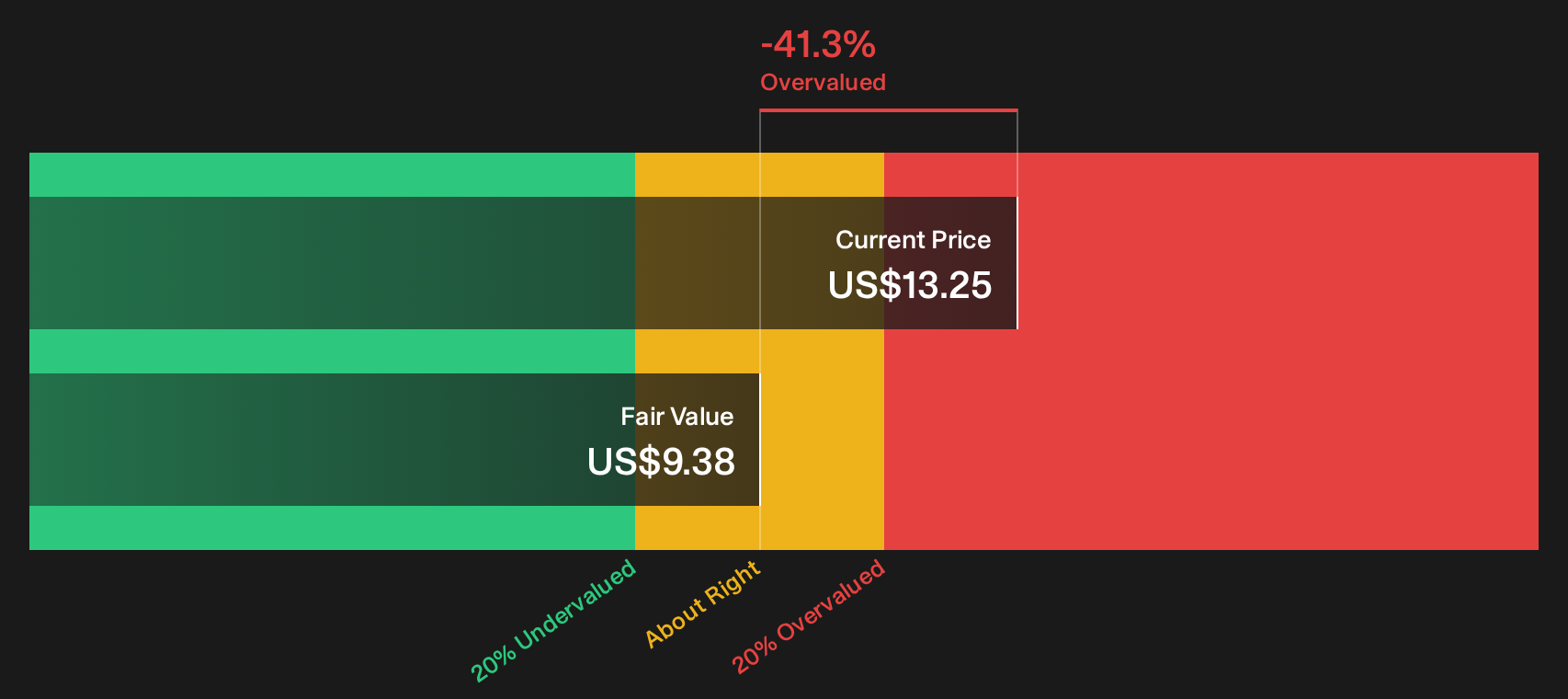
Simply Wall St performs a discounted cash flow (DCF) on every stock in the world every day (check out PG&E for example). We show the entire calculation in full. You can track the result in your watchlist or portfolio and be alerted when this changes, or use our stock screener to discover 32 high quality undervalued stocks. If you save a screener we even alert you when new companies match - so you never miss a potential opportunity.
Next Steps
Mixed messages on PG&E so far? Treat this as your starting point, move quickly through the underlying metrics, then weigh the 4 key rewards and 2 important warning signs against your own judgment.
Looking for more ideas beyond PG&E?
If PG&E has sharpened your focus on risk, do not stop here. Broaden your watchlist with fresh ideas that match your own risk and return comfort zone.
- Target sturdier balance sheets by scanning a list of solid balance sheet and fundamentals (24 results) to help keep financial pressure in check when headlines turn difficult.
- Hunt for mispriced quality with a 32 high quality undervalued stocks that screens for companies where fundamentals and price look out of sync.
- Prioritise consistent cash returns through a 6 dividend fortresses built to surface income ideas that might complement more volatile holdings.
Have feedback on this article? Concerned about the content? Get in touch with us directly. Alternatively, email editorial-team@simplywallst.com