
Income Investors Should Know That Ingersoll-Rand (India) Limited (NSE:INGERRAND) Goes Ex-Dividend Soon
Some investors rely on dividends for growing their wealth, and if you're one of those dividend sleuths, you might be intrigued to know that Ingersoll-Rand (India) Limited (NSE:INGERRAND) is about to go ex-dividend in just 3 days. The ex-dividend date is commonly two business days before the record date, which is the cut-off date for shareholders to be present on the company's books to be eligible for a dividend payment. The ex-dividend date is important as the process of settlement involves at least two full business days. So if you miss that date, you would not show up on the company's books on the record date. Thus, you can purchase Ingersoll-Rand (India)'s shares before the 19th of November in order to receive the dividend, which the company will pay on the 2nd of December.
The company's upcoming dividend is ₹20.00 a share, following on from the last 12 months, when the company distributed a total of ₹75.00 per share to shareholders. Calculating the last year's worth of payments shows that Ingersoll-Rand (India) has a trailing yield of 1.9% on the current share price of ₹3991.10. If you buy this business for its dividend, you should have an idea of whether Ingersoll-Rand (India)'s dividend is reliable and sustainable. So we need to check whether the dividend payments are covered, and if earnings are growing.
If a company pays out more in dividends than it earned, then the dividend might become unsustainable - hardly an ideal situation. Ingersoll-Rand (India) has a low and conservative payout ratio of just 23% of its income after tax. Yet cash flows are even more important than profits for assessing a dividend, so we need to see if the company generated enough cash to pay its distribution. Over the past year it paid out 168% of its free cash flow as dividends, which is uncomfortably high. We're curious about why the company paid out more cash than it generated last year, since this can be one of the early signs that a dividend may be unsustainable.
While Ingersoll-Rand (India)'s dividends were covered by the company's reported profits, cash is somewhat more important, so it's not great to see that the company didn't generate enough cash to pay its dividend. Cash is king, as they say, and were Ingersoll-Rand (India) to repeatedly pay dividends that aren't well covered by cashflow, we would consider this a warning sign.
See our latest analysis for Ingersoll-Rand (India)
Click here to see how much of its profit Ingersoll-Rand (India) paid out over the last 12 months.
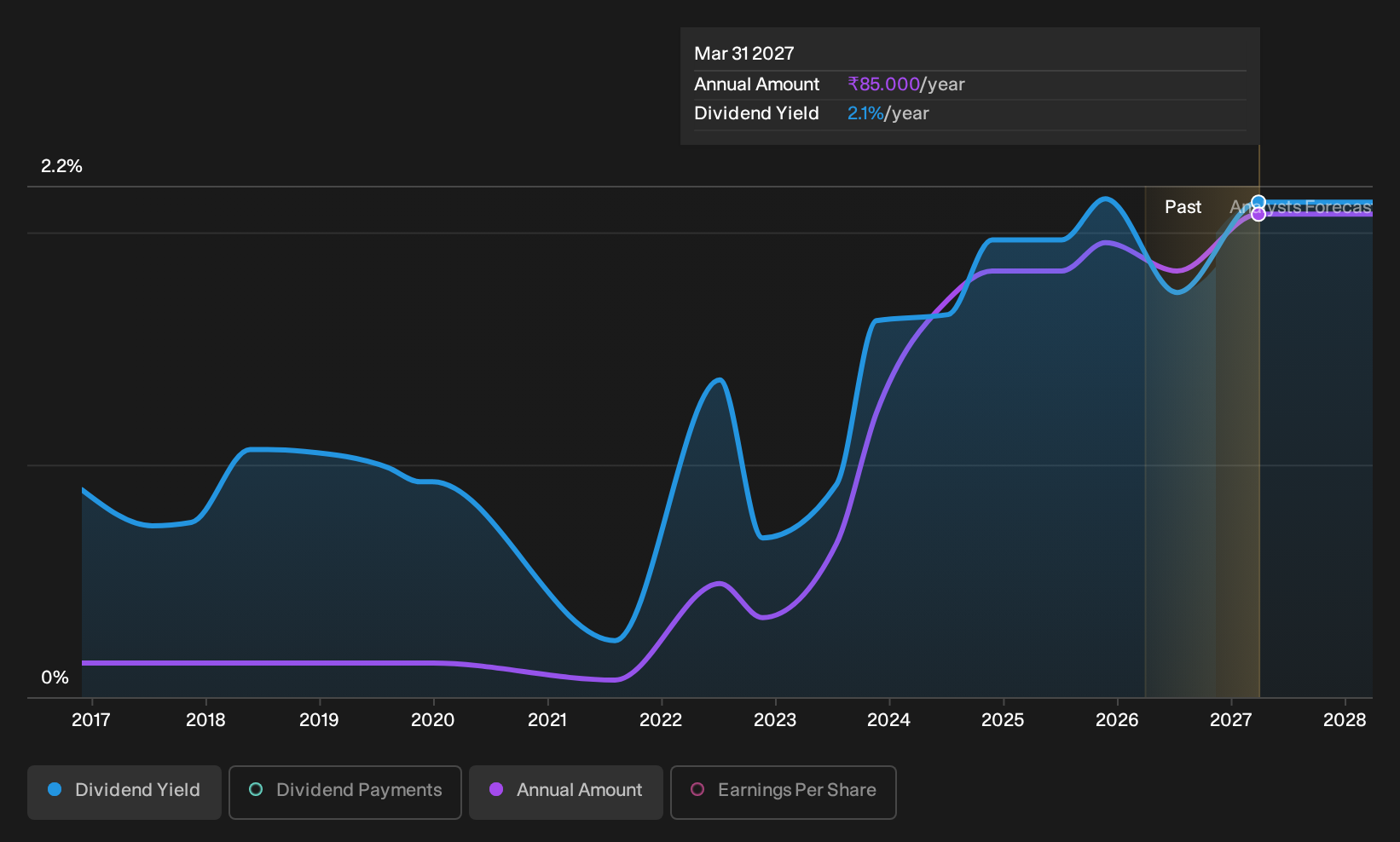
Have Earnings And Dividends Been Growing?
Stocks in companies that generate sustainable earnings growth often make the best dividend prospects, as it is easier to lift the dividend when earnings are rising. Investors love dividends, so if earnings fall and the dividend is reduced, expect a stock to be sold off heavily at the same time. That's why it's comforting to see Ingersoll-Rand (India)'s earnings have been skyrocketing, up 30% per annum for the past five years. Earnings have been growing quickly, but we're concerned dividend payments consumed most of the company's cash flow over the past year.
The main way most investors will assess a company's dividend prospects is by checking the historical rate of dividend growth. Ingersoll-Rand (India) has delivered 29% dividend growth per year on average over the past 10 years. Both per-share earnings and dividends have both been growing rapidly in recent times, which is great to see.
Final Takeaway
Should investors buy Ingersoll-Rand (India) for the upcoming dividend? We like that Ingersoll-Rand (India) has been successfully growing its earnings per share at a nice rate and reinvesting most of its profits in the business. However, we note the high cashflow payout ratio with some concern. While it does have some good things going for it, we're a bit ambivalent and it would take more to convince us of Ingersoll-Rand (India)'s dividend merits.
So while Ingersoll-Rand (India) looks good from a dividend perspective, it's always worthwhile being up to date with the risks involved in this stock. We've identified 2 warning signs with Ingersoll-Rand (India) (at least 1 which is concerning), and understanding them should be part of your investment process.
A common investing mistake is buying the first interesting stock you see. Here you can find a full list of high-yield dividend stocks.
Have feedback on this article? Concerned about the content? Get in touch with us directly. Alternatively, email editorial-team (at) simplywallst.com.